Reaction equation

[Cl:1][C:2]1[CH:7]=[CH:6][CH:5]=[CH:4][C:3]=1[N:8]1[C:17](=[O:18])[C:16]2[C:11](=[CH:12][CH:13]=[CH:14][CH:15]=2)[N:10]=[C:9]1[CH3:19].CO[CH:22](OC)[N:23]([CH3:25])[CH3:24]>CN(C)C=O>[Cl:1][C:2]1[CH:7]=[CH:6][CH:5]=[CH:4][C:3]=1[N:8]1[C:17](=[O:18])[C:16]2[C:11](=[CH:12][CH:13]=[CH:14][CH:15]=2)[N:10]=[C:9]1[CH:19]=[CH:22][N:23]([CH3:25])[CH3:24]Participants
Reactant 2

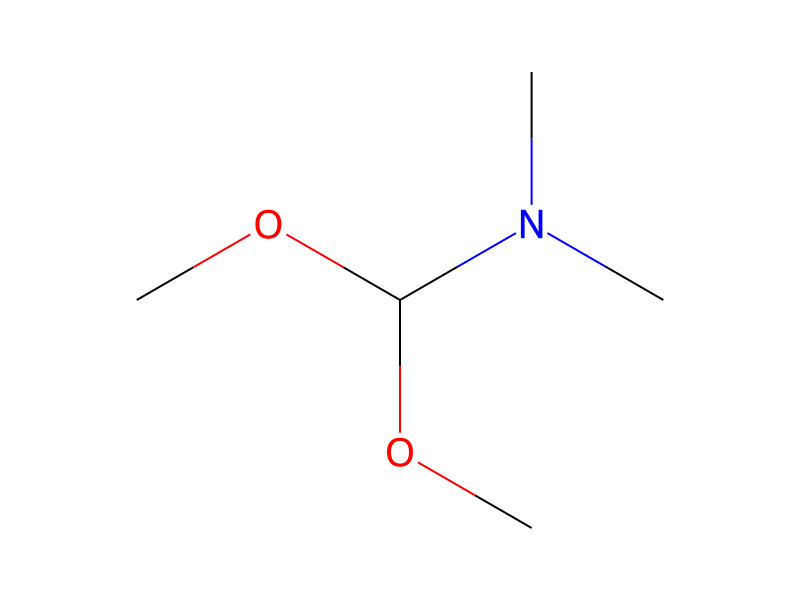
Product 1

Reagents, catalysts & solvents 1

Conditions
- Temperature
- 140 °C
Procedure
A mixture of 3-(2-chloro-phenyl)-2-methyl-3,4-dihydro-quinazolin-4-one (1.0 g, 3.69 mmol) and dimethylformamide dimethyl acetal (0.64 mL, 4.8 mmol) in dimethylformamide (4 mL) was heated to 140° C. for 24 hours. Additional dimethylformamide dimethyl acetal (0.32 mL, 2.4 mmol) was added and heating was continued for an additional 24 hours. The reaction was cooled to ambient temperature and concentrated at reduced pressure (60° C. bath temperature). The dark residue was triturated with methanol and the pale orange solid which formed was collected and dried to give 0.75 g (62%) of 3-(2-chloro-phenyl)-2-(2-dimethylamino-vinyl)-3,4-dihydro-quinazolin-4-one which had: mp 228-230° C.; 1H 1H NMR δ 8.19 (d, J=8 Hz, 1 H), 7.91 (d, J=12.3 Hz, 1 H), 7.71-7.18 (m, 7 H), 4.10 (d, J=12.3 Hz, 1 H), 2.81 (br s, 6 H). Analysis calculated for C18H16ClN3O: C, 66.36; H, 4.95; N, 12.90. Found: C, 66.20; H, 5.03; N, 12.79.
Workup
- temperatureheating
- temperatureThe reaction was cooled to ambient temperature
- concentrationconcentrated at reduced pressure (60° C. bath temperature)
- customThe dark residue was triturated with methanol
- customthe pale orange solid which formed
- customwas collected
- customdried
Sources & evidence
- ORD record
- ord-9ec17971598e4b4e8f829fb8df34cf1d
- Source dataset
- uspto-grants-2005_07
- Patent number
- US06921764B2
Linked notes
Loading…