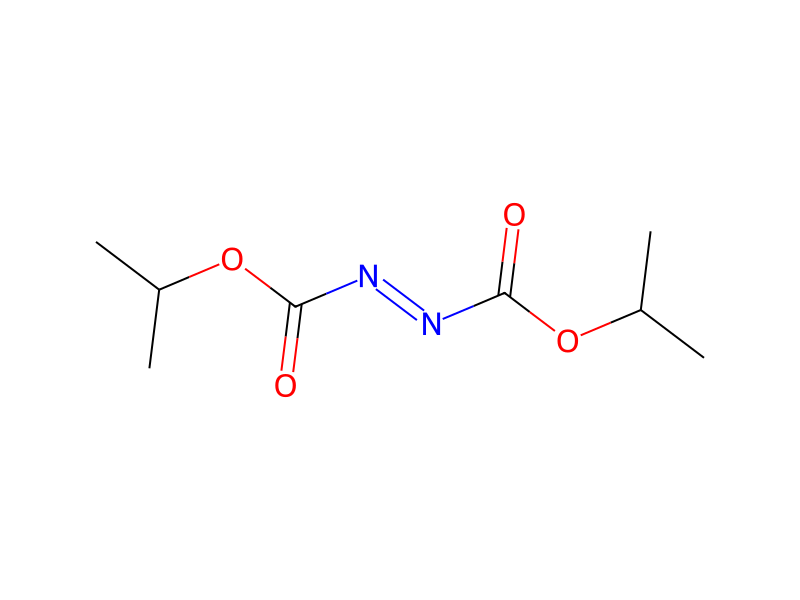
[Br:1][C:2]1[CH:3]=[C:4]2[C:12](=[CH:13][CH:14]=1)[NH:11][C:10]1[CH:9](O)[CH2:8][CH2:7][CH2:6][C:5]2=1.[F:16][C:17]1[CH:22]=[CH:21][C:20]([OH:23])=[CH:19][CH:18]=1.C1(P(C2C=CC=CC=2)C2C=CC=CC=2)C=CC=CC=1.N(C(OC(C)C)=O)=NC(OC(C)C)=O>C1COCC1>[Br:1][C:2]1[CH:3]=[C:4]2[C:12](=[CH:13][CH:14]=1)[N:11]([O:23][C:20]1[CH:21]=[CH:22][C:17]([F:16])=[CH:18][CH:19]=1)[C:10]1[CH2:9][CH2:8][CH2:7][CH2:6][C:5]2=1To a solution of 6-bromo-2,3,4,9-tetrahydro-1H-carbazol-1-ol (50 mg, 0.19 mmol) in THF (5 mL) was added p-fluorophenol (43 mg, 0.38 mmol), polymer supported triphenylphosphine (1.67 mmol/g, 228 mg, 0.38 mmol) and diisopropyl azodicarboxylate (77 mg, 0.38 mmol). The reaction was stirred at room temperature for 16 h, and additional diisopropyl azodicarboxylate (77 mg, 0.38 mmol) was added. The reaction was stirred for 16 h, filtered and concentrated. The crude product was purified by flash chromatography on silica (2% to 20% ethyl acetate/hexanes gradient) to provide 6-bromo-N-(4-fluorophenoxy)-2,3,4,9-tetrahydro-1H-carbazole (8 mg, 12%) as a white solid: 1H-NMR (DMSO-d6): δ 11.20 (s, 1H), 7.61 (d, 1H), 7.26 (d, 1H), 7.16-7.06 (m, 5H), 5.53 (t, 1H), 2.75-2.69 (m, 1H), 2.57-2.50 (m, 1H), 2.02-1.76 (m, 4H).