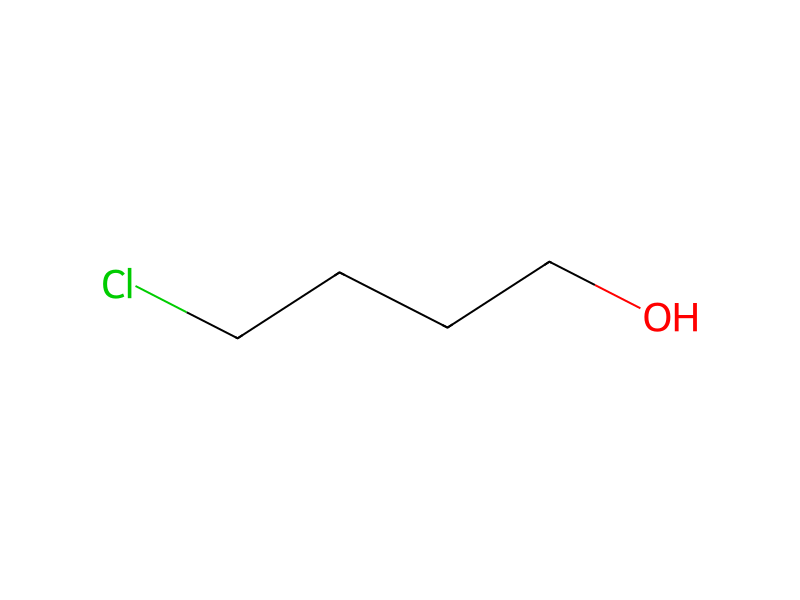
[Cl:1][CH2:2][CH2:3][CH2:4][CH2:5][OH:6].CS([C:11]1[N:16]=[C:15]([CH3:17])[C:14]([C:18]([O:20][CH2:21][CH2:22][C:23]([CH3:27])=[C:24]([F:26])[F:25])=[O:19])=[CH:13][N:12]=1)(=O)=O.C(N(CC)CC)C>O>[Cl:1][CH2:2][CH2:3][CH2:4][CH2:5][O:6][C:11]1[N:16]=[C:15]([CH3:17])[C:14]([C:18]([O:20][CH2:21][CH2:22][C:23]([CH3:27])=[C:24]([F:26])[F:25])=[O:19])=[CH:13][N:12]=1To 1.02 g (9.4 mmol) of 4-chlorobutanol was dissolved 1.00 g (3.1 mmol) of 4,4-difluoro-3-methyl-3-butenyl 2-methanesulfonyl-4-methylpyrimidine-5-carboxylate, followed by the addition of 0.38 g (3.8 mmol) of triethylamine under ice-cooling and stirring at room temperature for 14 hours. The reaction liquid was then poured in water and extracted with diethyl ether. The organic layer was washed with water and a saturated saline solution in this order, followed by drying over anhydrous magnesium sulfate and concentration under reduced pressure. The residue was purified with silica gel column chromatography (ethyl acetate:hexane=1:9) to obtain 0.30 g (yield: 27%) of 4,4-difluoro-3-methyl-3-butenyl 2-(4-chlorobutoxy)-4-methylpyrimidine-5-carboxylate.