Reaction equation

Cl[C:2]1[CH:3]=[C:4]2[C:9](=[CH:10][CH:11]=1)[N:8]=[CH:7][CH:6]=[CH:5]2.[CH3:12][C:13]1[N:18]=[C:17]([C:19](=[O:21])[CH3:20])[CH:16]=[CH:15][CH:14]=1.CC(C)([O-])C.[K+].C(O)(=O)C>O1CCCC1.C([O-])(=O)C.[Pd+2].C([O-])(=O)C.C1(P(C2CCCCC2)C2C=CC=CC=2C2C=CC=CC=2N(C)C)CCCCC1>[CH3:12][C:13]1[N:18]=[C:17]([C:19](=[O:21])[CH2:20][C:2]2[CH:3]=[C:4]3[C:9](=[CH:10][CH:11]=2)[N:8]=[CH:7][CH:6]=[CH:5]3)[CH:16]=[CH:15][CH:14]=1Participants
8
Reactant 4




Product 1

Reagents, catalysts & solvents 3


Conditions
- Temperature
- 80 °C
Procedure
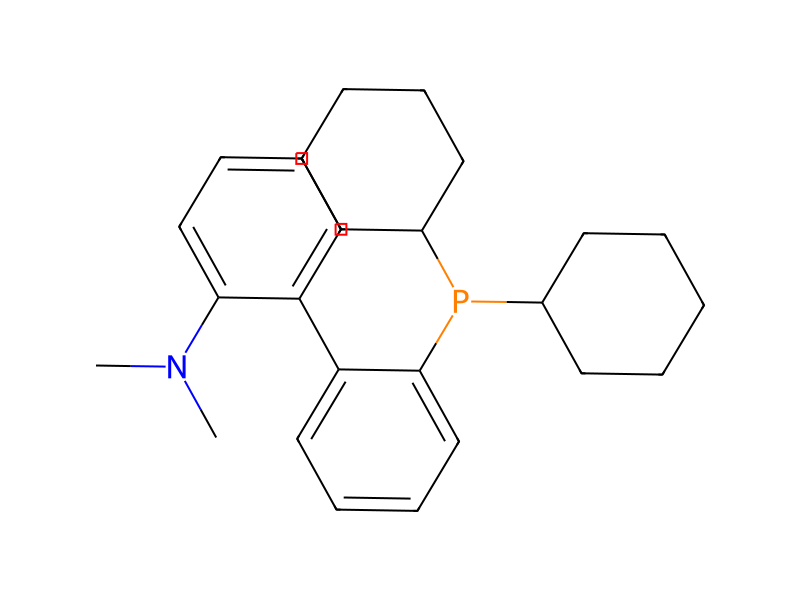
To a solution of 6-chloro-quinoline (2.08 g, 12.3 mmol) in tetrahydrofuran (50 mL) was added 1-(6-methyl-pyridin-2-yl)-ethanone (2.0 g, 14.8 mmol, 1.1 equiv), palladium acetate (0.055 g, 0.25 mmol, 0.02 equiv), 2-dicyclohexylphosphino-2′-(N,N-dimethylamino)biphenyl (0.197 g, 0.50 mmol, 0.04 equiv), and potassium tert-butoxide (3.76 g, 30.75 mmol, 2.2 equiv). The resulting reaction mixture was heated to 80° C. for 18 hours, then cooled down to 20° C., and slowly treated with acetic acid (3 mL). The resulting solids were filtered off, and the mother liquor was concentrated in vacuo. Silica gel chromatography (3:1 hexane/acetone) yielded 1-(6-Methyl-pyridin-2-yl)-2-quinolin-6-yl-ethanone (2.52 g, 78%).
Workup
- customThe resulting reaction mixture
- temperaturecooled down to 20° C.
- filtrationThe resulting solids were filtered off
- concentrationthe mother liquor was concentrated in vacuo
Sources & evidence
- ORD record
- ord-aded6d5236e449bebd3106f19a3e1ef9
- Source dataset
- uspto-grants-2007_09
- Patent number
- US07273936B2
Linked notes
Loading…