Reaction equation

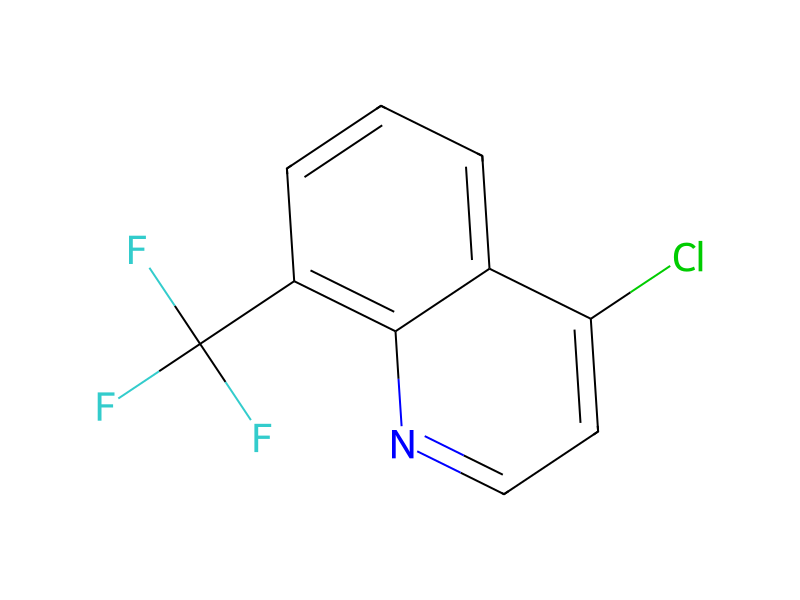
[C:1]([O:10][CH2:11][P:12]([CH3:15])([CH3:14])=[O:13])(=[O:9])[C:2]1[C:3](=[CH:5][CH:6]=[CH:7][CH:8]=1)[NH2:4].Cl[C:17]1[C:26]2[C:21](=[C:22]([C:27]([F:30])([F:29])[F:28])[CH:23]=[CH:24][CH:25]=2)[N:20]=[CH:19][CH:18]=1>C(O)(C)C.Cl>[F:30][C:27]([F:28])([F:29])[C:22]1[CH:23]=[CH:24][CH:25]=[C:26]2[C:21]=1[N:20]=[CH:19][CH:18]=[C:17]2[NH:4][C:3]1[C:2](=[CH:8][CH:7]=[CH:6][CH:5]=1)[C:1]([O:10][CH2:11][P:12]([CH3:15])([CH3:14])=[O:13])=[O:9]Participants
5




Procedure
4.6 grams (0.02 mol) of dimethylphosphinylmethyl anthranilate and 4.6 grams (0.02 mol) of 4-chloro-8-trifluoromethylquinoline are kept at 80° C. for about three and a half hours in 15 ml of isopropanol and 2.3 ml of concentrated aqueous hydrochloric acid. After removing the solvents and excess hydrochloric acid, the free base of the ester is liberated at 0° C. The dimethylphosphinyl-methyl N-(8-trifluoromethyl-4-quinolyl)-anthranilate obtained is identical to that prepared in Example 2a). Yield: 7.6 grams (90% of theory).
Workup
- customAfter removing the solvents and excess hydrochloric acid
- customis liberated at 0° C
Sources & evidence
- ORD record
- ord-b80cd8f233344c97a8eee27789d951d4
- Source dataset
- uspto-grants-1979_07
- Patent number
- US04160828
Linked notes
Loading…