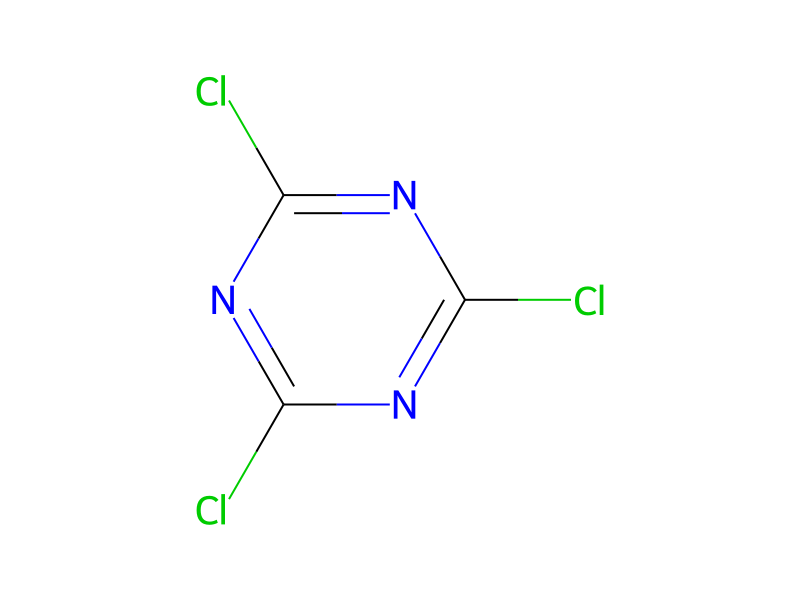
[N:1]1[C:8]([Cl:9])=[N:7][C:5]([Cl:6])=[N:4][C:2]=1[Cl:3].[Br:10][C:11]1[C:16]([OH:17])=[C:15]([Br:18])[C:14]([Br:19])=[C:13]([C:20]([C:23]2[CH:28]=[CH:27][C:26]([OH:29])=[CH:25][CH:24]=2)([CH3:22])[CH3:21])[C:12]=1[Br:30].Cl>C(C(C)=O)C>[Br:10][C:11]1[C:16]([OH:17])=[C:15]([Br:18])[C:14]([Br:19])=[C:13]([C:20]([C:23]2[CH:28]=[CH:27][C:26]([OH:29])=[CH:25][CH:24]=2)([CH3:22])[CH3:21])[C:12]=1[Br:30].[N:1]1[C:8]([Cl:9])=[N:7][C:5]([Cl:6])=[N:4][C:2]=1[Cl:3]To a reaction flask equipped with a stirrer, reflux condenser, a nitrogen purge, and a temperature controlling device, were added 25.0 grams (0.136 mole) of cyanuric chloride, 331.88 grams (0.61 mole) of tetrabromobisphenol A, and a 356.88 grams of methyl ethyl ketone. While maintaining the temperature at 30° C. 34.24 grams (0.428 mole) of 50% aqueous caustic was slowly added during about 30 minutes (1800 s). The reaction mixture was stirred for an additional hour (3600 s) at 30° C., then for an additional hour (3600 s) at 60° C. The mixture was then cooled, and neutralized with hydrochloric acid, then the salt removed via water washing, then the solvent removed via vacuum distillation to about 150° C. When cooled, the product was a solid with a Mettler softening point of 126.9° C.