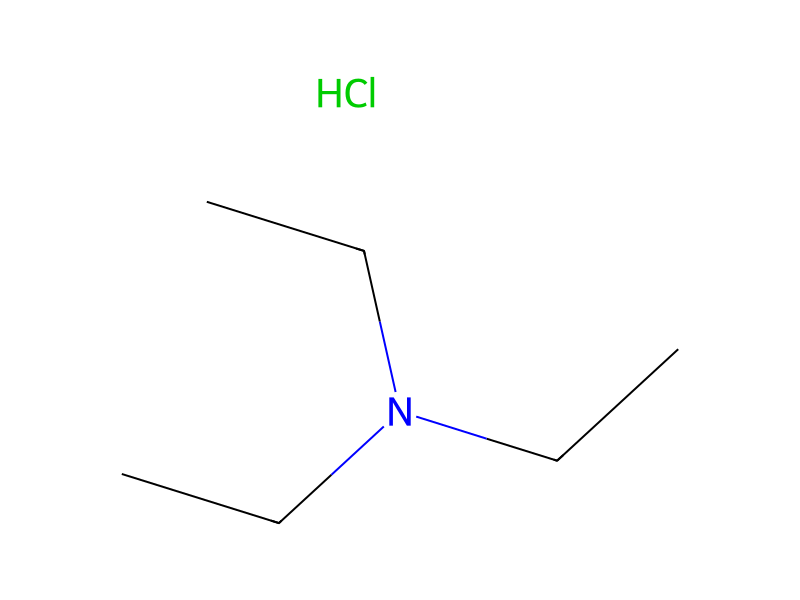
[ClH:1].C(N(CC)CC)C.[Cl:9][C:10]([CH3:29])([CH3:28])[CH2:11][CH2:12][CH2:13][C:14]([CH3:27])=[CH:15][CH2:16][CH2:17][C:18]([CH3:26])=[CH:19][CH2:20][CH2:21][C:22](=[CH2:25])[CH:23]=[CH2:24].[ClH:30].[Cl-:31].[NH4+]>C(O)(=O)C.C(Cl)Cl>[Cl:1][CH2:24][CH:23]=[C:22]([CH3:25])[CH2:21][CH2:20][CH2:19][C:18]([Cl:31])([CH3:26])[CH2:17][CH2:16][CH2:15][C:14]([Cl:30])([CH3:27])[CH2:13][CH2:12][CH2:11][C:10]([Cl:9])([CH3:29])[CH3:28]Triethylamine hydrochloride (0.48 g), methylene chloride (15 cc), acetic acid (10 cc) and cuprous chloride (90 mg) are introduced, under an argon atmosphere, into a 250 cc reactor. The reaction mixture is stirred until a homogeneous solution is obtained. This is cooled to -10° C. and 15-chloro-3-methylene-7,11,15-trimethyl-hexadeca-1,6,10-triene (10 g) is then added followed, over the course of 1 hour, by dry gaseous hydrogen chloride (3.9 g). The reaction mixture is poured into an aqueous solution (100 cc) of ammonium chloride (100 g/liter). The organic phase is removed by decanting and the aqueous phase is then extracted with methylene chloride (twice 100 cc). The combined organic phases are washed with water (100 cc) and then dried over potassium carbonate. After filtration and evaporation of the solvent, 1,7,11,15-tetrachloro-3,7,11,15-tetramethyl-hexadec-2-ene (13.1 g) is obtained in a yield of 96.5%.