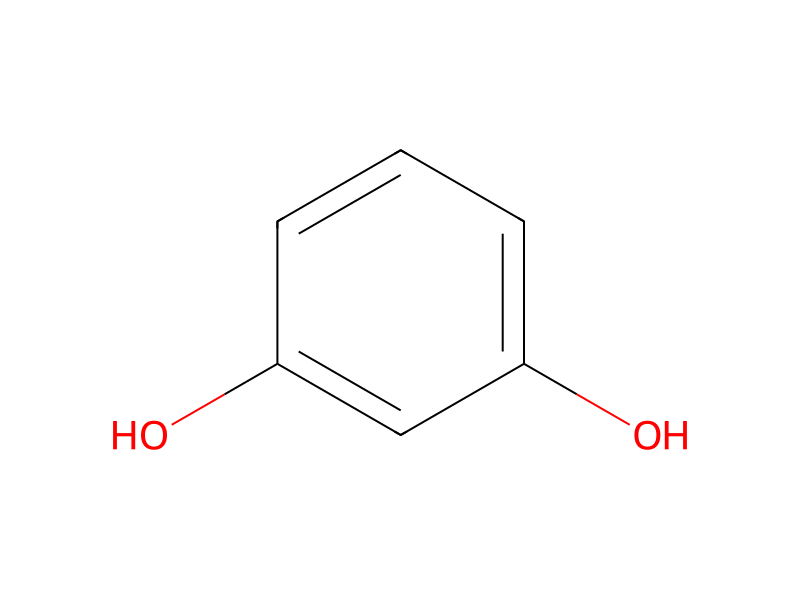
A mixture of 4.91 g (51.84 mmol) of chloroacetic acid, 4 mL (54.84 mmol) of thionyl chloride and one drop of DMF was stirred at 90° C. for 3 hours. The resulting solution was cooled and evaporated to remove excess thionyl chloride, hydrogen chloride and sulfur dioxide to yield crude chloroacetyl chloride as a colorless oil, pure enough to use in the next step without further purification. To a stirred suspension of 8.01 g (60.07 mmol) of anhydrous aluminum chloride in 10 mL of nitrobenzene were added 2 mL of chloroacetyl chloride and 2.37 g (21.52 mmol) of resorcinol at 0° C. The mixture was stirred at 0° C. for 10 minutes and at room temperature for 16 hours, poured into ice (ca. 20 mL), hydrolyzed by conc. HCl (10 mL), diluted with water (20 mL) and chloroform (50 mL) and separated. The organic layer was dried over MgSO4, evaporated and purified by column chromatography (75 g of SiO2, 20% ethyl acetate-hexane) to yield 2.57 g (13.77 mmol, 64.0% yield) of 4-(2-chloroacetyl)resorcinol. A mixture of 167.2 mg (0.896 mmol) of 4-(2-chloroacetyl)resorcinol and 109.0 mg (0.990 mmol) of resorcinol in methanesulfonic acid (0.5 mL) was stirred at 85° C. for 1 hour. To the resulting deep red solution, ice (ca. 10 mL) was added to precipitate a product as a black gummy material which eventually became reddish brown fine powder after scratching with a spatula. The precipitate was collected by filtration, washed with water and dried over P2O5 under vacuum to yield 196.6 mg (0.754 mmol, 84% yield) of 9-chloromethylxanthene as a reddish brown solid. 1H NMR (D2O+K2CO3) δ 7.66 (1H, d, J=9 Hz). 6.60 (1H, dd, J=9 & 2 Hz), 6.30 (1H, d, J=2 Hz), 4.82 (2H, s); MS (ES, positive) 261.4, 263.4; UV (KMOPS, pH 7.2) λmax (ε) 515 nm (41,200 M−1cm−1).