ホームMCPワークベンチSkills
ホームワークベンチ通知マイページ
llms.txt · MCPガイドプライバシーポリシー · 利用規約 · サポートv1.8.0
  1. ホーム
  2. /化合物

トリメチレンオキシド

Oxetane

HCID 10423
ノートを作成反応を作成見積依頼を出す
印刷プレビュー
基本情報概要名称と識別子物性安全と法規制化学と産業関連反応化合物ノート
部分構造検索類似構造を探す

基本情報

CAS
503-30-0
標準SMILES
C1COC1
InChIKey
AHHWIHXENZJRFG-UHFFFAOYSA-N
分子式
C3H6O
平均分子量
58.08 g/mol
単同位体質量
58.04186481

概要

1,3-propylene oxide is a clear, colorless liquid with an agreeable aromatic odor. (NTP, 1992)

名称と識別子

優先名称
Oxetane
IUPAC
oxetane
現地名
トリメチレンオキシド
英語名
Trimethylene oxide
分子式
C3H6O
分子量
58.08

名称と別名

OxetaneTrimethylene oxide503-30-01,3-Propylene oxideOxacyclobutane1,3-EPOXYPROPANECyclooxabutaneTrimethylenoxidOxetan1,3-Trimethylene oxidePropane, 1,3-epoxy-alpha,gamma-Propane oxide
名称をさらに表示
トリメチレンオキシドオキサシクロブタンオキセタン1,3-エポキシプロパン酸化トリメチレンOXECTANE1,3-EPOXYPROPAN
DTXSID8025969I279Q16FU6NSC-30086DTXCID705969CHEBI:30965RefChem:168900207-964-3Trimethylenoxid [German]

データベース識別子

CAS
503-30-0
PubChem CID
10423
DTXSID
DTXSID8025969
ChEMBL
CHEMBL1538076
ChEBI
CHEBI:30965
UNII
I279Q16FU6
EC Number
207-964-3
Nikkaji
J6.210C

物性

構造計算による物性

XLogP
-0.1
極性表面積
9.2 Ų
水素結合供与体数
0
水素結合受容体数
1
回転可能結合数
0
重原子数
4
形式電荷
0
複雑度
17.2

実験および物理化学的性質

Chemical ClassesOther Classes -> Other Organic Compounds
SpringerMaterials PropertiesSchoenflies notation
LogP · 2 件

log Kow= -0.14

-0.14

OdorAgreeable aromatic odor
Density · 2 件

0.893 at 77 °F (NTP, 1992) - Less dense than water; will float

0.8930 @ 25 °C/4 °C

Color/FormOil
Solubility · 3 件

10 to 50 mg/mL at 68 °F (NTP, 1992)

SOL IN ALL PROPORTIONS OF WATER, ALCOHOL; SOL IN ETHER; VERY SOL IN ACETONE, ORGANIC SOLVENTS

In water, miscible.

Flash Point · 2 件

-19 °F (NTP, 1992)

-28 °C

Boiling Point · 2 件

122 °F at 760 mmHg (NTP, 1992)

48 °C @ 750 mm Hg

DecompositionWhen heated to decomposition it emits acrid smoke and irritating fumes.

安全と法規制

安全情報は参考情報です。供給元の安全データシート(SDS)、適用法令、専門家による評価に代わるものではありません。

GHS分類

GHS Classification · 6 件

Danger

H225: Highly Flammable liquid and vapor [Danger Flammable liquids]

P210, P233, P240, P241, P242, P243, P261, P264, P270, P271, P280, P301+P317, P302+P352, P303+P361+P353, P304+P340, P317, P321, P330, P362+P364, P370+P378, P403+P235, and P501 (click each P-code to see the statement)

Danger

H225 (100%): Highly Flammable liquid and vapor [Danger Flammable liquids]

P210, P233, P240, P241, P242, P243, P261, P264, P270, P271, P280, P301+P317, P302+P352, P303+P361+P353, P304+P340, P317, P321, P330, P362+P364, P370+P378, P403+P235, and P501 (click each P-code to see the statement)

危険有害性情報

Regulatory Information1,3-Trimethylene oxide: HSNO Approval: HSR004981 Approved with controls
DOT LabelFlammable Liquid
Fire HazardsThis chemical is flammable. (NTP, 1992)
Health HazardsSYMPTOMS: Exposure to this compound may cause irritation.
Hazards SummaryA tumorigen and a mutagen; [RTECS] May cause irritation; Harmful by inhalation, ingestion, and skin absorption; [CAMEO] An irritant; [MSDSonline]
Reactive GroupEpoxides
Reactivity AlertsHighly Flammable
Reactivity Profile · 1 件

1,3-PROPYLENE OXIDE reacts with Grignard reagents and organolithium compounds. It is also incompatible with oxidizing agents and strong acids. (NTP, 1992). An explosion occurred when propylene oxide was added to epoxy resin. Polymerization was catalyzed by amine accelerator in the resin [Bretherick 1995]. Propylene oxide and sodium hydroxide base-catalyzed the polymerization of the former, causing ignition and explosion of a drum of the crude product. [Combust Sci. Technol., 1983].

化学と産業

用途と製造

Uses · 4 件

Used as a chemical intermediate for epoxy resins and 3-substituted propanols; [HSDB]

CHEM INT, EG, FOR EPOXY RESINS & 3-SUBSTITUTED PROPANOLS

Photoreactions leading to carefully selected oxetanes are impressive tools in the construction of complex molecules ... such as drugs, crop protection agents, and fragrants. /Oxetanes/

/Chemical intermediate/

Methods of Manufacturing · 2 件

Prepd by dropwise addition of 3-chloropropyl acetate to hot potassium hydroxide soln: Noller, Org Syn 29, 92 (1949); modified procedure: Searles, J Am Chem Soc, 73, 124 (1951).

REACTION OF 3-BROMOPROPANOL WITH POTASSIUM HYDROXIDE

General Manufacturing InformationOxetane: ACTIVE
応用分野 · 4 件

解説オキセタン.1-アセトキシ-3-クロロプロパンのアルカリ処理により分子内環化させると得られる.沸点48 ℃.d25 0.8930.n20D 1.3929.有機溶媒に易溶.水と混和する.アミン,アルコール類のほか,フリーデル-クラフツ触媒の存在下に,ベンゼンをヒドロキシプロピル化するのに用いられる.有機リチウム化合物やグリニャール試薬と反応して,第一級アルコールを与える.

使用Trimethylene oxide useful for the synthesis of 3-substituted propanols by reaction with Grignards or organolithiums in the presence of CuBr.

一般的な説明Clear, colorless liquid with an agreeable aromatic odor.

使用用途オキセタンは、医薬品原料、染料原料、防腐剤原料に用いられます。有機合成では、アミン、アルコール、ベンゼンのヒドロキシプロピル化に利用可能です。 オキセタンを含む各種誘導体は、エポキシ樹脂の高速硬化やプラスチック材料に対する優れた密着性のような特徴を持つため、エポキシ樹脂用添加剤に使用され、塗料、、各種コーティング剤などの用途があります。柔軟性や密着性に優れるほか、環境にやさしい材料として注目を浴びています。 オキセタン環を有する化合物の中には、抗ウイルス剤や血小板凝集に関わる物質、抗がん剤などの生化学的特徴を持つものも多いです。

調製方法 · 1 件

純化方法Distil oxetane twice from sodium metal and then fractionate it through a small column at atmospheric pressure, b 47.0-47.2o. It can also be purified by preparative gas chromatography using a 2m silica gel column. Alternatively, add KOH pellets (50g for 100g of oxetane) and distil it through an efficient column or a column packed with 1/4in Berl Saddles with the main portion boiling at 45-50o being collected and redistilled over fused KOH. [Noller Org Synth Coll Vol III 835 1955, Dittmer et al. J Am Chem Soc 79 4431 1957, Beilstein 17 H 6, 17 I 3, 17 II 12, 17 III/IV 13, 17/1 V 11.]

関連反応

48 件
反応記録を作成
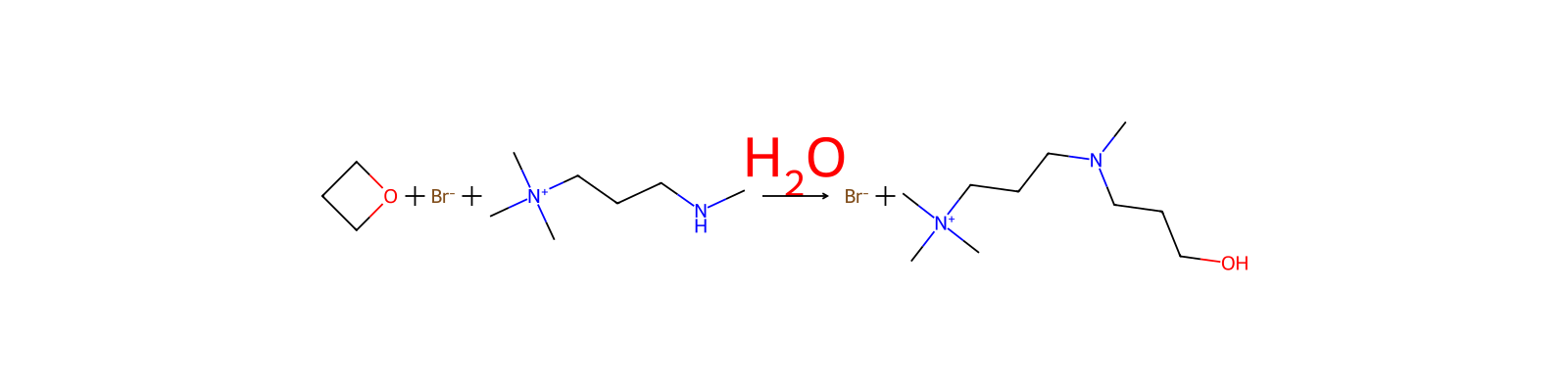
HRID 5213 の反応式
HRID 5213反応物としてuspto-grants-1993_09
HRID 5216 の反応式
HRID 5216反応物としてuspto-grants-1993_09
HRID 135345 の反応式
HRID 135345反応物としてTraining data from https://doi.org/10.1039/C8SC04228D (9/10)
HRID 143356 の反応式
HRID 143356反応物としてTraining data from https://doi.org/10.1039/C8SC04228D (9/10)
HRID 263167 の反応式
HRID 263167反応物としてuspto-grants-1979_05
HRID 263176 の反応式
HRID 263176反応物としてuspto-grants-1979_05
HRID 287428 の反応式
HRID 287428反応物としてTraining data from https://doi.org/10.1039/C8SC04228D (8/10)
HRID 287859 の反応式
HRID 287859反応物としてTraining data from https://doi.org/10.1039/C8SC04228D (8/10)
1 / 6 ページ

化合物ノート

読み込み中…

このページの内容基本情報概要名称と識別子物性安全と法規制化学と産業関連反応化合物ノート
その他の操作
ノートを作成反応を作成見積依頼を出す
Vapor Pressure · 2 件

324.0 [mmHg]

324 mm Hg @ 25 °C

Refractive IndexIndex of refraction: 1.3895 @ 25 °C/D

物理化学的性質

融点
97 °C · −97 °C (−143 °F; 176 K)
沸点
49 to · 49 to 50 °C (120 to 122 °F; 322 to 323 K)
比重(密度)
0.893 g/cm3 · 0.8930 g/cm3
蒸気圧
5.09 psi · 5.09 psi ( 20 °C)
屈折率
1.3895 at · 1.3895 at 25 °C
闪点
28.3 °C; · −28.3 °C; −19.0 °F; 244.8 K (NTP, 1992)
貯蔵温度
2 · 2-8°C
溶解性
1000 g/リットル · 1000g/リットル
外見
clear liquid
色
Colorless to Almost colorless
臭い (Odor)
心地よい匂い
爆発限界(explosive limit)
2.4 % · 2.4%(V)
水溶解度
水に溶ける。
Merck
14 · 14,9715
BRN
102382 · 102382
Henry's Law Constant
4 · 4.0×10-1 mol/(m3Pa) at 25℃, Duchowicz et al. (2020)
InChI
1S/C3H6O/c1-2-4-3-1/h1-3H2
InChIKey
AHHWIHXENZJRFG-UHFFFAOYSA-N
SMILES
C1COC1
CAS データベース
503 · 503-30-0(CAS DataBase Reference)
EPAの化学物質情報
Oxetane (503-30-0)

化学的性質

化学的特性CLEAR COLOURLESS LIQUID

Air and Water ReactionsHighly flammable. Water soluble.
Hazard Classes and Categories · 3 件

Flam. Liq. 2 (100%)

Flammable liquid - category 2

Flam. Liq. 2

Hazardous Reactivities and IncompatibilitiesStrained ring oxygen heterocycles such as epoxides and exetanes react with the oxide in dichloromethane at sub-ambient temperatures to form high yields of the powerfully explosive glycol dinitrate esters.

安全と保護具

Fire FightingFires involving this material should be controlled with a dry chemical carbon dioxide or Halon extinguisher. (NTP, 1992)
First Aid · 1 件

EYES: First check the victim for contact lenses and remove if present. Flush victim's eyes with water or normal saline solution for 20 to 30 minutes while simultaneously calling a hospital or poison control center. Do not put any ointments, oils, or medication in the victim's eyes without specific instructions from a physician. IMMEDIATELY transport the victim after flushing eyes to a hospital even if no symptoms (such as redness or irritation) develop.

Nonfire Spill Response · 1 件

SMALL SPILLS AND LEAKAGE: If you spill this chemical, FIRST REMOVE ALL SOURCES OF IGNITION. Then, use absorbent paper to pick up all liquid spill material. Seal the absorbent paper, as well as any of your clothing which may be contaminated, in a vapor-tight plastic bag for eventual disposal. Wash any surfaces you may have contaminated with a soap and water solution. Do not reenter the contaminated area until the Safety Officer (or other responsible person) has verified that the area has been properly cleaned.

Disposal Methods · 1 件

SRP: At the time of review, criteria for land treatment or burial (sanitary landfill) disposal practices are subject to significant revision. Prior to implementing land disposal of waste residue (including waste sludge), consult with environmental regulatory agencies for guidance on acceptable disposal practices.

Isolation and EvacuationExcerpt from ERG Guide 127 [Flammable Liquids (Water-Miscible); polymerization hazard]:
Personal Protective Equipment (PPE) · 1 件

RECOMMENDED RESPIRATOR: When working with this chemical, wear a NIOSH-approved full face chemical cartridge respirator equipped with the appropriate organic vapor cartridges. If that is not available, a half face respirator similarly equipped plus airtight goggles can be substituted. However, please note that half face respirators provide a substantially lower level of protection than do full face respirators. (NTP, 1992)

毒性情報

Environmental Fate · 3 件

TERRESTRIAL FATE: Based on a classification scheme(1), an estimated Koc value of 20(SRC), determined from a measured log Kow of -0.14(2) and a regression-derived equation(3), indicates that 1,3-epoxypropane is expected to have very high mobility in soil(SRC). Volatilization of 1,3-epoxypropane from moist soil surfaces may be an important fate process(SRC) given an estimated Henry's Law constant of 2.5X10⁻⁵ atm-cu m/mole(SRC), calculated from its vapor pressure of 324 mm Hg(4) and water solubility of 1,000,000 mg/l(5). The potential for volatilization of 1,3-epoxypropane from dry soil surfaces may exist(SRC) based upon its vapor pressure(4).

AQUATIC FATE: Based on a classification scheme(1), an estimated Koc value of 20(SRC), determined from a measured log Kow of -0.14(2) and a regression-derived equation(3), indicates that 1,3-epoxypropane is not expected to adsorb to suspended solids and sediment(SRC). Volatilization of 1,3-epoxypropane from water surfaces is expected to be an important fate process(SRC) given an estimated Henry's Law constant of 2.5X10⁻⁵ atm-cu m/mole(SRC), calculated from its vapor pressure of 324 mm Hg(4) and water solubility of 1,000,000 mg/l(5). Using this Henry's Law constant and an estimation method(3), volatilization half-lives for a model river and model lake are 29 and 269 hours, respectively(SRC). According to a classification scheme(6), an estimated BCF of 0.5(SRC), calculated from a log Kow of -0.14(2) and a regression-derived equation(7), suggests the potential for bioconcentration in aquatic organisms is low.

ATMOSPHERIC FATE: According to a model of gas/particle partitioning of semivolatile organic compounds in the atmosphere(1), 1,3-epoxypropane, which has a vapor pressure of 3.24X10+002 mm Hg at 25 °C(2), is expected to exist solely in the vapor-phase. Vapor-phase 1,3-epoxypropane is degraded in the atmosphere by reaction with photochemically-produced hydroxyl radicals(SRC); the half-life for this reaction in air is estimated to be 1.6 days(SRC), calculated from its rate constant of 1.03X10⁻¹¹ cu cm/molecule-sec at 25 °C(3).

Soil Adsorption/Mobility · 1 件

The Koc of 1,3-epoxypropane is estimated as 20(SRC), using a log Kow of -0.14(1) and a regression-derived equation(2). According to a classification scheme(3), this estimated Koc value suggests that 1,3-epoxypropane is expected to have very high mobility in soil.

Artificial Pollution Sources1,3-Epoxypropane's production and use as a chemical intermediate(1) may result in its release to the environment through various waste streams(SRC).
Environmental Bioconcentration · 1 件

An estimated BCF of 0.5 was calculated for 1,3-epoxypropane(SRC), using a log Kow of -0.14(1) and a regression-derived equation(2). According to a classification scheme(3), this BCF suggests the potential for bioconcentration in aquatic organisms is low(SRC).

Volatilization from Water/Soil · 1 件

The Henry's Law constant for 1,3-epoxypropane is estimated as 2.5X10⁻⁵ atm-cu m/mole(SRC) based upon its vapor pressure, 324 mm Hg(1), and water solubility, 1,000,000 mg/l(2). This Henry's Law constant indicates that 1,3-epoxypropane is expected to volatilize from water surfaces(3). Based on this Henry's Law constant, the volatilization half-life from a model river (1 m deep, flowing 1 m/sec, wind velocity of 3 m/sec)(3) is estimated as 29 hours(SRC). The volatilization half-life from a model lake (1 m deep, flowing 0.05 m/sec, wind velocity of 0.5 m/sec)(3) is estimated as 269 hours(SRC). 1,3-Epoxypropane's estimated Henry's Law constant indicates that volatilization from moist soil surfaces may occur(SRC). The potential for volatilization of 1,3-epoxypropane from dry soil surfaces may exist(SRC) based upon its vapor pressure(1).

Non-Human Toxicity ExcerptsBD STRAIN RATS GIVEN SC 40 MG/KG/WEEK, FOR DURATION OF 550 DAYS 6/14 DEVELOPED LOCAL SARCOMAS. DOSAGE OF 80 MG/KG/WEEK DURATION OF 550 DAYS 5/6 DEVELOPED LOCAL SARCOMAS AND 1/6 VAGINAL CARCINOMA. /FROM TABLE/
Environmental Abiotic Degradation · 1 件

The rate constant for the vapor-phase reaction of 1,3-epoxypropane with photochemically-produced hydroxyl radicals is 1.3X10⁻¹¹ cu cm/molecule-sec at 25 °C(1). This corresponds to an atmospheric half-life of about 1.6 days at an atmospheric concentration of 5X10+5 hydroxyl radicals per cu cm(1). 1,3-Epoxypropane may undergo hydrolysis in the environment because it contains hydrolyzable functional groups(2) but is not expected to directly photolyze due to a lack of absorption in the environmental UV spectrum (>290 nm)(2).

Probable Routes of Human ExposureOccupational exposure to 1,3-epoxypropane may occur through inhalation and dermal contact with this compound at workplaces where 1,3-epoxypropane is produced or used. (SRC)
Environmental Fate/Exposure Summary · 1 件

1,3-Epoxypropane's production and use as a chemical intermediate may result in its release to the environment through various waste streams. If released to air, a vapor pressure of 324 mm Hg at 25 °C indicates 1,3-epoxypropane will exist solely as a vapor in the ambient atmosphere. Vapor-phase 1,3-epoxypropane will be degraded in the atmosphere by reaction with photochemically-produced hydroxyl radicals; the half-life for this reaction in air is estimated to be 1.6 days. If released to soil, 1,3-epoxypropane is expected to have very high mobility based upon an estimated Koc of 20. Volatilization from moist soil surfaces may be an important fate process based upon an estimated Henry's Law constant of 2.5X10⁻⁵ atm-cu m/mole. 1,3-Epoxypropane may volatilize from dry soil surfaces based upon its vapor pressure. If released into water, 1,3-epoxypropane is not expected to adsorb to suspended solids and sediment based upon its estimated Koc. Volatilization from water surfaces may be an important fate process based upon this compound's estimated Henry's Law constant. Estimated volatilization half-lives for a model river and model lake are 29 and 269 hours, respectively. An estimated BCF of 0.5 suggests the potential for bioconcentration in aquatic organisms is low. Hydrolysis may be an important environmental fate process since this compound contains hydrolyzable functional groups, however information regarding the kinetics of this reaction are not available. Occupational exposure to 1,3-epoxypropane may occur through inhalation and dermal contact with this compound at workplaces where 1,3-epoxypropane is produced or used. (SRC)

Non-Human Toxicity ValuesLD50 Rat subcutaneous 500 mg/kg

安全データ

F
3-10-23
wgk
1
tsca
TSCA listed
rtecs
RQ6825000
ridadr
UN 1993 3/PG 2
毒性
mmo-sat 3333 mg/plate EMMUEG 11(Suppl 12),1,88
hs_code
29329990
risk_code
11-20/21/22
消防法
危-4-1-II
hazard_code
F,Xn
safety_code
9-16-26-29
hazard_class
3
packing_group
II
Hazard Classifications
Acute Tox. 4 DermalAcute Tox. 4 InhalationAcute Tox. 4 OralFlam. Liq. 2
ストレージクラス
3 - Flammable liquids
有毒物質データの
503-30-0(Hazardous Substances Data)

上流・下流製品情報

上流原料

トリブチルブロミド2H-オキセト3-クロロ-1-プロパノール1-アセチルシクロブタン-1-カルボン酸エチル1,3-ジブロモプロパン1,1-シクロブタンジカルボン酸ジメチル1,1-シクロブタンジカルボン酸ジエチル3-エトキシプロピルアルコール(3-クロロプロポキシ)トリメチルシラン1,3-プロパンジオール

下流製品

poly [3, 3-di(chloromethyl) oxaheterocyclobutane] plastics thermoelectric filmPentanoic acid, 5-hydroxy-, 1,1-dimethylethyl ester3,3-ジメチルオキセタン1-ヨード-3-[(TERT-ブチルジメチルシリル)オキシ]プロパンsec-ブチルメチルエーテル

補足説明

定義ChEBI: A saturated organic heteromonocyclic parent that is a four-membered ring comprising of three carbon atoms and an oxygen atom.