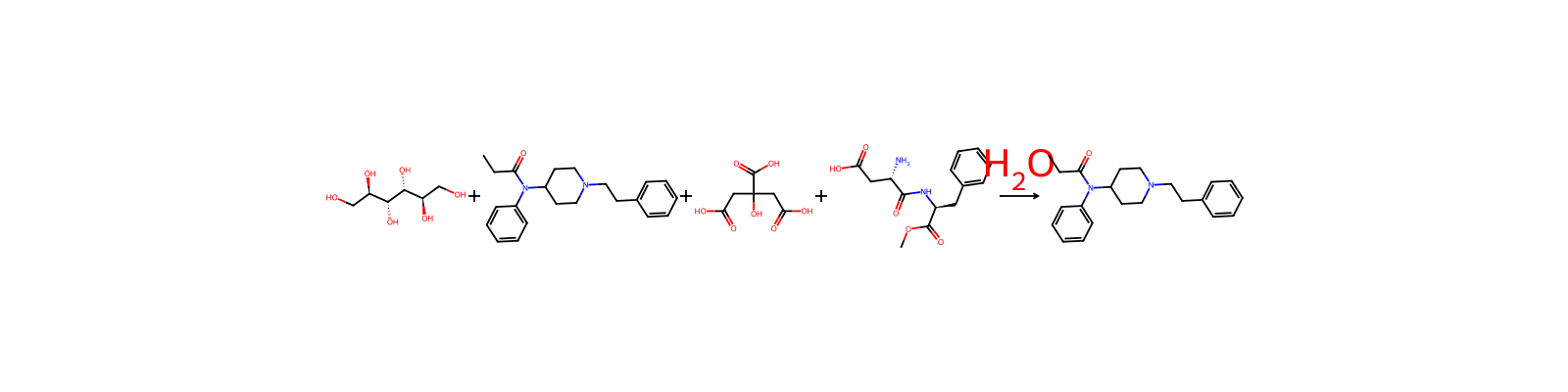
Fentanyl Citrate
データを補完しています。しばらくしてからページを更新すると最新の内容を表示できます

基本情報
- CAS
990-73-8- 標準SMILES
CCC(=O)N(c1ccccc1)C1CCN(CCc2ccccc2)CC1.O=C(O)CC(O)(CC(=O)O)C(=O)O- InChIKey
IVLVTNPOHDFFCJ-UHFFFAOYSA-N- 分子式
- C28H36N2O8
- 平均分子量
- 528.6 g/mol
- 単同位体質量
- 528.24716611
概要
Fentanyl citrate is the citric acid salt of fentanyl, comprising equimolar amounts of citric acid and fentanyl. A -opioid receptor agonist, it is a potent opioid analgesic used in the management of labour pain, postoperative pain, and chronic intractable cancer pain. It is also widely used as the analgesic component of balanced anaesthesia. It has a role as an opioid analgesic and a mu-opioid receptor agonist. It contains a fentanyl.
名称と識別子
- 優先名称
- Fentanyl Citrate
- IUPAC
- 2-hydroxypropane-1,2,3-tricarboxylic acid;N-phenyl-N-[1-(2-phenylethyl)piperidin-4-yl]propanamide
名称と別名
FENTANYL CITRATE990-73-8LeptanalOraletPhentanyl citrateActiqAbstralLazandaOnsolisInstanylFentanyl buccalMcN-JR-4263-49
名称をさらに表示
Fentanyl citrate ciiSUBLIMAZE PRESERVATIVE FREEMUN5LYG46HN-(1-Phenethyl-4-piperidyl)propionanilide citrateFENTANYL CITRATE PRESERVATIVE FREEKw-2246N-(1-Phenethyl-4-piperidyl)propionanilide dihydrogen citrateN-(1-Phenethyl-4-piperidinyl)propionanilide dihydrogen citrate
データベース識別子
- CAS
990-73-8- PubChem CID
- 13810
- DTXSID
DTXSID80243933- ChEMBL
CHEMBL688- ChEBI
CHEBI:31602- UNII
- MUN5LYG46H
- EC Number
- 213-588-0
物性
構造計算による物性補完中
- 極性表面積
- 156 Ų
- 水素結合供与体数
- 4
- 水素結合受容体数
- 9
- 回転可能結合数
- 11
- 重原子数
- 38
- 形式電荷
- 0
- 複雑度
- 618
実験および物理化学的性質
Chemical ClassesOther Uses -> Pharmaceuticals
Human Drugs
FDA approved drugs -> Active ingredient
EMA approved medicines: Human medicine
FDA approved drugs -> Active ingredient
Animal DrugsActive Ingredients (Fentanyl Citrate) -> FDA Greenbook
安全と法規制
安全情報は参考情報です。供給元の安全データシート(SDS)、適用法令、専門家による評価に代わるものではありません。
GHS分類
GHS Classification
Danger
H300 (100%): Fatal if swallowed [Danger Acute toxicity, oral]
P233, P260, P261, P262, P264, P270, P271, P272, P280, P284, P301+P316, P302+P352, P304+P340, P316, P320, P321, P330, P333+P317, P342+P316, P361+P364, P362+P364, P403, P403+P233, P405, and P501 (click each P-code to see the statement)
Aggregated GHS information provided per 68 reports by companies from 11 notifications to the ECHA C&L Inventory. Each notification may be associated with multiple companies.
危険有害性情報
Regulatory InformationFentanyl citrate: HSNO Approval: HSR003800 Approved with controls
Other Safety InformationIMAP assessments - Propanamide, N-phenyl-N-[1-(2-phenylethyl)-4-piperidinyl]-,2-hydroxy-1,2,3-propanetricarboxylate (1:1): Environment tier I assessment
Hazards Summary
Fentanyl is a solid. It is a Schedule II controlled substance. Fentanyl citrate is a strong analgesic used preoperatively, during surgery, and in the immediate postoperative period for its analgesic action. . . . Introduced into clinical practice in the 1960s, the analgesic fentanyl is 100 times more potent than morphine. [HSDB] TLV Basis is CNS impairment and respiratory depression; [ACGIH TLVs and BEIs]
Hazard Classes and CategoriesAcute Tox. 2 (100%)
安全と保護具
Threshold Limit Values (TLV)
0.00001, inhalable particulate matter (Surface Level = 1 ug/100cm2)
0.00002, inhalable particulate matter
毒性情報
化学と産業
薬理情報
FDA Pharmacological Classification
FENTANYL CITRATE
Opioid Agonist [EPC]; Full Opioid Agonists [MoA]
MeSH Pharmacological Classification
Compounds with activity like OPIATE ALKALOIDS, acting at OPIOID RECEPTORS. Properties include induction of ANALGESIA or NARCOSIS.
Agents that are administered in association with anesthetics to increase effectiveness, improve delivery, or decrease required dosage.
Agents that induce NARCOSIS. Narcotics include agents that cause somnolence or induced sleep (STUPOR); natural or synthetic derivatives of OPIUM or MORPHINE or any substance that has such effects. They are potent inducers of ANALGESIA and OPIOID-RELATED DISORDERS.
Ultrashort-acting anesthetics that are used for induction. Loss of consciousness is rapid and induction is pleasant, but there is no muscle relaxation and reflexes frequently are not reduced adequately. Repeated administration results in accumulation and prolongs the recovery time. Since these agents have little if any analgesic activity, they are seldom used alone except in brief minor procedures. (From AMA Drug Evaluations Annual, 1994, p174)
用途と製造
Use ClassificationAnimal Drugs -> FDA Approved Animal Drug Products (Green Book) -> Active Ingredients
関連反応
5 件




化合物ノート
読み込み中…