
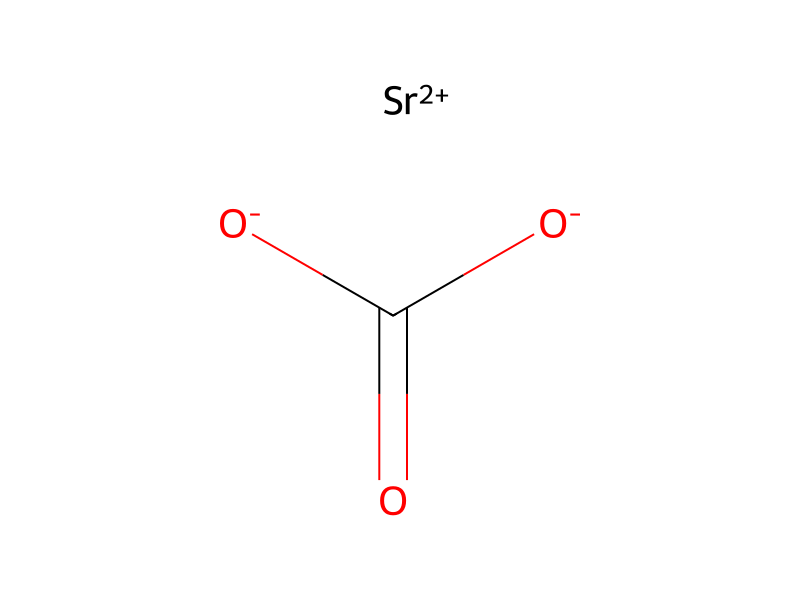
基本情報
- CAS
1633-05-2- 標準SMILES
O=C([O-])[O-].[Sr+2]- InChIKey
LEDMRZGFZIAGGB-UHFFFAOYSA-L- 分子式
- SrCO3
- 平均分子量
- 147.63 g/mol
- 単同位体質量
- 147.89035596
概要
Strontianite is a mineral with formula of SrCO3 or Sr(CO3). The IMA symbol is Str.
名称と識別子
- 優先名称
- Strontium carbonate
- IUPAC
- strontium carbonate
- 現地名
- 炭酸ストロンチウム
- 英語名
- Strontium carbonate
- 分子式
- CO3Sr
- 分子量
- 147.63
名称と別名
STRONTIUM CARBONATE1633-05-2StrontianiteCarbonic acid, strontium salt (1:1)Strontium carbonate (SrCO3)Carbonic acid strontium salt (1:1)DTXSID3029651CI 7783741YPU4MMCAC.I. 77837STRONTIUM CARBONICUMDTXCID009651
名称をさらに表示
炭酸ストロンチウム炭酸ストロンチウム,3N炭酸ストロンチウム/ 99+%炭酸ストロンチウム, 99.9%Sulfuryl caprylateSTRONTIUM CARBONATE POWDERSrCOci77837Nsc112224StrontiumcarbonatStrontuM carbonateSTRONTIUM CARBONAEStorntiumCarbonate
NSC-112224RefChem:58367216-643-7strontium;carbonateCO3SrSrCO3CCRIS 3203EINECS 216-643-7
データベース識別子
- CAS
1633-05-2- PubChem CID
- 15407
- DTXSID
DTXSID3029651- ChEMBL
CHEMBL3188467- UNII
- 41YPU4MMCA
- EC Number
- 216-643-7
- Nikkaji
- J44.008F
物性
構造計算による物性
- 極性表面積
- 63.2 Ų
- 水素結合供与体数
- 0
- 水素結合受容体数
- 3
- 回転可能結合数
- 0
- 重原子数
- 5
- 形式電荷
- 0
- 複雑度
- 18.8
実験および物理化学的性質
Chemical ClassesMetals -> Metals, Inorganic Compounds
OdorODORLESS
TasteTASTELESS
Density
3.5 g/cu-cm
3.5 g/cm³
3.5 @25 °C
Color/Form
WHITE POWDER
Colorless or white rhombic crystalline solid transforming to hexagonal above 926 °C
White orthorhombic crystals
White crystalline powder
Solubility
11 MG/L OF WATER AT 18 °C; 650 MG/L OF WATER AT 100 °C
Sol in ammonium salts
Sol in dilute acids
SOL IN 100,000 PARTS WATER; IN ABOUT 1000 PARTS WATER SATURATED WITH CARBON DIOXIDE.
Soluble in acids, carbonated water, and solutions of ammonium salts
Solubility in water, g/100ml at 18 °C: 0.011 (very poor)
DecompositionDECOMPOSES AT 1100 °C INTO STRONTIUM OXIDE AND CARBON DIOXIDE
Melting Point
1494 °C
1494 °C
Refractive IndexIndex of refraction (alpha, beta, gamma): 1.518, 1.666, 1.668
Physical Description
Dry Powder
White odorless solid; [Merck Index] Colorless or white odorless hygroscopic solid; [HSDB] White odorless powder; [MSDSonline]
WHITE ODOURLESS POWDER.
Other Experimental Properties
DECOMPOSES AT 1100 °C INTO STRONTIUM OXIDE AND CARBON DIOXIDE
Liberates carbon dioxide at 1340 °C; impalpable
Enthalpy of formation (crystal): -1220.1 KJ/mol @ 25 °C; Gibbs Energy of formation (crystal): -1140.1 KJ/mol @ 25 °C; Entropy of formation (crystal): 97.1 J/mol-K @ 25 °C; Heat capacity @ constant pressure (crystal): 81.4 J/mol-K @ 25 °C
Hygroscopic
For more Other Experimental Properties (Complete) data for STRONTIUM CARBONATE (6 total), please visit the HSDB record page.
物理化学的性質
- 融点
- 1494 °C · 1494 °C (lit.)
- 比重(密度)
- 3.7 g/mL · 3.7 g/mL at 25 °C (lit.)
- 屈折率
- 1.518 · 1.518
- 貯蔵温度
- Inert atmosphere,Room Temperature
- 溶解性
- 希酸水溶液: わずかに溶ける(lit.)
- 外見
- 粉
- 比重
- 3.7 · 3.7
- 色
- 白い
- PH
- 7 · 7-8 (20°C, 0.01g/L in H2O)
- 臭い (Odor)
- Odorless
- 水溶解度
- 塩化アンモニウムに可溶。アンモニアおよび水にわずかに溶ける。
- 比熱容量
- 0.55 J/ · Cp(crystal): 0.55 J/(g·K), at 25℃
- Merck
- 14 · 14,8838
- 安定性
- 安定。強酸とは相容れない。
- InChI
- 1S/CH2O3.Sr/c2-1(3)4;/h(H2,2,3,4);/q;+2/p-2
- InChIKey
- LEDMRZGFZIAGGB-UHFFFAOYSA-L
- SMILES
- [Sr++].[O-]C([O-])=O
- LogP
- -0.809 · -0.809 (est)
- CAS データベース
- 1633 · 1633-05-2(CAS DataBase Reference)
- EPAの化学物質情報
- Carbonic acid, strontium salt (1:1) (1633-05-2)
化学的性質
化学的特性Heating strontium carbonate up from 1000°C to 1300°C causes the compound to undergo a decomposition reaction which results in the capture of thermal energy, shown here as the peak in the black curve occurring between Time = 20 and Time = 40 minutes. Cooling the system back down to 1000°C leads to reconstitution of the starting material in a carbonation reaction thereby releasing the stored thermal energy, a process shown as the valley in the black curve between Time = 50 and Time = 80 minutes.
化学的特性Strontium carbonate is a milky white free flowing powder. It is little more insoluble (Ksol=10-8.8) than calcium carbonate (Ksol=10-8.07), so it should not be surprising that under appropriate conditions Sr2+ can be precipitated by biogenic carbonate.
安全と法規制
GHS分類
GHS Classification
This chemical does not meet GHS hazard criteria for 99.3% (398 of 401) of all reports.
Not Classified
Aggregated GHS information provided per 401 reports by companies from 5 notifications to the ECHA C&L Inventory.
危険有害性情報
Regulatory Information
Chemical: Carbonic acid, strontium salt (1:1)
Carbonic acid, strontium salt (1:1) is listed on the EPA's Chemical Data Reporting (CDR) system. Manufacturers and importers of Carbonic acid, strontium salt (1:1) are required to report information about their production and use of this chemical to the EPA under the Toxic Substances Control Act (TSCA). (40 eCFR Part 711)
Status: Active Update: 15-03-2023 https://echa.europa.eu/registration-dossier/-/registered-dossier/14362
Strontium carbonate: Does not have an individual approval but may be used under an appropriate group standard
Other Safety InformationIMAP assessments - Carbonic acid, strontium salt (1:1): Human health tier I assessment
Fire HazardsNot combustible.
Hazards Summary
An irritant to the eyes and the respiratory tract; Strontium ion has effects on the calcium content of the bones and teeth, but data concerning harmful doses of strontium carbonate are inadequate. [ICSC] May cause irritation; [MSDSonline] See Strontium.
Chemical DangersReacts with acids.
Hazard Classes and CategoriesNot Classified
State Drinking Water Standards
(AL) ALABAMA 8 pCi/l /Strontium 90/
(CA) CALIFORNIA 8 pCi/l /Strontium 90/
(CT) CONNECTICUT 8 pCi/l /Strontium 90/
(IL) ILLINOIS 8 pCi/l /Strontium 90/
For more State Drinking Water Standards (Complete) data for STRONTIUM CARBONATE (6 total), please visit the HSDB record page.
State Drinking Water Guidelines
(FL) FLORIDA 4,200 ug/l /Strontium/
(ME) MAINE 4200 ug/l /Strontium/
Federal Drinking Water GuidelinesEPA 4000 ug/l
安全と保護具
Fire FightingIn case of fire in the surroundings, use appropriate extinguishing media.
First Aid Measures
Fresh air, rest.
Rinse and then wash skin with water and soap.
Rinse with plenty of water for several minutes (remove contact lenses if easily possible).
Rinse mouth. Give one or two glasses of water to drink.
Safe StorageSeparated from acids.
Disposal Methods
SRP: At the time of review, criteria for land treatment or burial (sanitary landfill) disposal practices are subject to significant revision. Prior to implementing land disposal of waste residue (including waste sludge), consult with environmental regulatory agencies for guidance on acceptable disposal practices.
Spillage DisposalPersonal protection: particulate filter respirator adapted to the airborne concentration of the substance. Sweep spilled substance into covered containers. If appropriate, moisten first to prevent dusting.
Eye PreventionWear safety goggles.
Inhalation RiskA nuisance-causing concentration of airborne particles can be reached quickly.
Skin PreventionProtective gloves.
Exposure PreventionPREVENT DISPERSION OF DUST!
Ingestion PreventionDo not eat, drink, or smoke during work.
Inhalation PreventionAvoid inhalation of dust.
Effects of Short Term ExposureMay cause mechanical irritation to the eyes and respiratory tract.
毒性情報
Signs and Symptoms
Cough.
Redness.
Natural Pollution Sources
Strontium forms 0.02-0.03% of the earth's crust and is present in igneous rocks in amounts averaging 375 ppm(1). Of the naturally occurring strontium compounds, only the minerals strontianite (strontium carbonate) and celestite (strontium sulfate) are of economic importance(2).
OCCURS IN NATURE AS THE MINERAL STRONTIANITE.
Human Toxicity Excerpts... Inorganic salts of strontium /such/ as the chloride, sulfate, carbonate ... are remarkably benign. ... In large oral doses they presumably exert local osmotic effects & so tend to induce vomiting & diarrhea.
Artificial Pollution Sources
More than 80% of all strontium consumed in 1995 was used in ceramic and glass manufacture, primarily in televison faceplate glass (strontium carbonate/oxide)(1). In addition, strontium (strontium carbonate) is used to remove lead impurities during the electrolytic production of zinc(1). The production and use of these strontium compounds may result in its release to the environment through various waste streams(SRC).
Non-Human Toxicity Excerpts
Major signs of chronic toxicity, which involve the skeleton, have been labeled as "strontium rickets". ... Rickets /have been produced/ in laboratory rats by feeding them strontium carbonate at 2% strontium in diet.
THE SKELETAL MALFORMATIONS INDUCED IN RATS OF WISTAR STRAIN BY STRONTIUM CARBONATE WERE STUDIED WITH SKELETAL PREPARATIONS (DAWSON'S & NOVAK'S METHODS) & FETUSES WITH MARKED CONGENITAL KYPHOSIS WERE EXAMINED HISTOLOGICALLY. STRONTIUM CARBONATE (200 MG/100 G BODY WT) MIXED WITH A PELLET (ORIENTAL KOBO LTD 15 G/DAY) OR A ROUTINE DIET WAS ADMINISTERED DURING PREGNANCY. THE VERTEBRAL COLUMN SHOWED KYPHOSIS AROUND THE JUNCTION OF THORACIC & LUMBAR VERTEBRAE, & DISARRANGEMENT OF VERTEBRAE WERE SOMETIMES SHOWN AT THE OTHER PARTS. THE VERTEBRAL BODY AT THE CURVED VERTEBRAL COLUMN WAS TRAPEZOID IN FIGURE. SKELETAL MALFORMATIONS OF A ROUTINE DIET GROUP WERE MORE FREQUENT & MORE MARKED THAN A PELLET GROUP.
A SINGLE INTRATRACHEAL INSTILLATION OF 50 MG STRONTIUM CARBONATE/RAT RESULTED IN HYPERVOLEMIA OF PULMONARY BLOOD VESSELS & HYPERPLASIA OF THE LYMPHOID FOLLICLES IN THE BRONCHIAL SUBMUCOSA AFTER 1 MONTH. AFTER 9 & 12 MONTHS, SCLEROSIS OF THE WALLS OF BLOOD VESSELS & BRONCHI WAS FOUND. THE BRONCHIAL EPITHELIUM WAS REGENERATED.
Adult white leghorn hens were fed a standard diet containing 2.93% calcium, 0.79% phosphorus & 17% protein & water ad libitum for a 4-wk period. The dietary calcium was fed at a constant level of 2.93% for all dietary treatments. Strontium carbonate was added to the diets of 10 birds to supply levels of 0, 1.5 & 3.0% strontium. These levels produced zero hatchability of fertile eggs & ash content of egg shells was increased as the dietary strontium level was increased. Embryo ash, calcium & phosphorus contents were reduced with incr dietary strontium level. Skeletal calcification in chick embryos appeared to be inhibited by retained transferred strontium.
法規制情報
State Drinking Water Standards
(AL) ALABAMA 8 pCi/l /Strontium 90/
(CA) CALIFORNIA 8 pCi/l /Strontium 90/
(CT) CONNECTICUT 8 pCi/l /Strontium 90/
(IL) ILLINOIS 8 pCi/l /Strontium 90/
For more State Drinking Water Standards (Complete) data for STRONTIUM CARBONATE (6 total), please visit the HSDB record page.
State Drinking Water Guidelines
(FL) FLORIDA 4,200 ug/l /Strontium/
(ME) MAINE 4200 ug/l /Strontium/
Federal Drinking Water GuidelinesEPA 4000 ug/l
安全データ
- wgk
- -
- tsca
- TSCA listed
- hs_code
- 2836920000
- ストレージクラス
- 13 - Non Combustible Solids
- 有毒物質データの
- 1633-05-2(Hazardous Substances Data)
化学と産業
用途と製造
Uses
Naturally found as the mineral strontianite; [Merck Index] Used in pyrotechnics, signals, ceramic ferrites, phosphors, iridescent glass, glass for color television tubes, oxide coatings, and fluxes for producing high-grade steels; Also used in refining sugar and as a lead scavenger in zinc production; [HSDB] Used in the electrical/electronic engineering industry; [IUCLID]
Steel Producing [Category: Industry]
IN PYROTECHNICS; MANUFACTURING IRIDESCENT GLASS; REFINING SUGAR
As a catalyst; in radiation-resistant glass for color television tubes, ceramic ferrites, pyrotechnics.
AS A FLUX IN THE PRODUCTION OF HIGH-GRADE ALLOY STEELS
Manufacture of glass faceplates for color television tubes (x-ray absorber)
U.S. Imports
(1986) 3.97X10+4 lb /Strontium carbonate not precipitated incl strontianite/
(1986) 1.20X10+7 lb /Strontium carbonate not precipitated incl strontianite/
U.S. Production2023: 1,000,000 - <5,000,000 lb
Consumption PatternsX-RAY ABSORBER IN FACEPLATES FOR COLOR TELEVISION TUBES, 77%; COMPONENT OF FERRITE MAGNETS, 16%; COMPONENT OF CERAMIC GLAZES, 2%; MISCELLANEOUS, 5% (1982)
Consumer UsesFiller
Industry UsesFiller
Methods of Manufacturing
CELESTITE IS BOILED WITH A SOLUTION OF AMMONIUM CARBONATE OR IS FUSED WITH SODIUM CARBONATE.
... Celestite ore is crushed, ground, & stored in bins before it is fed to rotary kilns. As ground ore is being conveyed to the kilns, it is mixed with ground coke. In the kilns, the celestite is reduced to strontium sulfide, which is known as black ash. ... The product ... from the kilns is collected in storage bins. Black ash ... is fine-ground in a ball mill & fed to a leacher circuit ... where it is dissolved in water & the muds are separated by counter current decantation. ... The filered product, a saturated soln containing 12-13% strontium sulfide, is sent to an agitation tank where soda ash is added to cause precipitation of strontium carbonate crystals ... After precipitation is complete, slurry is pumped to vacuum drum filters where nearly complete liq-solids separation is accomplished. The liq is dilute sodium sulfide soln, which is concentrated by evaporation. ... The filter cake is 60% strontium carbonate solid. ... Strontium carbonate also precipitates from strontium sulfide soln with carbon dioxide.
Formulations/PreparationsGRADES: PRECIPITATED; TECHNICAL; NATURAL; REAGENT.
General Manufacturing Information
Paint and Coating Manufacturing
Carbonic acid, strontium salt (1:1): ACTIVE
応用分野
解説炭酸ストロンチウム天然にはストロンチアン石として産出する.ストロンチウム塩水溶液に炭酸アンモニウムを加えると得られる.また,水酸化ストロンチウムに二酸化炭素を吸収させても得られる.無色の斜方晶系結晶.926 ℃ で六方晶系に転移する.強熱すると二酸化炭素と酸化ストロンチウムとに分解する.水に難溶,塩化アンモニウム水溶液に可溶,エタノールに不溶.酸と反応して二酸化炭素を発生してその酸のストロンチウム塩を生じる.二酸化炭素を含む水には炭酸水素ストロンチウムとなって溶解する.
用途超電導材料、フェライト材料。
用途ブラウン管、花火、信号筒、光学レンズの材料。
用途炭酸ストロンチウムストロンチウム塩の製造,花火(赤色),変色ガラスの原料,ブラウン管,電子材料,蛍光体磁性材料,砂糖の精製などに用いられる.炭酸のストロンチウム塩。天然にストロンチアン石として産出する。人工的には、天青石(硫酸ストロンチウム)と炭酸ナトリウムの混合物を融解してつくる。副生した硫酸ナトリウムは水で抽出し除去する。ストロンチウム塩の水溶液に炭酸アンモニウムを加えると、純粋なものを沈殿として得ることができる。加熱すると次の反応によって解離する。 SrCO3SrO+CO2 種々のストロンチウム塩や酸化物、水酸化物の製造原料となる。
説明Strontium carbonate has the formula of SrCO3 and the molecular weight of 147.6326 g/mol. Strontium carbonate occurs in nature as the mineral “strontianite”. The name strontianite comes from a famous location for the mineral, Strontian, Scotland. Strontianite is strontium carbonate as found naturally. It occurs as white or slightly gray orthorhombic crystals with a refractive index of 1.518. The unit-cell parameters are: a = 5.107 , b = 8.414 , c = 6.029 , Z = 4; V = 259.07 3, Den(Calc) = 3.78. The crystal system is orthorhombic with space group Pmcn and point group 2/m, 2/m, 2/m. Strontium carbonate has only one stable form (aragonite-type structure) and temperature of precipitation has no effect on crystal form, unlike that of calcium or magnesium carbonates.
天然物の起源Strontium carbonate occurs in nature as mineral strontianite. The compound is used in pyrotechnics and ceramic ferrites. It also is used in making iridescent glass for color television tubes. Other uses are in refining sugar and preparing other strontium salts.
使用Strontium carbonate (SrCO3) is used to make radiation-resistant glass and TV picture tubes, as well as pyrotechnics.
一般的な説明Strontium carbonate is insoluble in water. It is used predominantly in producing other strontium salts.
一般的な説明Strontianite is a strontium carbonate mineral (SrCO3). It is the original and principal source of strontium. It often occurs in white masses of radiating fibres, although pale green, yellow, or gray colours are also known. Strontianite forms soft, brittle crystals that are commonly associated with barite, celestine, and calcite in low-temperature veins. Strontianite is used in pyrotechnics to impart a red colour and in sugar refining as a clarifying agent.
調製方法
Strontium carbonate, formed (1) by reaction of strontium salt solution and sodium carbonate or bicarbonate solution, (2) by reaction of strontium hydroxide solution and CO2. Strontium carbonate decomposes at 1,200 °C (2,192 °F) to form strontium oxide and CO2, and is dissolved by excess CO2, forming strontium bicarbonate, Sr(HCO3)2, solution.
製造方法Strontium carbonate occurs in nature as strontianite and can be mined from its deposit. It is, however, usually made commercially from the mineral “celestite”. Celestite is fused with sodium carbonate at elevated temperatures or boiled with a solution of ammonium carbonate.Strontium carbonate is insoluble in water. It precipitates from the product mixture in the second reaction. If fused with sodium carbonate, the product mixture is leached with water. Insoluble carbonate separates from the water-soluble sodium sulfate.
上流・下流製品情報
上流原料
下流製品
サプライヤー100 社
国药集团化学试剂有限公司86-21-63210123 · [email protected]
上海阿拉丁生化科技股份有限公司400-6206333 13167063860 · [email protected]
四川华南无机盐有限公司15223036127 · [email protected]
合肥翰刚医药科技有限公司+8618062405514 · [email protected]
上海光铧科技有限公司13801626616 · [email protected]
Baoji Guokang Healthchem co.,ltd+8615604608665 15604608665 · [email protected]
Dayang Chem (Hangzhou) Co.,Ltd.+86-0571-88938639 17705817739 · [email protected]
Hebei Yanxi Chemical Co., Ltd.+86-17531190177 · [email protected]
阿法埃莎(中国)化学有限公司400-6106006 · [email protected]
安耐吉化学&3A(安徽泽升科技股份有限公司)400-0056266 · [email protected]
北京绿百草科技发展有限公司010-61136123 · [email protected]
上海瀚鸿科技股份有限公司021-54306202 13764082696 · [email protected]
河北缤享新材料科技有限公司+8618633865755 · [email protected]
雨木(宁波)新材料有限公司13116661121
山东洛克化工有限公司17653113209 13065062079 · [email protected]
上海景颜化工科技有限公司13817811078 · [email protected]
池州捷峰生物科技有限公司0566-8928158 · [email protected]
武汉丰泰威远科技有限公司027-87465837 19945049750 · [email protected]
天津金汇太亚化学试剂有限公司022-59582624 18622766592 · [email protected]
广东大小化工有限公司1866-171603 18666171603 · [email protected]
玛雅试剂+86 (573) 82222445 (0)18006601000 452520369 · [email protected]
四川库利南科技有限公司400-1166-196 18981987031 · [email protected]
天津希恩思生化科技有限公司400 638 7771 · [email protected]
衡水昊业科技有限公司0318-2012300 +86-18632882519 · [email protected]
斯百全化学(上海)有限公司021-021-021-67601398-809-809-809 15221380277 · [email protected]
艾科试剂4008-755-333 18080918076 · [email protected]
青岛保税区鲁联国际贸易有限公司0532-83893697 18561902820 · [email protected]
上海遐瑞医药科技有限公司+86 21 61551611
上海好慕仁新材料有限公司15317828837 · [email protected]
上海倍卓生物科技有限公司021-61119791,13386096464 · [email protected]
北京环宇世纪化学科技有限公司hysj_bj.com
上海将来实业股份有限公司400-0066400 13621662912 · [email protected]
上海将来实业股份有限公司021-61552785 · [email protected]
日照力德士化工有限公司010-51268198 · [email protected]
上海爱蝶实业有限公司021-58957966 18930537195 · [email protected]
成都零六生物科技有限公司400-1166-196 13458535857 · [email protected]
上海麦克林生化科技股份有限公司15221275939 15221275939 · [email protected]
杭州杰恒化工有限公司0571-87396432 · [email protected]
上海兴鲁化工科技有限公司02120970332 · [email protected]
成都润泽本土化工有限公司13096311329 028-88469284 616445927 · [email protected]
湖北巨胜科技有限公司027-59599241 18871490274 · [email protected]
池州凯隆进出口贸易有限公司[email protected]
Sigma-Aldrich西格玛奥德里奇(上海)贸易有限公司021-61415566 800-8193336 · [email protected]
九鼎化学(上海)科技有限公司4009209199 · [email protected]
Henan Alfa Chemical Co., Ltd+8618339805032 · [email protected]
厦门志信化学有限公司+86-5922680277 +86-13806087780 · [email protected]
山东智尚新材料有限公司+8617653113209 · [email protected]
Alfa Chemistry+1-5166625404 · [email protected]
sgtlifesciences pvt ltd+91-8790379245 · [email protected]
成都润泽本土化工有限公司028-88469284 18000562381 · [email protected]
補足説明
定義strontianite: A mineral form ofstrontium carbonate, SrCO3.
関連反応
28 件


化合物ノート
読み込み中…