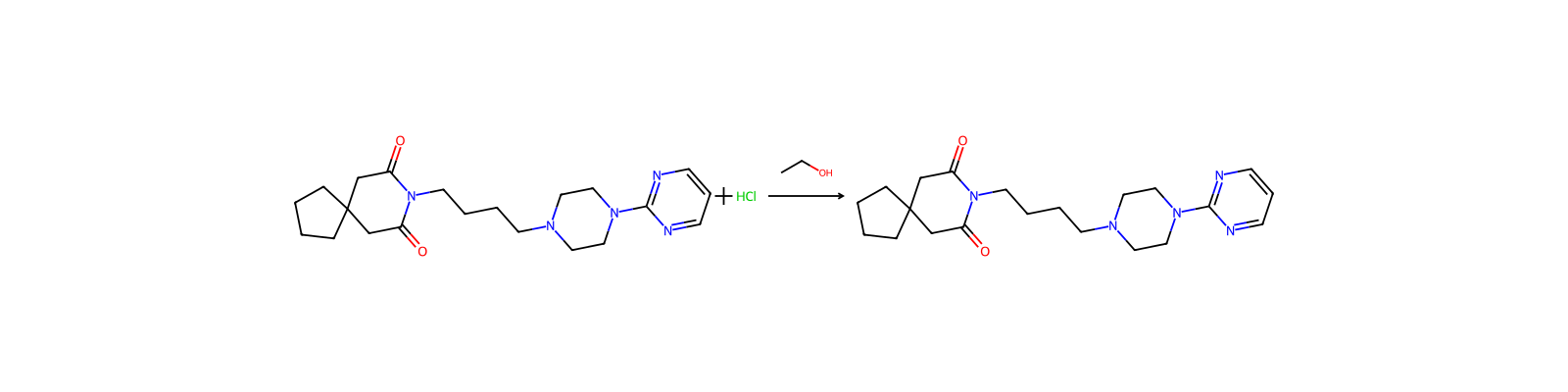
HRID 1402639反応物として
Buspirone Hydrochloride

33386-08-2Cl.O=C1CC2(CCCC2)CC(=O)N1CCCCN1CCN(c2ncccn2)CC1RICLFGYGYQXUFH-UHFFFAOYSA-NBuspirone hydrochloride is a hydrochloride salt resulting from the reaction of equimolar amounts of buspirone and hydrogen chloride. It has a role as an anxiolytic drug, a sedative, a serotonergic agonist and an EC 3.4.21.26 (prolyl oligopeptidase) inhibitor. It contains a buspirone(1+).
FDA approved drugs -> Active ingredient
FDA approved drugs -> Active ingredient
安全情報は参考情報です。供給元の安全データシート(SDS)、適用法令、専門家による評価に代わるものではありません。
Danger
H301 (100%): Toxic if swallowed [Danger Acute toxicity, oral]
P264, P270, P301+P316, P321, P330, P405, and P501 (click each P-code to see the statement)
Aggregated GHS information provided per 47 reports by companies from 4 notifications to the ECHA C&L Inventory.
General symptomatic and supportive measures should be used along with immediate gastric lavage. Respiration, pulse, and blood pressure should be monitored as in all cases of drug overdosage. No specific antidote is known to buspirone, and dialyzability of buspirone has not been determined. (L1712)
Buspirone binds to 5-HT type 1A serotonin receptors on presynaptic neurons in the dorsal raphe and on postsynaptic neurons in the hippocampus, thus inhibiting the firing rate of 5-HT-containing neurons in the dorsal raphe. Buspirone also binds at dopamine type 2 (DA2) receptors, blocking presynaptic dopamine receptors. Buspirone increases firing in the locus ceruleus, an area of brain where norepinephrine cell bodies are found in high concentration. The net result of buspirone actions is that serotonergic activity is suppressed while noradrenergic and dopaminergic cell firing is enhanced.
Metabolized hepatically, primarily by oxidation by cytochrome P450 3A4 producing several hydroxylated derivatives and a pharmacologically active metabolite, 1-pyrimidinylpiperazine (1-PP) Route of Elimination: In a single-dose study using 14C-labeled buspirone, 29% to 63% of the dose was excreted in the urine within 24 hours, primarily as metabolites; fecal excretion accounted for 18% to 38% of the dose. Half Life: 2-3 hours (although the action of a single dose is much longer than the short halflife indicates).
Agents that alleviate ANXIETY, tension, and ANXIETY DISORDERS, promote sedation, and have a calming effect without affecting clarity of consciousness or neurologic conditions. ADRENERGIC BETA-ANTAGONISTS are commonly used in the symptomatic treatment of anxiety but are not included here.
Endogenous compounds and drugs that bind to and activate SEROTONIN RECEPTORS. Many serotonin receptor agonists are used as ANTIDEPRESSANTS; ANXIOLYTICS; and in the treatment of MIGRAINE DISORDERS.
説明Buspirone hydrochloride is an anxiolytic agent indicated for the management of anxiety disorders with or without accompanying depression. In contrast to the benzodiazepines, buspirone does not interact with alcohol, and lacks sedative, anticonvulsant, and muscle relaxant effects, and abuse potential.
使用Non-benzodiazepine anxiolitic; 5-hydroxytryptamine (5-HT1) receptor agonist.
一般的な説明Pharmaceutical secondary standards for application in quality control provide pharma laboratories and manufacturers with a convenient and cost-effective alternative to the preparation of in-house working standards


33386-08-2DTXSID1037193CHEMBL1200399CHEBI:3224化学的特性White Solid
Drug Induced Liver Injury Rank (DILIrank 2.0)
Buspirone hydrochloride
Ambiguous-DILI-concern
3
Adverse reactions
DOI:10.1016/j.drudis.2016.02.015
定義ChEBI: A hydrochloride salt resulting from the reaction of equimolar amounts of buspirone and hydrogen chloride.