
HRID 23073反応物として
4-Phenylbutyric Acid
データを補完しています。しばらくしてからページを更新すると最新の内容を表示できます
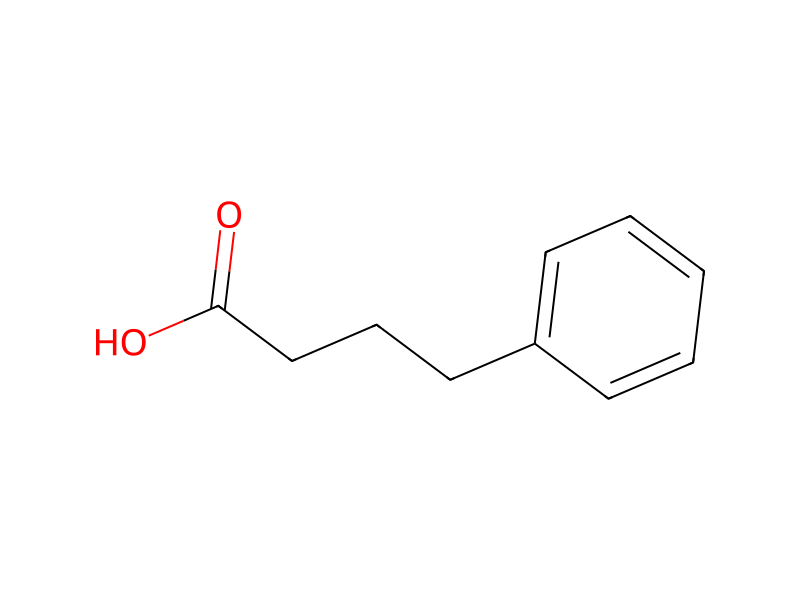
1821-12-1O=C(O)CCCc1ccccc1OBKXEAXTFZPCHS-UHFFFAOYSA-N4-phenylbutyric acid is a monocarboxylic acid the structure of which is that of butyric acid substituted with a phenyl group at C-4. It is a histone deacetylase inhibitor that displays anticancer activity. It inhibits cell proliferation, invasion and migration and induces apoptosis in glioma cells. It also inhibits protein isoprenylation, depletes plasma glutamine, increases production of foetal haemoglobin through transcriptional activation of the gamma-globin gene and affects hPPARgamma activation. It has a role as an antineoplastic agent, a prodrug, an EC 3.5.1.98 (histone deacetylase) inhibitor and an apoptosis inducer. It is functionally related to a butyric acid. It is a conjugate acid of a 4-phenylbutyrate.
1821-12-1DTXSID2037631Other Classes -> Organic Acids
Industrial compound
2.42
2.32
White or off-white powder; [Alfa Aesar MSDS]
Solid
安全情報は参考情報です。供給元の安全データシート(SDS)、適用法令、専門家による評価に代わるものではありません。
Warning
H315 (83.3%): Causes skin irritation [Warning Skin corrosion/irritation]
P261, P264, P264+P265, P271, P280, P302+P352, P304+P340, P305+P351+P338, P319, P321, P332+P317, P337+P317, P362+P364, P403+P233, P405, and P501 (click each P-code to see the statement)
Aggregated GHS information provided per 12 reports by companies from 7 notifications to the ECHA C&L Inventory. Each notification may be associated with multiple companies.
Status: Active Update: 15-05-2018 https://echa.europa.eu/registration-dossier/-/registered-dossier/16079
Benzenebutanoic acid: Does not have an individual approval but may be used under an appropriate group standard
While the urea cycle disorders are caused by deficiencies of hepatic enzymes responsible for the elimination of nitrogen, patients generally present with hyperammonemia without other features or biochemical evidence of hepatic injury. Thus, serum aminotransferase, alkaline phosphatase and bilirubin levels are generally normal or only mildly elevated. Newborns presenting with hyperammonemia may have hepatomegaly but other, non-urea cycle, liver function is normal as is hepatic histology. Phenylbutyrate can help to lower ammonia levels acutely and manage to keep them in the normal or near normal range, but generally does not affect other liver functions. In open label studies, a small proportion of patients (particularly with ornithine transcarbamylase [OTC] deficiency) have had ALT or AST elevations, but these have generally been attributed to the underlying condition or its complications. Phenylbutyrate has not been linked to instances of clinically apparent liver injury with jaundice.
Phenylbutyric acid decreases elevated plasma ammonia glutamine levels in patients with urea cycle disorders. It increases waste nitrogen excretion in the form of phenylacetylglutamine. In the intestines, phenylbutyric acid was shown to reduce mucosal inflammation, regulate transepithelial fluid transport, and improve oxidative status. Some studies report antineoplastic properties of phenylbutyric acid, showing that phenylbutyric acid can promote growth arrest and apoptosis of cancer cells. It is suggested that phenylbutyric acid can act as an ammonia scavenger, chemical chaperone, and histone deacetylase inhibitor.
Sodium phenylbutyrate is the most commonly used salt used in drug products of phenylbutyric acid. Sodium phenylbutyrate is a pro-drug that rapidly metabolizes to phenylacetate. Phenylacetate is conjugated with phenylacetyl-CoA, which in turn combines with glutamine via acetylation to form phenylacetylglutamine. Phenylacetylglutamine is then excreted by the kidneys, thus providing an alternate mechanism of waste nitrogen excretion to the urea cycle. Phenylacetylglutamine is comparable to urea, as each molecule contains two moles of nitrogen.
The major sites for metabolism of sodium phenylbutyrate are the liver and kidney. Phenylbutyric acid is rapidly metabolized to phenylacetate via beta-oxidation. Phenylacetate is conjugated with phenylacetyl-CoA, which in turn combines with glutamine via acetylation to form phenylacetylglutamine.
7WY7YBI87E
PHENYLBUTYRIC ACID
Mechanisms of Action [MoA] - Ammonium Ion Binding Activity


CHEMBL1469CHEBI:41500化学的特性4-Phenylbutyric acid is white to slightly yellowish crystalline powder. It is slightly soluble in chloroform and methanol. Its solubility in water is 5.3 g/l (at 40 °C).
Established Pharmacologic Class [EPC] - Nitrogen Binding Agent
Phenylbutyric acid is a Nitrogen Binding Agent. The mechanism of action of phenylbutyric acid is as an Ammonium Ion Binding Activity.
Following oral administration of a single 5g dose of sodium phenylbutyrate, the Cmax was 195-218 µg/mL under fasting conditions and the Tmax was one hour. The effect of food on drug absorption is unknown.
Approximately 80–100% of the dose was excreted by the kidneys within 24 hours as the conjugation product, phenylacetylglutamine. For each gram of sodium phenylbutyrate administered, it is estimated that between 0.12–0.15 grams of phenylacetylglutamine nitrogen are produced.
一般的な説明4-Phenylbutyric acid (4-PBA) is a small-molecular-weight fatty acid with a terminal aromatic group, and its sodium salt (sodium 4-phenyl butyrate) has been used for the treatment of urea cycle disorders. This molecule is also used for the treatment of sickle cell diseases and thalassemia owing to its ability to activate β-globin transcription. Moreover, 4-PBA is employed as an orally bioavailable agent for the treatment of spinal muscular atrophy (SMA) and tumors. Neuroprotective Effects of 4-phenylbutyric Acid and Its Derivatives: Possible Therapeutics for Neurodegenerative Diseases
製造方法4-phenylbutyric acid is obtained by the reaction of benzene with butyrolactone in the presence of aluminum chloride, followed by neutralization with base.Synthesis of 4-phenylbutyric acid
純化方法Crystallise the acid from pet ether (b 40-60o). [Beilstein 9 IV 1811.]
定義4-Phenylbutyric acid is a monocarboxylic acid the structure of which is that of butyric acid substituted with a phenyl group at C-4. It is a histone deacetylase inhibitor that displays anticancer activity. It inhibits cell proliferation, invasion and migration and induces apopto is in glioma cells. It also inhibits protein isoprenylation, depletes plasma glutamine, increases production of foetal haemoglobin through transcriptional activation of the gamma-globin gene and affects hPPARgamma activation.