
HRID 155036生成物として
Sulfometuron-methyl
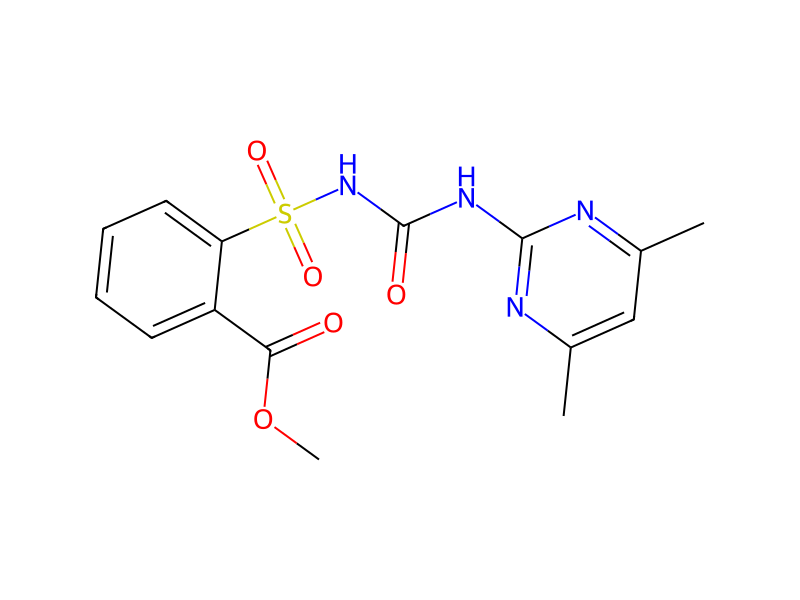
74222-97-2COC(=O)c1ccccc1S(=O)(=O)NC(=O)Nc1nc(C)cc(C)n1ZDXMLEQEMNLCQG-UHFFFAOYSA-NSulfometuron methyl is a benzoate ester that is the methyl ester of 2-{[(4,6-dimethylpyrimidin-2-yl)carbamoyl]sulfamoyl}benzoic acid. It has a role as an EC 2.2.1.6 (acetolactate synthase) inhibitor and a herbicide. It is a benzoate ester, a member of pyrimidines and a N-sulfonylurea. It is functionally related to a sulfometuron.
Pesticides -> Herbicides, Sulfonylurea
Pesticide (Sulfometuron methyl) -> USDA PDB
Pesticide
log Kow = 1.20
1.3
In mg/kg at 25 °C: acetone 3300, acetonitrile 1800, ethyl acetate 650, diethyl ether 60, hexane <1, methanol 550, dichloromethane 15,000, dimethyl sulfoxide 32,000, octanol 140, toluene 240
In water, pH 5 buffer 6.42 ppm; pH 7 buffer 244 ppm; pH 8.6 buffer 12,500 ppm
In water, 244 mg/L at 25 °C
202 °C
397.4-401 °F
0.00006 [mmHg]
5.48X10⁻¹⁶ mm Hg at 25 °C
White solid;
White solid.
安全情報は参考情報です。供給元の安全データシート(SDS)、適用法令、専門家による評価に代わるものではありません。
This chemical does not meet GHS hazard criteria for 3% (3 of 99) of reports.
Warning
H319 (28.3%): Causes serious eye irritation [Warning Serious eye damage/eye irritation]
P261, P264+P265, P271, P273, P280, P304+P340, P305+P351+P338, P317, P337+P317, P391, and P501 (click each P-code to see the statement)
Aggregated GHS information provided per 99 reports by companies from 5 notifications to the ECHA C&L Inventory. Each notification may be associated with multiple companies.
Warning
Sulfometuron Methyl is listed in the dataset of EPA Human Health Benchmarks for Pesticides under the Safe Drinking Water Act (40 eCFR 141)
Benzoic acid, 2-(4,6-dimethyl-2-pyrimidinyl)aminocarbonylaminosulfonyl-, methyl ester: Does not have an individual approval but may be used as a component in a product covered by a group standard. It is not approved for use as a chemical in its own right.
Urea-derived herbicides have low toxicity in animal feeding studies; [HSDB] Systemic toxicity unlikely unless large amounts ingested; [EPA Pesticides, p. 122] Hematological effects (hemolysis) are seen in high-dose, chronic, feeding studies of animals; [ACGIH]
USEPA/Office of Prevention, Pesticides and Toxic Substances; Reregistration Eligibility Decision Document - Sulfometuron Methyl (September 2008). The RED summarizes the risk assessment conclusions and outlines any risk reduction measures necessary for the pesticide to continue to be registered in the U.S.[Available from, as of May 27, 2009: http://www.epa.gov/pesticides/reregistration/status.htm]
California Environmental Protection Agency/Department of Pesticide Regulation; Environmental Fate Review Summaries on Sulfometuron methyl (74222-97-2) (1999).[Available from, as of May 8, 2009: http://www.cdpr.ca.gov/docs/emon/pubs/envfate.htm]
Compounds or agents that combine with an enzyme in such a manner as to prevent the normal substrate-enzyme combination and the catalytic reaction.
Pesticides used to destroy unwanted vegetation, especially various types of weeds, grasses (POACEAE), and woody plants. Some plants develop HERBICIDE RESISTANCE.
... Sulfometuron methyl was rapidly metabolized and excreted by goats, a representative ruminant animal. The majority of dosed (14)C-labeled sulfometuron methyl, 94-99%, was excreted in urine and feces. Less than 1% was excreted in milk. Major residues in urine and feces consisted of both sulfometuron methyl and (hydroxymethyl)-pyrimidine sulfometuron methyl (HM-SM). The major metabolite in milk was also HM-SM. Less than 10% (<0.01 ppm) of total (14)C labeled residues in milk was the parent herbicide, indicating that sulfometuron methyl accumulation in milk was below detectable limits of 0.03 ppm. In the same study, accumulation of (14)C-labeled residues in meat and fat were also below detectable limits.
Used as a non-crop herbicide (weed killer); [ACGIH]
Farming (Pesticides) [Category: Industry]
For sulfometuron methyl (USEPA/OPP Pesticide Code: 122001) ACTIVE products with label matches. /SRP: Registered for use in the U.S. but approved pesticide uses may change periodically and so federal, state and local authorities must be consulted for currently approved uses./


74222-97-2DTXSID0034936CHEMBL513261CHEBI:9348化学的特性The prodrug is white solid. m.p. 203~205℃, vapor pressure 7.39×10⁻¹⁴Pa, relative density 1.48. At 25℃, the solubility is: acetone 2.4g/kg, acetonitrile 1.5g/kg, ethanol 137mg/kg, ether 32mg/kg, xylene 37mg/kg, water 8mg/L (pH=5), 70mg/L (pH =7). The partition coefficient was 0.31 (pH=7). The hydrolysis half-life of the aqueous suspension was 18d at pH=5, and it was stable at pH=7-9. The half-life in soil was about 28d.
USEPA, Office of Prevention, Pesticides, and Toxic Substances; Revised HED Human Health Risk Assessment for Sulfometuron-methyl (74222-97-2) (December 2007). EPA Docket No.: EPA-HQ-OPP-2008-0129-0003.
The Agency has previously identified and required the submission of the generic (i.e., active ingredient-specific) data required to support reregistration of products containing sulfometuron methyl as an active ingredient. The Agency has completed its review of these generic data, and has determined that the data are sufficient to support reregistration of all products containing sulfometuron. The Agency has completed its assessment of the human health and ecological risks associated with the use of pesticide products containing sulfometuron methyl. The Agency has determined that sulfometuron products are eligible for reregistration provided the risk mitigation measures outlined in ... /the Reregistration Eligibility Decisiion/ document are adopted and label amendments are made to implement these mitigation measures ... Should a registrant fail to implement any of the reregistration requirements identified in ... /the Reregistration Eligibility Decisiion/ document, the Agency may take regulatory action to address these concerns.
As the federal pesticide law FIFRA directs, EPA is conducting a comprehensive review of older pesticides to consider their health and environmental effects and make decisions about their continued use. Under this pesticide reregistration program, EPA examines newer health and safety data for pesticide active ingredients initially registered before November 1, 1984, and determines whether the use of the pesticide does not pose unreasonable risk in accordance to newer saftey standards, such as those described in the Food Quality Protection Act of 1996. Pesticides for which EPA had not issued Registration Standards prior to the effective date of FIFRA '88 were divided into three lists based upon their potential for human exposure and other factors, with List B containing pesticides of greater concern than those on List C, and with List C containing pesticides of greater concern than those on List D. Sulfometuron methyl is found on List C. Case No: 3136; Pesticide type: herbicide; Case Status: OPP is reviewing data from the pesticide's producers regarding its human health and/or environmental effects, or OPP is determining the pesticide's eligibility for reregistration and developing the RED document.; Active ingredient (AI): methyl 2-[[[[(4,6-dimethyl-2-pyrimidinyl)amino]carbonyl]amino]sulfonyl]benzoate; Data Call-in (DCI) Date(s): 4/2/92, 10/13/95; AI Status: The producers of the pesticide have made commitments to conduct the studies and pay the fees required for reregistration, and are meeting those commitments in a timely manner.
Eye Irrit. 2 (28.3%)
Skin corrosion/irritation - Category 2
Skin corrosion/irritation - Category 2
SRP: Wastewater from contaminant suppression, cleaning of protective clothing/equipment, or contaminated sites should be contained and evaluated for subject chemical or decomposition product concentrations. Concentrations shall be lower than applicable environmental discharge or disposal criteria. Alternatively, pretreatment and/or discharge to a POTW is acceptable only after review by the governing authority. Due consideration shall be given to remediation worker exposure (inhalation, dermal and ingestion) as well as fate during treatment, transfer and disposal. If it is not practicable to manage the chemical in this fashion, it must meet Hazardous Material Criteria for disposal.
SRP: The most favorable course of action is to use an alternative chemical product with less inherent propensity for occupational exposure or environmental contamination. Recycle any unused portion of the material for its approved use or return it to the manufacturer or supplier. Ultimate disposal of the chemical must consider: the material's impact on air quality; potential migration in soil or water; effects on animal, aquatic, and plant life; and conformance with environmental and public health regulations.
Do not discharge effluent containing this product into lakes, streams, ponds, estuaries, oceans, or other waters unless in accordance with the requirements of a National Pollution Discharge Elimination System (NPDES) permit and the permitting authority has been notified in writing prior to discharge.
SRP: Contaminated protective clothing should be segregated in such a manner so that there is no direct personal contact by personnel who handle, dispose, or clean the clothing. Quality assurance to ascertain the completeness of the cleaning procedures should be implemented before the decontaminated protective clothing is returned for reuse by the workers. Contaminated clothing should not be taken home at end of shift, but should remain at employee's place of work for cleaning.
SRP: The scientific literature for the use of contact lenses in industry is conflicting. The benefit or detrimental effects of wearing contact lenses depend not only upon the substance, but also on factors including the form of the substance, characteristics and duration of the exposure, the uses of other eye protection equipment, and the hygiene of the lenses. However, there may be individual substances whose irritating or corrosive properties are such that the wearing of contact lenses would be harmful to the eye. In those specific cases, contact lenses should not be worn. In any event, the usual eye protection equipment should be worn even when contact lenses are in place.
Users should remove PPE immediately after handling this product. Wash the outside of gloves before removing. As soon as possible, wash thoroughly and change into clean clothing.
Users should remove clothing/PPE immediately if pesticide gets inside. Then wash thoroughly and put on clean clothing.
For more Preventive Measures (Complete) data for Sulfometuron-methyl (11 total), please visit the HSDB record page.
5.0 [mg/m3], inhalable fraction and vapor
8 hr Time Weighted Avg (TWA): 5 mg/cu m
Excursion Limit Recommendation: Excursions in worker exposure levels may exceed 3 times the TLV-TWA for no more than a total of 30 minutes during a work day, and under no circumstances should they exceed 5 times the TLV-TWA, provided that the TLV-TWA is not exceeded.
A4: Not classifiable as a human carcinogen.
5 mg/m³ (inhalable fraction and vapor) [1991]
LC50; Species: Anas platyrhynchos (Mallard duck, age 16 days) diet >4600 ppm for 8 days
LC50; Species: Colinus virginianus (Northern bobwhite, age 14 days) diet >5620 ppm for 8 days
LD50; Species: Anas platyrhynchos (Mallard duck, age 9 months) oral via capsule >5000 mg/kg
LD50; Species: Apis mellifera (Honey bee) topical, general >100 ug/bee
For more Ecotoxicity Values (Complete) data for Sulfometuron-methyl (20 total), please visit the HSDB record page.
TERRESTRIAL FATE: Based on a classification scheme(1), an estimated Koc value of 107(SRC), determined from a log Kow of 1.2(2)and a regression-derived equation(3), indicates that sulfometuron methyl is expected to have high mobility in soil(SRC). The pKa of sulfometuron methyl is 5.2(2), indicating that this compound will partially exist in anion form in the environment and anions generally do not adsorb more strongly to soils containing organic carbon and clay than their neutral counterparts(4). Volatilization of sulfometuron methyl from moist soil surfaces is not expected to be an important fate process(SRC) given an estimated Henry's Law constant of 5.2X10⁻¹⁴ atm-cu m/mole(SRC), using a fragment constant estimation method(4). Sulfometuron methyl is not expected to volatilize from dry soil surfaces based upon a vapor pressure of 5.48X10⁻¹⁶ mm Hg at 25 °C(2). Biodegradation half-lives of 12-25 days in soil(5,6) suggest that biodegradation may be an important environmental fate process in soil(SRC).
AQUATIC FATE: Based on a classification scheme(1), an estimated Koc value of 107(SRC), determined from a log Kow of 1.2(2), and a regression-derived equation(3) indicates that sulfometuron methyl is not expected to adsorb to suspended solids and sediment(SRC). Volatilization from water surfaces is not expected(4) based upon an estimated Henry's Law constant of 5.2X10⁻¹⁴ atm-cu m/mole(SRC), developed using a fragment constant estimation method(5). According to a classification scheme(6), an estimated BCF of 99(SRC), from its log Kow(2) and a regression-derived equation(7), suggests the potential for bioconcentration in aquatic organisms is moderate(SRC). Sulfometuron methyl has been shown to photolyze completely under aquatic photolysis conditions with half-lives from 22-37 days(8). Pseudo-first-order dissipation rate constants of 1.27X10⁻² days-1 and 3.95X10⁻² days-1 from a stream and pond(9), corresponding to half-lives of 54 and 17 days, respectively(SRC), suggest that biodegradation may be an important environmental fate process in water(SRC).
AQUATIC FATE: Sulfometuron methyl was applied by a ground sprayer to 4 ha Coastal Plain flatwoods watershed, Gainsville, FL in preparation for tree planting; the application rate was at a maximum labeled rate of 0.42 kg/ha. Herbicide residues were detected in streamflow but were not found in sediment. Sampling 1.5 m below the ground surface did not detect any sulfometuron methyl. Sampling of shallow ground water <1.5 m below the surface did not detect any sulfometuron methyl after 203 days post application. The lack of herbicide residue was attributed to low application rates, rapid hydrolysis in acidic soil and water, and dilution in streamflow(1).
ATMOSPHERIC FATE: According to a model of gas/particle partitioning of semivolatile organic compounds in the atmosphere(1), sulfometuron methyl, which has a vapor pressure of 5.48X10⁻¹⁶ mm Hg at 25 °C(2), is expected to exist solely in the particulate phase in the ambient atmosphere. Particulate-phase sulfometuron methyl may be removed from the air by wet or dry deposition(SRC). (14C)Sulfometuron methyl was completely degraded to 14-C02 under aquatic photolysis conditions(2) and therefore is expected to be susceptible to direct photolysis by sunlight(SRC). The compound has been shown to photolyze completely under aquatic photolysis conditions with half-lives from 22-37 days(3).
EXPERIMENTAL: Sulfometuron methyl was rapidly metabolized and excreted by goats, a representative ruminant animal ... Less than 1% was excreted in milk ... The major metabolite in milk was also (hydroxymethyl)-pyrimidine sulfometuron methyl (HM-SM). Less than 10% (<0.01 ppm) of total (14)C labeled residues in milk was the parent herbicide, indicating that sulfometuron methyl accumulation in milk was below detectable limits of 0.03 ppm.
Using a structure estimation method based on molecular connectivity indices(1), the Koc of sulfometuron methyl can be estimated to be 107(SRC). According to a classification scheme(2), this estimated Koc value suggests that sulfometuron methyl is expected to have high mobility in soil. The pKa of sulfometuron methyl, a weak acid(3), is 5.2(4), indicating that this compound will exist partially in the anion form in the environment and anions generally do not adsorb more strongly to soils containing organic carbon and clay than their neutral counterparts(5). Sulfomethuron methyl's potential to leach in alkaline soils is higher than in low pH soils(6). Sulfometuron methyl (or its degradation products) was more mobile in soils with pH 7 or greater than in soils with pH near or below the sulforneturon methyl pKa. This increased mobility was attributed to ionization of sulfometuron methyl and hence increased water solubility(7). (14-C)Sulfometuron methyl was mobile on soils when tested using soil thin-layer plates and soil columns; this mobility agreed reasonably well with Freundlich soil isotherm constants(8).
The Kd for sulfometuron methyl sorption to soils of 0-20 cm depths ranged from 0.04 to 0.6. Sorption of sulfometuron methyl on soil from depths 65-95 cm was less than in the surface soils. It appears that once this herbicide leaches past the top 10 cm of these soils, retardation of the herbicide would be slight(1).
/SURVEILLANCE/ There are 4 reported incidents in the IDS since 2000. The incidents are associated with a variety of symptoms including abdominal pain, diarrhea, tremors, joint pain, edema, hives, welts, hair loss, fingernail loss, jaundice, eye irritation, welts, respiratory irritation, weakness, and a fast pulse.
Sulfometuron methyl's production may result in its release to the environment through various waste streams; its use as an herbicide to manage annual and perennial broadleaf weeds and grasses in non-agricultural sites(1) will result in its direct release to the environment(SRC).
AEROBIC: Sulfometuron readily biodegrades in aerobic soil. The half-life was reported to be 12-25 days (2-4 weeks) in various soil conditions(1,2). In native sediments at neutral pH, microbial degradation of sulfometuron methyl was prevalent. Pseudo-first-order dissipation rate constants between 1.27X10⁻² days-1 and 3.95X10⁻² days-1 were determined from a stream and pond near Athens, Georgia(3), corresponding to half-lives of 54 and 17 days, respectively(SRC). (14C)Sulfometuron methyl degraded in aerobic soils under laboratory and field conditions at a rate dependent upon soil pH and moisture content. Saccharin was the major degradation product under sterile conditions, but in the presence of a viable soil microbial population, metabolism of the phenyl ring of [phenyl-14C]sulfometuron methyl to 14-CO2 was observed(4).
An estimated BCF of 99 was calculated for sulfometuron methyl using an estimated log Kow of 1.2(1) and a regression-derived equation(2). According to a classification scheme(3), this BCF suggests the potential for bioconcentration in aquatic organisms is moderate(SRC). (14C)Sulfometuron methyl has a low partition ratio (0.31) between n-octanol and 0.01 M phosphate buffer, pH 7.0. It does not accumulate in fish tissue when fish are exposed to 0.01 ppm or 1.0 ppm (14C)-sulfometuron methyl in their environment(4).
The Henry's Law constant for sulfometuron methyl is estimated as 5.2X10⁻¹⁴ atm-cu m/mole(SRC) using a fragment constant estimation method(1). This Henry's Law constant indicates that sulfometuron methyl is expected to be essentially nonvolatile from water surfaces(2). The Henry's Law constant for sulfometuron methyl indicates that volatilization from moist soil surfaces is not expected(SRC). Sulfometuron methyl is not expected to volatilize from dry soil surfaces(SRC) based upon a vapor pressure of 5.48X10⁻¹⁶ mm Hg(3).
/LABORATORY ANIMALS: Subchronic or Prechronic Exposure/ In a repeated-dose dermal toxicity study sulfometuron-methyl ... was applied as an aqueous paste to the shaved intact skin (surface area treated not reported) of 5 New Zealand White rabbits/sex/dose at dose levels of 0, 125, 500, or 2000 mg/kg/day, 6 hours/day for 21 consecutive days. At the conclusion of the treatment period, 3 rabbits/sex/dose were sacrificed and subjected to gross and microscopic pathological evaluations. The remaining 2 rabbits/sex/dose were allowed to recover for 14 days, after which the animals were sacrificed and subjected to gross and microscopic pathological evaluations. No adverse compound-related effects were observed in mortality, clinical signs of toxicity, body weight, hematology, clinical chemistry, or gross or microscopic pathology in either sex. The LOAEL was not observed. The NOAEL is 2000 mg/kg/day (2x the limit dose).
/LABORATORY ANIMALS: Chronic Exposure or Carcinogenicity/ In a chronic toxicity study in dogs sulfometuron-methyl (98.8-100% a.i., Batch Nos. INT-5648-12 and INT-5648-13) was administered daily in the diet to 6 beagle dogs/sex/dose for 1 year at concentrations of 0, 200, 1000, or 5000 ppm (equivalent to 0/0, 5.2/5.3, 27.5/28.3, and 152.6/148.5 mg/kg/day in males/females). Additionally, a palatability study was completed where 1 dog/sex/dose was treated with the test compound in the diet at 5000 or 7500 ppm for 4 weeks. No adverse, treatment-related effects were observed on mortality, clinical signs, food consumption, food efficiency, urinalysis or gross pathology. The 5000 ppm males lost weight during the first 4 weeks (-0.3 kg), when food consumption was similar to controls. In addition, overall body weight gain was also decreased in the 5000 ppm males (-1.3 kg treated vs 0.2 kg controls) at week 53. Due to the early reductions in body weight gain observed during weeks 0-2 and 0-4, it might be assumed that the reduction in gain could be associated with diet palatability but only a very slight and non-significant reduction in food consumption was apparent in males. Sulfometuron methyl induces hemolytic anemia in male and female dogs. Statistically significant decreases (p</= 0.05) in erythrocyte count, hemoglobin, and hematocrit were noted in the 5000 ppm males (/decreased/ 13-17%) and in females at both the 1000 and 5000 ppm dose levels (/decreased/ 8- 10%) at 12 months. Decreases were apparent at other sampling intervals during the study, but no statistical assessment was performed at these other times. In addition, increases in platelet count were concurrently observed. Decreases in monocytes were observed in females at all dose levels at both the 6 month and 12 month assessment intervals, but not at the 9 month interval at any dose level. Therefore, it is unclear whether the observed effect on monocytes is a real manifestation of toxicity. Mildly increased hemosiderin was noted in the spleen of 3/6 females at 5000 ppm vs 0/6 controls. These effects were considered indicative of hemolytic anemia and considered compound related. Increased serum alkaline phosphatase levels were observed in the 5000 ppm males (/increased/ 11-113%) and females (/increased/ 26-181%). This increase grew in magnitude with the duration of treatment and was determined to be statistically different (p</= 0.05) from the controls at 12 months in both males and females. Increased alkaline phosphatase was also apparent at the 1000 ppm level in females. However, statistical significance was only assessed at 12-months. Cholesterol was increased in the 1000 ppm females from 7-37% for months 1, 3, 6, 9 and 12 and in 5000 ppm females over the same sampling periods (/increased/ 14-33%) with statistical significance (p</= 0.05) at the 12 month interval. Statistically significantly increased (p< 0.05) absolute liver weights were noted in 5000 ppm females and increased relative liver weights were observed in male and female 5000 ppm groups. In the absence of associated histopathological changes in the liver, the increased liver weight might be considered compensatory and not adverse. In addition, increased absolute and relative thymus weights were noted in 5000 ppm females. Increased thymus weights were also observed in males at all dose levels but without an apparent dose response relationship. At 5000 ppm, increased incidences of small prostate and mild atrophic acini in the prostate were noted (2/6 treated vs 0/6 controls). Testicular atrophy was noted in one control, one 1000 ppm male and two high dose males. Testicular degeneration was observed in one control, one 1000 ppm male and in three 5000 ppm males. The two animals with small prostate noted at necropsy, both had testes weights below the mean for the 5000 ppm group. The mean testes weight in the 5000 ppm group was 19.068 grams while the animals with the small prostate weights had testes weights of 18.22 and 17.28 grams. In addition, these same two animals were two of the three 5000 ppm males with testicular degeneration. Other organ weight changes were also observed but without clear dose-response relationships. The NOAEL is 1000 ppm (equivalent to 27.5/28.3 mg/kg/day in males/females). The LOAEL was 5000 ppm (equivalent to 152.6/148.5 mg/kg/day in males/females, respectively) based on findings of hemolytic anemia, reduced body weight gain in males and increased serum alkaline phosphatase levels in both males and females.
The Agency has previously identified and required the submission of the generic (i.e., active ingredient-specific) data required to support reregistration of products containing sulfometuron methyl as an active ingredient. The Agency has completed its review of these generic data, and has determined that the data are sufficient to support reregistration of all products containing sulfometuron. The Agency has completed its assessment of the human health and ecological risks associated with the use of pesticide products containing sulfometuron methyl. The Agency has determined that sulfometuron products are eligible for reregistration provided the risk mitigation measures outlined in ... /the Reregistration Eligibility Decisiion/ document are adopted and label amendments are made to implement these mitigation measures ... Should a registrant fail to implement any of the reregistration requirements identified in ... /the Reregistration Eligibility Decisiion/ document, the Agency may take regulatory action to address these concerns.
As the federal pesticide law FIFRA directs, EPA is conducting a comprehensive review of older pesticides to consider their health and environmental effects and make decisions about their continued use. Under this pesticide reregistration program, EPA examines newer health and safety data for pesticide active ingredients initially registered before November 1, 1984, and determines whether the use of the pesticide does not pose unreasonable risk in accordance to newer saftey standards, such as those described in the Food Quality Protection Act of 1996. Pesticides for which EPA had not issued Registration Standards prior to the effective date of FIFRA '88 were divided into three lists based upon their potential for human exposure and other factors, with List B containing pesticides of greater concern than those on List C, and with List C containing pesticides of greater concern than those on List D. Sulfometuron methyl is found on List C. Case No: 3136; Pesticide type: herbicide; Case Status: OPP is reviewing data from the pesticide's producers regarding its human health and/or environmental effects, or OPP is determining the pesticide's eligibility for reregistration and developing the RED document.; Active ingredient (AI): methyl 2-[[[[(4,6-dimethyl-2-pyrimidinyl)amino]carbonyl]amino]sulfonyl]benzoate; Data Call-in (DCI) Date(s): 4/2/92, 10/13/95; AI Status: The producers of the pesticide have made commitments to conduct the studies and pay the fees required for reregistration, and are meeting those commitments in a timely manner.
Controls many annual, biennial, and perennial grasses and annual broadleaf weeds growing in noncropland, and reforestation areas including certain conifers and hardwoods. Effective for control of johnsongrass. Gives contact and residual control; used alone and in combination with other residuals for nonselective use. Also recommended for selective weed control in bermudagrass, bahiagrass, crested wheatgrass, and smooth brome on noncrop sites.
Sulfometuron methyl is a nonselective, sulfonyl urea herbicide. It is labeled for commercial pre and post-emergent applications to manage annual and perennial broadleaf weeds and grasses in non-agricultural sites (i.e., forestry, rights of way, non-crop industrial sites, and unimproved turf).
Sulfometuron-methyl is produced by reaction of 2-sulfonylisocyanate methylbenzoate with 2-amino-4,6-dimethylpyrimidine.
Preparation: G. Levitt, EP 7687; idem, US 4394506 (1980, 1983 both to Du Pont)
One registered sulfometuron methyl product is formulated as a granular; all other products are formulated as water dispersible granules (WDG).
Spyder Selective Herbicide; Active ingredient 75.00% Sulfometuron methyl
Dupont Oust Herbicide; Active ingredient 75.00% Sulfometuron methyl
Sulfometuron methyl Technical; Active ingredient 97.60% Sulfometuron methyl
For more Formulations/Preparations (Complete) data for Sulfometuron-methyl (29 total), please visit the HSDB record page.
用途農薬、複素還元系有機薬品
使用Metsulfuron-methyl is a sulfonylurea herbicide that inhibits the synthesis of branched-chain amino acids, thereby inhibiting cell division at the growing tips of plants, preventing the growth of weeds, and leading to chlorosis and necrosis. It is suitable for the control of annual and perennial grass weeds and broadleaf weeds in forestry.
製造方法Sulfometuron-methyl is produced by reaction of 2-sulfonylisocyanate methylbenzoate with 2-amino-4,6-dimethylpyrimidine.
定義ChEBI: Sulfometuron methyl is a benzoate ester that is the methyl ester of 2-{[(4,6-dimethylpyrimidin-2-yl)carbamoyl]sulfamoyl}benzoic acid. It has a role as a herbicide and an EC 2.2.1.6 (acetolactate synthase) inhibitor. It is a member of pyrimidines, a benzoate ester and a N-sulfonylurea. It is functionally related to a sulfometuron.
/LABORATORY ANIMALS: Chronic Exposure or Carcinogenicity/ Eighty Crl:CD(SD)BR rats/sex/group received sulfometuron methyl in the diet at 0, 50, 500, and 5000 ppm in a 2-yr lifetime study (of these, 20 rats/sex/group were used for a reproduction "sub-study" and were returned to this main study after weaning of the F1b litters). Estimated achieved doses were 2, 20, and 199 mg/kg/day in low to high dose males, and 3, 26, and 260 mg/kg/day in corresponding females. There were no clinical signs of toxicity. High dose female body weights were marginally decreased compared to controls (significant, p < 0.05 at some time intervals), and food consumption was marginally decreased in those females. These are possible minor treatment effects. Apparent NOEL = 50 ppm, based primarily on fibrosis and hyperplasia in bile ducts in females (designated as a possible adverse effect). Males were unaffected at all dose levels tested.
/LABORATORY ANIMALS: Developmental or Reproductive Toxicity/ In a developmental toxicity study Sulfometuron-methyl (100% a.i.; Batch# not provided) in 0.5% aqueous methylcellulose was administered via oral gavage at a dose volume of 4 mL/kg to 17 artificially inseminated New Zealand White rabbits/dose group at doses of 0, 30, 100, or 300 mg/kg/day from gestation days (GD) 6-18. On GD 29, all does were euthanized, and the uterus was removed via cesarean section and its contents examined. Fetuses were examined for external, visceral, and skeletal malformations and variations. There were no mortalities and no treatment-related clinical signs or macroscopic findings. During the treatment interval (GD 6-18), decreased maternal body weight gains of 44% were observed at the HDT (300 mg/kg/day), as compared to controls. Further evaluation of this finding revealed that this percent reduction in body weight gain at the high dose level constitutes only a 95.8 gram difference in animals of greater than 4 kg mean body weight, is not of biological significance and no toxicity was observed associated with this finding. Also note that on gestation day 29, corrected body weights showed no effects at any dose level. No abortions were noted in this study at any dose level up to the high dose tested (HDT), 300 mg/kg/day.
For more Non-Human Toxicity Excerpts (Complete) data for Sulfometuron-methyl (10 total), please visit the HSDB record page.