
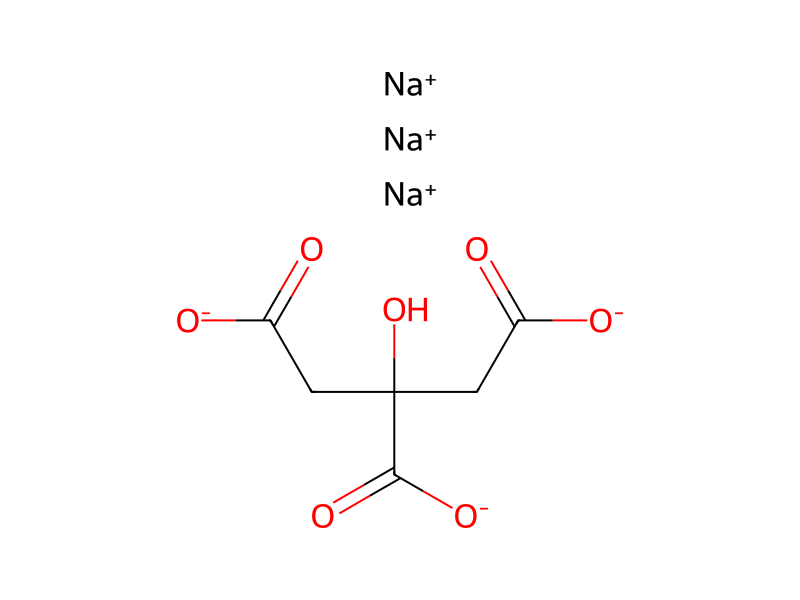
基本情報
- 標準SMILES
O=C([O-])CC(O)(CC(=O)[O-])C(=O)[O-].[Na+].[Na+].[Na+]- InChIKey
HRXKRNGNAMMEHJ-UHFFFAOYSA-K- 分子式
- C6H5Na3O7
- 平均分子量
- 258.07 g/mol
- 単同位体質量
- 257.97283534
概要
Sodium citrate is the trisodium salt of citric acid. It has a role as a flavouring agent and an anticoagulant. It contains a citrate(3-).
名称と識別子
- 優先名称
- Trisodium citrate
- IUPAC
- trisodium;2-hydroxypropane-1,2,3-tricarboxylate
- 英語名
- trisodium 2-hydroxypropane-1,2,3-tricarboxylate
- 分子式
- C6H5Na3O7
- 分子量
- 0
名称と別名
Sodium citrate68-04-2TRISODIUM CITRATENatrocitralCitrosodineCitric acid, trisodium saltTrisodium citrate, anhydroussodium citrate, anhydrousCitnatinCitrosodinaCitrosodnaCitreme
名称をさらに表示
trisodium 2-hydroxypropane-1,2,3-tricarboxylate
trisodium-citrateanhydrous sodium citrateAnhydrous trisodium citrateTrisodium citrate anhydrousSodium citrate (Na3C6H5O7)Sodium citrate,anhydrousNatrii citrasRS7A450LGA
データベース識別子
- CAS
18996-35-5、68-04-2、8055-55-8、994-36-5- PubChem CID
- 6224
- DTXSID
DTXSID2026363- ChEMBL
CHEMBL1355- ChEBI
CHEBI:53258- UNII
- RS7A450LGA
- EC Number
- 200-675-3、213-618-2、686-193-8
- Nikkaji
- J1.168A
物性
構造計算による物性
- 極性表面積
- 141 Ų
- 水素結合供与体数
- 1
- 水素結合受容体数
- 7
- 回転可能結合数
- 2
- 重原子数
- 16
- 形式電荷
- 0
- 複雑度
- 211
実験および物理化学的性質
Chemical Classes
Metals -> Organic Acids, Metal Salts
Metals -> Organic Acids, Metal Salts
Cosmetics
Cosmetic ingredients (Sodium Citrate) -> CIR (Cosmetic Ingredient Review)
Buffering; Chelating
pHBetween 7,5 and 9,0 (5 % aqueous solution)
FragrancesFragrance Ingredient (Sodium citrate) -> IFRA transparency List
Food Additives
COLOR OR COLORING ADJUNCT, EMULSIFIER OR EMULSIFIER SALT, FLAVORING AGENT OR ADJUVANT, MALTING OR FERMENTING AID, NUTRIENT SUPPLEMENT, PH CONTROL AGENT, SEQUESTRANT, STABILIZER OR THICKENER, SURFACE-ACTIVE AGENT -> FDA Substance added to food
Solubility
29.4g/L
White, odorless crystals, granules or powder; cool, saline taste. Stable in air; becomes anhydrous at 150 °C. Sol in 1.3 parts water, 0.6 part boiling water. Insol in alcohol. The aqueous soln is slightly alkaline to litmus; pH about 8; /Dihydrate/
Solubility in water, g/100ml at 25 °C: 42.5
Human Drugs
FDA approved drugs -> Active ingredient
FDA approved drugs -> Active ingredient
Animal DrugsPharmaceuticals -> UK Veterinary Medicines Directorate List
Boiling PointBP: Decomposes at red heat /Dihydrate/
Melting Point>300 °C
Food Contact SubstancesFCS -> FDA Inventory of Food Contact Substances Listed in 21 CFR
Physical Description
CBI; Large Crystals; Other Solid; Dry Powder; Liquid
Crystalline white powder or colourless crystals
White solid; [ICSC]
White odorless solid; [JECFA] White crystalline powder; [Alfa Aesar MSDS]
WHITE GRANULES OR POWDER.
安全と法規制
GHS分類
GHS Classification
This chemical does not meet GHS hazard criteria for 94.3% (1117 of 1184) of all reports.
Not Classified
Aggregated GHS information provided per 1184 reports by companies from 9 notifications to the ECHA C&L Inventory.
This chemical does not meet GHS hazard criteria for 27.7% (41 of 148) of reports.
Warning
H319 (72.3%): Causes serious eye irritation [Warning Serious eye damage/eye irritation]
危険有害性情報
Regulatory Information
Chemical: 1,2,3-Propanetricarboxylic acid, 2-hydroxy-, trisodium salt
Chemical: 1,2,3-Propanetricarboxylic acid, 2-hydroxy-, sodium salt
1,2,3-Propanetricarboxylic acid, 2-hydroxy-, sodium salt (1:3) is listed on the EPA's Chemical Data Reporting (CDR) system. Manufacturers and importers of 1,2,3-Propanetricarboxylic acid, 2-hydroxy-, sodium salt (1:3) are required to report information about their production and use of this chemical to the EPA under the Toxic Substances Control Act (TSCA). (40 eCFR Part 711)
Status: Active Update: 02-05-2023 https://echa.europa.eu/registration-dossier/-/registered-dossier/15303
Trisodium citrate: Does not have an individual approval but may be used under an appropriate group standard
1,2,3-Propanetricarboxylic acid, 2-hydroxy-, sodium salt: Does not have an individual approval but may be used as a component in a product covered by a group standard. It is not approved for use as a chemical in its own right.
Other Safety Information
IMAP assessments - 1,2,3-Propanetricarboxylic acid, 2-hydroxy-, trisodium salt: Environment tier I assessment
IMAP assessments - 1,2,3-Propanetricarboxylic acid, 2-hydroxy-, sodium salt: Human health tier I assessment
Fire HazardsCombustible.
Hazards Summary
Emergency treatment: symptomatic drug ingestion; [HSDB] An eye and respiratory tract irritant; [ICSC] May cause irritation; [MSDSonline] See Citric acid.
Causes convulsions in intraperitoneal lethal-dose studies of mice and rats; [RTECS] Acceptable daily intake (ADI) as food additive not limited; [JECFA] May cause irritation; [Alfa Aesar MSDS] See Citric acid.
FDA Requirements
Manufacturers, packers, and distributors of drug and drug products for human use are responsible for complying with the labeling, certification, and usage requirements as prescribed by the Federal Food, Drug, and Cosmetic Act, as amended (secs 201-902, 52 Stat. 1040 et seq., as amended; 21 U.S.C. 321-392).
Trisodium citrate is a prior sanctioned food ingredient classified as a stabilizer when migrating from food-packaging material.
EPA Safer Chemical
Chemical: Sodium citrate, anhydrous
Chemical: Sodium citrate
Chemical DangersThe solution in water is a weak base.
Hazard Classes and Categories
Eye Irrit. 2 (72.3%)
Not Classified
Not Classified
安全と保護具
Fire FightingUse water spray, powder.
First Aid Measures
Fresh air, rest.
Rinse and then wash skin with water and soap.
First rinse with plenty of water for several minutes (remove contact lenses if easily possible), then refer for medical attention.
Rinse mouth.
Storage ConditionsKEEP WELL CLOSED. /PENTAHYDRATE/
Disposal Methods
SRP: At the time of review, criteria for land treatment or burial (sanitary landfill) disposal practices are subject to significant revision. Prior to implementing land disposal of waste residue (including waste sludge), consult with environmental regulatory agencies for guidance on acceptable disposal practices.
Spillage DisposalSweep spilled substance into covered containers. If appropriate, moisten first to prevent dusting. Wash away remainder with plenty of water.
Eye PreventionWear safety spectacles.
Fire PreventionNO open flames.
Inhalation RiskEvaporation at 20 °C is negligible; a nuisance-causing concentration of airborne particles can, however, be reached quickly when dispersed.
Ingestion PreventionDo not eat, drink, or smoke during work.
Inhalation PreventionUse ventilation (not if powder).
Effects of Short Term ExposureThe substance is irritating to the eyes and respiratory tract.
Protective Action Criteria (PAC)
9.0 [mg/m3]
99 [mg/m3]
590 [mg/m3]
9.3 [mg/m3]
100 [mg/m3]
610 [mg/m3]
毒性情報
Exposure RoutesThe substance can be absorbed into the body by inhalation of its aerosol and by ingestion.
Toxicity SummarySafe in the present practices of use and concentration. Ingredient, concentration, and use information are available in documents discoverable at https://cir-reports.cir-safety.org
Signs and Symptoms
Cough. Sore throat.
Redness.
Non-Human Toxicity ExcerptsNO TERATOGENIC EFFECTS WERE OBSERVED IN SINGLE-COMB WHITE LEGHORN CHICK EMBRYOS AFTER 10.00 MG/EGG SODIUM CITRATE (DISSOLVED IN WATER) WAS INJECTED INTO AIR CELL AT 96 HR OF INCUBATION.
法規制情報
FDA Requirements
Manufacturers, packers, and distributors of drug and drug products for human use are responsible for complying with the labeling, certification, and usage requirements as prescribed by the Federal Food, Drug, and Cosmetic Act, as amended (secs 201-902, 52 Stat. 1040 et seq., as amended; 21 U.S.C. 321-392).
Trisodium citrate is a prior sanctioned food ingredient classified as a stabilizer when migrating from food-packaging material.
化学と産業
薬理情報
ATC Code
B - Blood and blood forming organs
QB - Blood and blood forming organs
PharmacodynamicsCitrate prevents activation of the clotting cascade by chelating calcium ions. Citrate neutralizes acid in the stomach and urine, raising the pH.
Mechanism of Action
Citrate chelates free calcium ions preventing them from forming a complex with tissue factor and coagulation factor VIIa to promote the activation of coagulation factor X. This inhibits the extrinsic initiation of the coagulation cascade. Citrate may also exert an anticoagulant effect via a so far unknown mechanism as restoration of calcium concentration does not fully reverse the effect of citrate. Citrate is a weak base and so reacts with hydrochloric acid in the stomach to raise the pH. It it further metabolized to bicarbonate which then acts as a systemic alkalizing agent, raising the pH of the blood and urine. It also acts as a diuretic and increases the urinary excretion of calcium.
Biological Half-Life18-54 min
Metabolism/Metabolites
Citrate is metabolized to bicarbonate in the liver and plays a role as an intermediate in the citric acid cycle.
IN THE BODY, SODIUM CITRATE IS OXIDIZED TO BICARBONATE...
FDA Pharmacological Classification
SODIUM CITRATE
Anti-coagulant [EPC]; Acidifying Activity [MoA]; Decreased Coagulation Factor Activity [PE]; Calcium Chelating Activity [MoA]; Calculi Dissolution Agent [EPC]
MeSH Pharmacological Classification
Agents that prevent BLOOD CLOTTING.
A chemical system that functions to control the levels of specific ions in solution. When the level of hydrogen ion in solution is controlled the system is called a pH buffer.
Substances capable of inhibiting, retarding or arresting the process of fermentation, acidification or other deterioration of foods.
Absorption, Distribution and Excretion
Tmax of 98-130min.
Largely eliminated through hepatic metabolism with very little cleared by the kidneys.
19-39L.
Total clearance of 313-1107mL/min.
IN THE BODY, SODIUM CITRATE IS OXIDIZED TO BICARBONATE & EXCRETED IN THE URINE...
用途と製造
Uses
CIR ingredient: Sodium Citrate
Used as an emulsifier, acidulant, sequestrant, medication (expectorant, systemic alkalizer, diuretic, sudorific, and anticoagulant), and general purpose additive for foods; Also used in photography, detergents, and electroplating and to remove sulfur dioxide from smelter waste gases; [HSDB]
Electroplating [Category: Plate]
Used as a buffering agent and sequestrant for food; [JECFA] Permitted for use as an inert ingredient in non-food pesticide products; [EPA]
AS A PHARMACEUTIC AID, SODIUM CITRATE IS USED TO PREVENT DARKENING WHEN IRON IS ADDED TO PREPARATIONS CONTAINING TANNIN.
OFFICIALLY RECOGNIZED ONLY FOR ITS USE AS A BLOOD ANTICOAGULANT FOR BLOOD OR PLASMA THAT IS TO BE FRACTIONATED OR FOR BLOOD THAT IS TO BE STORED. THE ANTICOAGULANT EFFECT IS DUE TO THE CONVERSION OF IONIZED CALCIUM IN THE BLOOD TO NONIONIZED CALCIUM CITRATE.
U.S. Production2023: 55,000,000 - <70,000,000 lb
Consumer UsesProcessing aids not otherwise specified
Industry UsesChelating agent
Methods of Manufacturing
USUALLY BY ADDING SODIUM CARBONATE TO A SOLN OF CITRIC ACID UNTIL EFFERVESCENCE CEASES, EVAPORATING, AND GRANULATING THE PRODUCT.
Sodium sulfate soln is treated with calcium citrate, filtered, concentrated and crystallized. /Dihydrate/
Formulations/Preparations
SODIUM CITRATE IS AN INGREDIENT IN ANTICOAGULANT CITRATE DEXTROSE SOLUTION USP; ANTICOAGULANT CITRATE PHOSPHATE DEXTROSE SOLUTION USP; & SODIUM CITRATE & CITRIC ACID SOLUTION USP.
Grades: highest purity, medicinal; pure, commercial, CP; USP; FCC. /Dihydrate/
Household Products
Information on 532 consumer products that contain Sodium citrate (Trisodium citrate) in the following categories is provided:
Information on 54 consumer products that contain Sodium Citrate in the following categories is provided:
Use Classification
EPA Safer Chemical Functional Use Classes -> Chelating Agents;Preservatives and Antioxidants;Processing Aids and Additives
Safer Chemical Classes -> Green circle - The chemical has been verified to be of low concern
EPA Safer Chemical Functional Use Classes -> Chelating Agents;Preservatives and Antioxidants;Processing Aids and Additives
Safer Chemical Classes -> Green circle - The chemical has been verified to be of low concern
Food additives
Fragrance Ingredients
General Manufacturing Information
Soap, Cleaning Compound, and Toilet Preparation Manufacturing
1,2,3-Propanetricarboxylic acid, 2-hydroxy-, sodium salt (1:3): ACTIVE
関連反応
93 件






関連ノート
読み込み中…