
HRID 22441反応物として
Triethyl Citrate
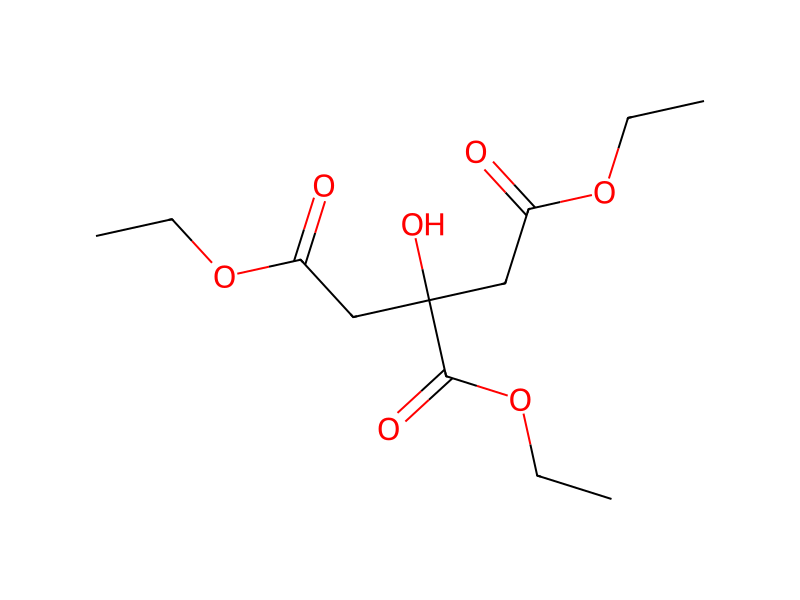
77-93-0CCOC(=O)CC(O)(CC(=O)OCC)C(=O)OCCDOOTYTYQINUNNV-UHFFFAOYSA-NTriethyl citrate is a carbonyl compound.
77-93-0DTXSID0040701CHEMBL464988CHEBI:168426Other Classes -> Other Organic Compounds
Waste-water effluent contaminant
Plastics -> PUR; PVC (soft)
Plastics -> Plasticisers
Cosmetic ingredients (Triethyl Citrate) -> CIR (Cosmetic Ingredient Review)
Solvent; Antioxidant; Plasticiser; Deodorant
Plasticizer
Plasticizer
1.1369 g/cu cm at 20 °C
安全情報は参考情報です。供給元の安全データシート(SDS)、適用法令、専門家による評価に代わるものではありません。
This chemical does not meet GHS hazard criteria for 96.4% (1942 of 2014) of all reports.
Not Classified
Aggregated GHS information provided per 2014 reports by companies from 5 notifications to the ECHA C&L Inventory.
Not Classified
Warning
H332: Harmful if inhaled [Warning Acute toxicity, inhalation]
Chemical: 1,2,3-Propanetricarboxylic acid, 2-hydroxy-, triethyl ester
1,2,3-Propanetricarboxylic acid, 2-hydroxy-, 1,2,3-triethyl ester is listed on the EPA's Chemical Data Reporting (CDR) system. Manufacturers and importers of 1,2,3-Propanetricarboxylic acid, 2-hydroxy-, 1,2,3-triethyl ester are required to report information about their production and use of this chemical to the EPA under the Toxic Substances Control Act (TSCA). (40 eCFR Part 711)
REACH registered substance: Triethyl citrate (EC: 201-070-7)
Ethyl citrate: Does not have an individual approval but may be used under an appropriate group standard
Safe when used as a flavoring agent in food; [JECFA] Effects in lethal-dose studies include somnolence, ataxia, and convulsions; [RTECS] An eye and respiratory tract irritant; [ICSC] May cause irritation; Effects in high-dose animal studies include convulsions; [MSDSonline]
Triethyl citrate is hydrolyzed in vivo to citric acid and ethanol. Triethyl citrate appeared to be hydrolyzed at a slower rate with human serum compared to rat serum.
Samples of freshly collected rat or human serum were spiked with triethyl citrate and the disappearance of the triethyl citrate measured over a 4 hr period. Triethyl citrate was rapidly hydrolysed by rat serum (15 min), but hydrolysisoccurred at a much slower rate in human serum and was not complete at the end of the 4 hr test period.
Rat-, mouse- and human-liver homogenates as well as serum enzymes hydrolyse triethyl citrate to 1 mol citric acid and 3 mol ethanol/mol ester.
/Triethyl citrate/ is expected to be extensively metabolized by esterases and cytochrome P450 enzymes and break-down in the beta-oxidation or citric acid cycle or in cases subsequent glucuronidation. The substance is assumed to be excreted (if not metabolized completely in beta-oxidation and citric cycle) as metabolites (i.e. conjugates with glucuronic acid) via urine and to a lower extent via bile.
In order to assess the toxicological behavior of triethyl citrate, the available experimental and predicted physico-chemical data have been evaluated. The substance is expected to be absorbed very well. The absorption of any metabolite of the substances of interest is fast and complete. Concerning the absorption after exposure via inhalation, as the chemical has a low vapor pressure, it is clear, that the substance is poorly available after inhalation. Given its lipophilicity (LogPow 1.17) - if absorbed - it is expected to be absorbed directly across the respiratory tract epithelium. The substance is expected to be also poorly absorbed following dermal exposure into the stratum corneum and to a certain extent into the epidermis, due to its molecular weight and its LogPow. In addition, the systemic toxicity via the skin is assumed to be low and this has been proven with the results of the acute dermal study with triethyl citrate, in which a LD50 of 5000 mg/kg bw has been obtained. Concerning the distribution in the body, triethyl citrate is expected to be mainly available in the circulatory system (due to its water solubility). The experimentally determined LogPow value, the water solubility and predicted behavior concerning absorption of the substance triethyl citrate do not indicate a potential for accumulation.


Relative density (water = 1): 1.1
1.138-1.139
化学的特性Triethyl citrate is a clear, viscous, odorless, and practically colorless, hygroscopic liquid.
An ingredient whose use in food or food packaging is subject to a prior sanction or approval within the meaning of section 201(s)(4) of the Act is exempt from classification as a food additive. ... Substances classified as plasticizers, when migrating from food-packaging material shall include ... triethyl citrate.
Substance added directly to human food affirmed as generally recognized as safe (GRAS).
Unless specifically excluded, residues resulting from the use of the following substance as either an inert or an active ingredient in a pesticide chemical formulation, including antimicrobial pesticide chemicals, is exempted from the requirement of a tolerance under FFDCA section 408, if such use is in accordance with good agricultural or manufacturing practices. Citric acid, triethyl ester is included on this list.
Not Classified
Not Classified
Fresh air, rest.
Remove contaminated clothes. Rinse skin with plenty of water or shower.
First rinse with plenty of water for several minutes (remove contact lenses if easily possible), then refer for medical attention.
Rinse mouth. Give one or two glasses of water to drink.
Suitable extinguishing media: Use water spray, alcohol-resistant foam, dry chemical or carbon dioxide.
Advice for firefighters: Wear self contained breathing apparatus for fire fighting if necessary.
Use dry chemical, carbon dioxide.
Accidental release measures: Personal precautions, protective equipment and emergency procedures: Use personal protective equipment. Avoid breathing vapors, mist or gas. Ensure adequate ventilation.; Environmental precautions: Do not let product enter drains.; Methods and materials for containment and cleaning up: Soak up with inert absorbent material and dispose of as hazardous waste. Keep in suitable, closed containers for disposal.
SRP: Recycle any unused portion of the material for its approved use or return it to the manufacturer or supplier. Ultimate disposal of the chemical must consider: the material's impact on air quality; potential migration in air, soil or water; effects on animal, aquatic and plant life; and conformance with environmental and public health regulations. If it is possible or reasonable use an alternative chemical product with less inherent propensity for occupational harm/injury/toxicity or environmental contamination.
Product: Offer surplus and non-recyclable solutions to a licensed disposal company. Contaminated packaging: Dispose of as unused product.
Precautions for safe handling: Avoid contact with skin and eyes. Avoid inhalation of vapor or mist. Normal measures for preventive fire protection.
Appropriate engineering controls: Handle in accordance with good industrial hygiene and safety practice. Wash hands before breaks and at the end of workday.
Gloves must be inspected prior to use. Use proper glove removal technique (without touching glove's outer surface) to avoid skin contact with this product. Dispose of contaminated gloves after use in accordance with applicable laws and good laboratory practices. Wash and dry hands.
TERRESTRIAL FATE: Based on a classification scheme(1), an estimated Koc value of 20(SRC), determined from a structure estimation method(2), indicates that triethyl citrate is expected to have very high mobility in soil(SRC). Volatilization of triethyl citrate from moist soil surfaces is not expected to be an important fate process(SRC) given an estimated Henry's Law constant of 3.8X10⁻⁹ atm-cu m/mole(SRC) based upon its vapor pressure, 6.87X10⁻⁴ mm Hg(3), and water solubility, 6.5X10+4 mg/L(5). Triethyl citrate is not expected to volatilize from dry soil surfaces(SRC) based upon its vapor pressure(4). Biodegradation data in soil were not available(SRC, 2015). Based on data for acetyl tributyl citrate, a structural analog, triethyl citrate may be expected to biodegrade rapidly(SRC). Utilizing the Japanese MITI test acetyl tributyl citrate, present at 100 mg/L, reached 82% of its theoretical BOD in 4 weeks using an activated sludge inoculum at 30 mg/L(5) suggesting that biodegradation of triethyl citrate may be an important environmental fate process in soil(SRC).
AQUATIC FATE: Based on a classification scheme(1), an estimated Koc value of 20(SRC), determined from a structure estimation method(2), indicates that triethyl citrate is not expected to adsorb to suspended solids and sediment(SRC). Volatilization from water surfaces is not expected(3) based upon an estimated Henry's Law constant of 3.8X10⁻⁹ atm-cu m/mole(SRC) derived from its vapor pressure, 6.87X10⁻⁴ mm Hg(4), and water solubility, 6.5X10+4 mg/L(5). According to a classification scheme(6), an estimated BCF of 3(SRC), from an estimated log Kow of 0.33(2) and a regression-derived equation(2), suggests the potential for bioconcentration in aquatic organisms is low(SRC). Biodegradation data in water were not available(SRC, 2015). Based on data for acetyl tributyl citrate, a structural analog, triethyl citrate may be expected to biodegrade rapidly(SRC). Utilizing the Japanese MITI test acetyl tributyl citrate, present at 100 mg/L, reached 82% of its theoretical BOD in 4 weeks using an activated sludge inoculum at 30 mg/L(7) suggesting that biodegradation of triethyl citrate may be an important environmental fate process in water(SRC).
ATMOSPHERIC FATE: According to a model of gas/particle partitioning of semivolatile organic compounds in the atmosphere(1), triethyl citrate, which has a vapor pressure of 6.87X10⁻⁴ mm Hg at 25 °C(2), is expected to exist solely as a vapor in the ambient atmosphere. Vapor-phase triethyl citrate is degraded in the atmosphere by reaction with photochemically-produced hydroxyl radicals(SRC); the half-life for this reaction in air is estimated to be 4 days(SRC), calculated from its rate constant of 7.3X10⁻¹² cu cm/molecule-sec at 25 °C(SRC) that was derived using a structure estimation method(3). Triethyl citrate does not contain chromophores that absorb at wavelengths >290 nm(4) and, therefore, is not expected to be susceptible to direct photolysis by sunlight(SRC).
Safe in the present practices of use and concentration. Ingredient, concentration, and use information are available in documents discoverable at https://cir-reports.cir-safety.org
IDENTIFICATION AND USE: Triethyl citrate is a colorless, oily liquid with bitter taste. It is used as solvent and plasticizer for nitrocellulose and natural resins, softener, paint removers, agglutinant, perfume base, food additive (not over 0.25%) as an emulsifier and as a flavor-preserving agent. HUMAN EXPOSURE AND TOXICITY: Triethyl citrate 20% in petrolatum was not a primary irritant or sensitizer in human studies. ANIMAL STUDIES: Triethyl citrate, applied undiluted during epidermal induction, was a strong sensitizer in a guinea pig maximization test. Triethyl citrate 33.3% produced irritation in rabbit eyes. Intravenous administration of a 100 mg/kg bw dose of triethyl citrate to rabbits produced a marked increase in motor activity and respiration. A group of 20 mice given intraperitoneal doses of 350 mg/kg bw of triethyl citrate daily for 14 days had a slightly lower mean growth rate than control animals. No differences were seen in the two groups in erythrocyte and leucocyte blood cell count, clotting time and hemoglobin levels. Examination of the liver, lung and kidney tissues of two animals at necropsy revealed no pathological cellular changes. At doses ranging from 0.5 to 10 mg/kg b.w. triethyl citrate was nonteratogenic in the chicken embryo. Ames test using triethyl citrate (0.4%-1.6%) on Salmonella typhimurium TA1535, TA1537, TA1538 was negative with and without metabolic activation.
Cough.
Redness.
Vomiting.
EPA has released the first beta version (version 0.5) of the Interactive Chemical Safety for Sustainability (iCSS) Dashboard. The beta version of the iCSS Dashboard provides an interactive tool to explore rapid, automated (or in vitro high-throughput) chemical screening data generated by the Toxicity Forecaster (ToxCast) project and the federal Toxicity Testing in the 21st century (Tox21) collaboration. /The title compound was tested by ToxCast and/or Tox21 assays; Click on the "Chemical Explorer" button on the tool bar to see the data./[USEPA; ICSS Dashboard Application; Available from, as of April 22, 2015: http://actor.epa.gov/dashboard/]
Triethyl citrate was identified in the column inflow at the beginning of an experiment on May 29, 2001 below the reporting limit of 0.500 ug/L but reported as 0.200 ug/L and at the end of the experiment Jun 20, 2001 concentrations were reported as below the reporting limit of 0.500 ug/L. The concentration in the column drainage at the end of the experiment Jun 20, 2001 was also below the reporting limit of 0.500 ug/L(1). Treated effluent was applied to the top of a 2.4 meter soil column over 23 days. The soil was packed with a Mohall-Laveen sandy loam from an area northwest of Phoenix, AZ with no known history of cultivation or irrigation. Secondarily treated effluent from a 17.5 million gallon/day municipal waste water treatment plant serving 120,000-150,000 residents near Phoenix, AZ was employed(1). Triethyl citrate was identified in effluent samples that receive domestic waste waters of 50,000 inhabitants of Southern Finland(2). Triethyl citrate was detected (reporting limit 0.5 ug/L) at a median concentration of 0.270 ug/L and a maximum of 0.52 ug/L with a detection frequence of 100% in water samples from 10 waste water treatment plants located around the country (Arizona, Colorado, Georgia, Iowa, Kansas, Minnesota, Nevada, New Jersey, New York, South Dakota)(3). Triethyl citrate was detected (reporting limit 0.5 ug/L) at a median concentration of 0.105 ug/L and a maximum of 0.400 ug/L with a detection frequence of 100% in water samples downstream (96 to 14,484 meters)and at a median concentration of 0.082 ug/L and a maximum of 0.26 ug/L with a detection frequency of 70% in water samples downstream (805 to 96,561 meters) from 10 waste water treatment plants located around the country (Arizona, Colorado, Georgia, Iowa, Kansas, Minnesota, Nevada, New Jersey, New York, South Dakota)(3).
Using a structure estimation method based on molecular connectivity indices(1), the Koc of triethyl citrate can be estimated to be 20(SRC). According to a classification scheme(2), this estimated Koc value suggests that triethyl citrate is expected to have very high mobility in soil.
/HUMAN EXPOSURE STUDIES/ Triethyl citrate 20% in pet (petrolatum) was not a primary irritant or sensitizer in human studies.
/OTHER TOXICITY INFORMATION/ Due to its sensitizing potential ... triethyl citrate /is not considered/ to be a suitable substitute for phthalates as plasticizers in children's toys.
AEROBIC: Biodegradation data in soil and water were not available for triethyl citrate(SRC, 2015). Based on data for acetyl tributyl citrate (CAS 77-90-7), a structural analog, triethyl citrate is expected to biodegrade rapidly(SRC). Utilizing the Japanese MITI test acetyl tributyl citrate, present at 100 mg/L, reached 82% of its theoretical BOD in 4 weeks using an activated sludge inoculum at 30 mg/L(1).
An ingredient whose use in food or food packaging is subject to a prior sanction or approval within the meaning of section 201(s)(4) of the Act is exempt from classification as a food additive. ... Substances classified as plasticizers, when migrating from food-packaging material shall include ... triethyl citrate.
Substance added directly to human food affirmed as generally recognized as safe (GRAS).
Unless specifically excluded, residues resulting from the use of the following substance as either an inert or an active ingredient in a pesticide chemical formulation, including antimicrobial pesticide chemicals, is exempted from the requirement of a tolerance under FFDCA section 408, if such use is in accordance with good agricultural or manufacturing practices. Citric acid, triethyl ester is included on this list.
CIR ingredient: Triethyl Citrate
Used as plasticizer (cellulose acetate, cellulose nitrate, vinyl acetate, natural resins, and hair fixative finishing sprays), softener, agglutinant, perfume base, food emulsifier, and flavor preserving agent; Also used in paint removers and for treatment of bloat in ruminants; [HSDB]
Dressing Hair [Category: Other]
Solvent and plasticizer for nitrocellulose and natural resins, softener, paint removers, agglutinant, perfume base, food additive (not over 0.25%).
MEDICATION (VET)
Used as a plasticizer and solvent for cellulose nitrate, cellulose acetate, and cellulose ethers. It can also be used as a plasticizer for PVC. It has been used as a solvent, in paint removers, in emulsifiers in food industry, and as a flavor-preserving agent.
2023: 8,500,000 - <10,000,000 lb
(1975) PROBABLY GREATER THAN 4.54X10+5 GRAMS
Production volume for non-confidential chemicals reported under the 2006 Inventory Update Rule. Chemical: 1,2,3-Propanetricarboxylic acid, 2-hydroxy-, 1,2,3-triethyl ester. Aggregated National Production Volume: 1 to < 10 million pounds.
Non-confidential 2012 Chemical Data Reporting (CDR) information on the production and use of chemicals manufactured or imported into the United States. Chemical: 1,2,3-Propanetricarboxylic acid, 2-hydroxy-, 1,2,3-triethyl ester. National Production Volume: 1,000,000 - 10,000,000 lb/yr.
EPA Safer Chemical Functional Use Classes -> Solvents
Safer Chemical Classes -> Yellow triangle - The chemical has met Safer Choice Criteria for its functional ingredient-class, but has some hazard profile issues
Food additives
Fragrance Ingredients
Flavouring Agent -> FLAVOURING_AGENTFood Additives -> CARRIER_SOLVENT; SEQUESTRANT -> JECFA Functional Classes
Flavoring Agents -> JECFA Flavorings Index
Paint and Coating Manufacturing
1,2,3-Propanetricarboxylic acid, 2-hydroxy-, 1,2,3-triethyl ester: ACTIVE
天然物の起源Reported found in Morello cherry, sour cherry and red currant. Also reported found in raw cabbage and white wine.
使用Triethyl Citrate is a sequestrant that is an oily liquid, slightly solu- ble in water. it is found in lemon drinks.
一般的な説明Triethyl citrate is a safe direct food additive.
Triethyl citrate is prepared by the esterification of citric acid and ethanol in the presence of a catalyst.
製造方法By esterification of ethyl alcohol with citric acid.
定義本品は、クエン酸(*)とエタノール(*)とのトリエステルであり、次の化学式で表される。参照表示名称:クエン酸, エタノール