アントロン
Anthrone
データを補完しています。しばらくしてからページを更新すると最新の内容を表示できます
基本情報
- CAS
90-44-8- 標準SMILES
O=C1c2ccccc2Cc2ccccc21- InChIKey
RJGDLRCDCYRQOQ-UHFFFAOYSA-N- 分子式
- C14H10O
- 平均分子量
- 194.23 g/mol
- 単同位体質量
- 194.07316494
概要
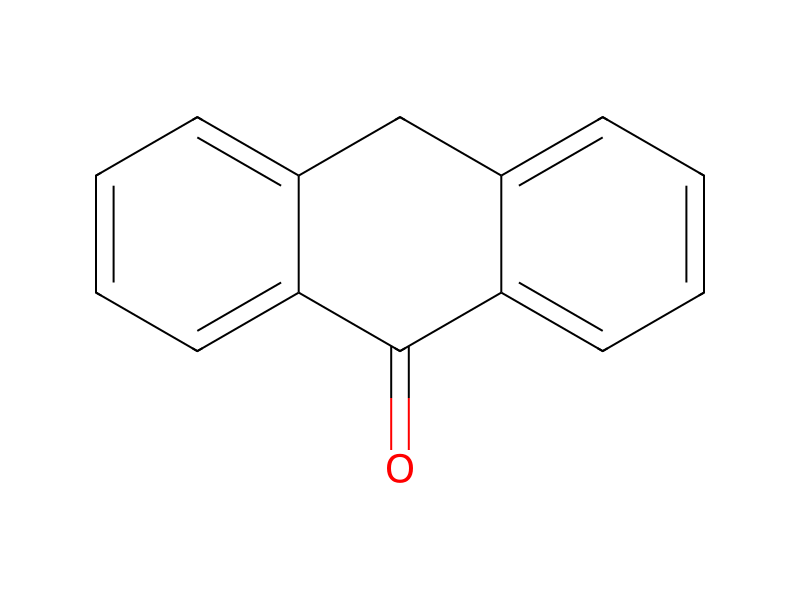
Anthrone is a member of the class of anthracenes that is 9,10-dihydroanthracene carrying an oxo group at C-9. It has a role as a radical scavenger. It is a tautomer of a 9-anthrol.
名称と識別子
- 優先名称
- Anthrone
- IUPAC
- 10H-anthracen-9-one
- 現地名
- アントロン
- 英語名
- Anthrone
- 分子式
- C14H10O
- 分子量
- 194.23
名称と別名
ANTHRONE90-44-89(10H)-AnthracenoneCarbothroneanthracen-9(10H)-oneAnthranone9-Oxoanthracene9,10-Dihydro-9-oxoanthraceneAnthracene, 9,10-dihydro-9-oxo-DTXSID1049431FP0FJ7K744CHEBI:33835
名称をさらに表示
アントロンアンスロンAnthron(10H)-9-AnthracenoneAnthroneGrANTHRACENONEAnthrone,97%
NSC-1965DTXCID0029391RefChem:113082201-994-010H-anthracen-9-oneAz-OMFCD000011879,10-DIHYDROANTHRACEN-9-ONE
データベース識別子
- CAS
90-44-8- PubChem CID
- 7018
- DTXSID
DTXSID1049431- ChEMBL
CHEMBL124440- ChEBI
CHEBI:33835- UNII
- FP0FJ7K744
- EC Number
- 201-994-0
- Nikkaji
- J3.916K
物性
構造計算による物性補完中
- XLogP
- 3.7
- 極性表面積
- 17.1 Ų
- 水素結合供与体数
- 0
- 水素結合受容体数
- 1
- 回転可能結合数
- 0
- 重原子数
- 15
- 形式電荷
- 0
- 複雑度
- 234
実験および物理化学的性質
PolymersOther Classes -> Polycyclic Aromatic Hydrocarbons
SpringerMaterials PropertiesAngular frequency
LogP
Log Kow = 3.66
3.46
Color/Form
ORTHORHOMBIC NEEDLES FROM BENZENE AND PETROLEUM ETHER
COLORLESS NEEDLES
Solubility
SOL IN MOST ORG SOLVENTS WITHOUT FLUORESCENCE
SOL IN ACETONE, HOT BENZENE, CONCN SULFURIC ACID, HOT DIL ALKALI
Melting Point155 °C
Vapor Pressure0.0000183 [mmHg]
Physical DescriptionColorless solid; [Hawley] Colorless crystalline powder; [Alfa Aesar MSDS]
Stability/Shelf LifeTENDENCY TO CHANGE TO ANTHRAQUINONE /IN SOLN/
Other Experimental Properties
ANY FLUORESCENCE PRESENT IS DUE TO ANTHRANOL
ADDITION CMPD WITH 4 MOLECULES DESOXYCHOLIC ACID, C110-H170-O17, MP 179 °C
EQUIL IN ABSOLUTE ALCOHOL: 89% ANTHRONE; 11% ANTHRANOL; TENDENCY TO CHANGE TO ANTHRAQUINONE
物理化学的性質
- 融点
- 154 · 154-157 °C (lit.)
- 沸点
- 721 °C · 721 °C
- 比重(密度)
- 1.055 · 1.0550 (rough estimate)
- 屈折率
- 1.55 · 1.5500 (estimate)
- 貯蔵温度
- 2 · 2-8°C
- 溶解性
- 不溶性
- 外見
- 粉
- 色
- 黄色
- 水溶解度
- 不溶性
- Merck
- 14 · 14,691
- BRN
- 1910173 · 1910173
- Henry's Law Constant
- 1.2 · 1.2×101 mol/(m3Pa) at 25℃, HSDB (2015)
- 安定性
- 安定。強力な酸化剤とは相容れない。可燃性。
- 主な用途
- 診断アッセイの製造血液学組織学
- InChI
- 1S/C14H10O/c15-14-12-7-3-1-5-10(12)9-11-6-2-4-8-13(11)14/h1-8H,9H2
- InChIKey
- RJGDLRCDCYRQOQ-UHFFFAOYSA-N
- SMILES
- O=C1c2ccccc2Cc3ccccc13
- CAS データベース
- 90 · 90-44-8(CAS DataBase Reference)
- NISTの化学物質情報
- Anthrone(90-44-8)
- EPAの化学物質情報
- 9 · 9(10H)-Anthracenone (90-44-8)
化学的性質
化学的特性off-white to light yellow crystals
安全と法規制
安全情報は参考情報です。供給元の安全データシート(SDS)、適用法令、専門家による評価に代わるものではありません。
GHS分類
GHS Classification
This chemical does not meet GHS hazard criteria for 3.9% (2 of 51) of reports.
Warning
H315 (96.1%): Causes skin irritation [Warning Skin corrosion/irritation]
P261, P264, P264+P265, P271, P280, P302+P352, P304+P340, P305+P351+P338, P319, P321, P332+P317, P337+P317, P362+P364, P403+P233, P405, and P501 (click each P-code to see the statement)
Aggregated GHS information provided per 51 reports by companies from 9 notifications to the ECHA C&L Inventory. Each notification may be associated with multiple companies.
危険有害性情報
Regulatory Information
Chemical: 9(10H)-Anthracenone
9(10H)-Anthracenone: Does not have an individual approval but may be used under an appropriate group standard
Hazards SummaryA skin and severe eye irritant; [Alfa Aesar MSDS] See POLYCYCLIC AROMATIC HYDROCARBONS.
Hazard Classes and CategoriesSkin Irrit. 2 (96.1%)
安全と保護具
Disposal Methods
SRP: At the time of review, criteria for land treatment or burial (sanitary landfill) disposal practices are subject to significant revision. Prior to implementing land disposal of waste residue (including waste sludge), consult with environmental regulatory agencies for guidance on acceptable disposal practices.
毒性情報
Environmental Fate
TERRESTRIAL FATE: Based on a recommended classification scheme(1), an estimated Koc value of 2300(SRC), determined from a measured log Kow(2) and a recommended regression-derived equation(3), indicates that anthrone will have only slight mobility in soil(SRC). Biodegradation of anthrone is expected based on limited data and may be a major fate process for this compound in soil(SRC). A mixed bacterial population, isolated from a hydrocarbon-polluted creek, degraded 40% of anthrone to traces of anthrone and to anthraquinone in 30% yield(4). Anthrone's estimated values for vapor pressure(5) and Henry's Law constant(6,SRC) indicate that volatilization from dry and moist soil surfaces is not likely to be a major fate process for this compound(SRC).
AQUATIC FATE: Based on a recommended classification scheme(1), an estimated Koc value of 2300(SRC), determined from a measured log Kow(2) and a recommended regression-derived equation(3), indicates that anthrone should adsorb to sediment and suspended solids(SRC). Anthrone may volatilize slowly from water surfaces based on an estimated Henry's Law constant of 7.9X10⁻⁷ atm-cu m/mole(SRC), developed using a fragment constant estimation method(4). Estimated half-lives for a model river and model lake are 65 and 480 days, respectively(3,SRC). An estimated BCF value of 360(3,SRC), from a measured log Kow(2), suggests that anthrone will bioconcentrate in aquatic organisms(SRC), according to a recommended classification scheme(5).
ATMOSPHERIC FATE: According to a suggested classification scheme(1), an estimated vapor pressure of 1.8X10⁻⁵ mm Hg at 25 °C(2,SRC) indicates that anthrone will exist in both the vapor and particulate phases in the ambient atmosphere. Vapor-phase anthrone is degraded in the atmosphere by reaction with photochemically produced hydroxyl radicals(SRC); the half-life for this reaction in air is estimated to be about 40 hours(3,SRC). Particulate-phase anthrone may be physically removed from the air by dry deposition(SRC).
Animal ConcentrationsSnails, Thais haemostoma, which had been collected from two areas offshore in Pensacola Bay, FL near an onshore hazardous-waste site contained anthrone/phenanthrone at unreported concentrations(1).
Effluent Concentrations
Several unspecified isomers of anthrone were detected in chlorinated coal-tar leachate at unreported concentrations(1). A heavy-duty diesel exhaust particulate sample, NBS SRM 1650, contained anthrone at unreported concentrations(2). Diesel emission particulates, collected from a Volkswagen Rabbit contained anthrone(3). Fine particle emissions from the combined exhaust of a vented natural gas-fired residential space heater plus a water heater contained 21.4 pg/kJ anthrone(4).
Soil Adsorption/Mobility
The Koc of anthrone is estimated as approximately 2300(SRC), using a measured log Kow of 3.66(1) and a regression-derived equation(2,SRC). According to a recommended classification scheme(3), this estimated Koc value suggests that anthrone has only slight mobility in soil(SRC).
Atmospheric ConcentrationsREMOTE: Anthrone was found on aerosols from the southern North Atlantic Ocean, at a mean concentration of 0.47 ng/cu m(1).
Artificial Pollution SourcesAnthrone's production and use in organic synthesis and as a general reagent for carbohydrates(1) may result in its release to the environment through various waste streams(SRC).
Sediment/Soil Concentrations
Superficial marine sediments of Cortiou Creek, in the sewage area of Marseilles, France, are contaminated with anthrone at concentrations ranging from non-detectable to 300 ng/g (9 of 10 sites had measurable quantities of anthrone; detection limit not given)(1).
Environmental Bioconcentration
An estimated BCF value of 360 was calculated for anthrone(SRC), using a measured log Kow of 3.66(1) and a recommended regression-derived equation(2). According to a recommended classification scheme(3), this BCF value suggests that bioconcentration in aquatic organisms will be an important fate process(SRC).
Volatilization from Water/Soil
The Henry's Law constant for anthrone is estimated as 7.9X10⁻⁷ atm-cu m/mole(SRC) using a fragment constant estimation method(1). This value indicates that anthrone will slowly volatilize from water surfaces(2,SRC). Based on this Henry's Law constant, the volatilization half-life from a model river (1 m deep, flowing 1 m/sec, wind velocity of 3 m/sec) is estimated as approximately 65 days(2,SRC). The volatilization half-life from a model lake (1 m deep, flowing 0.05 m/sec, wind velocity of 0.5 m/sec) is estimated as approximately 480 days(2,SRC). Anthrone's values for vapor pressure(3) and Henry's Law constant(1,SRC) indicate that volatilization from dry and moist soil surfaces is not likely to be a major fate process for this compound(SRC).
Environmental Abiotic Degradation
The rate constant for the vapor-phase reaction of anthrone with photochemically produced hydroxyl radicals has been estimated as 9.8X10⁻¹² cu cm/molecule-sec at 25 °C(SRC) using a structure estimation method(1,SRC). This corresponds to an atmospheric half-life of about 40 hours at an atmospheric concentration of 5X10+5 hydroxyl radicals per cu cm(1,SRC).
Probable Routes of Human ExposureNIOSH (NOES Survey 1981-1983) has statistically estimated that 28 workers are potentially exposed to anthrone in the USA(1).
Environmental Water ConcentrationsDRINKING WATER: Two samples of Ottawa drinking water, one collected in January and the other in February 1978, contained non-detectable (detection limit not reported) and 1.4 ng/L anthrone, respectively(1).
安全データ
- F
- 8
- wgk
- 3
- tsca
- TSCA listed
- rtecs
- CB8925500
- 毒性
- mmo-sat 60 mg/plate MUREAV 157,149,85
- hs_code
- 29143990
- risk_code
- 36/37/38-20/21/22
- hazard_code
- Xi,Xn
- safety_code
- 26-36
- Hazard Classifications
- Eye Irrit. 2Skin Irrit. 2STOT SE 3
- ストレージクラス
- 11 - Combustible Solids
- 有毒物質データの
- 90-44-8(Hazardous Substances Data)
化学と産業
薬理情報
Metabolism/MetabolitesYIELDS ANTHRAQUINONE & 9-HYDROXYANTHRACENE IN RATS. /FROM TABLE/
用途と製造
Uses
Used in the colorimetric determination of sugar and animal starch in body fluids, as a general reagent for carbohydrates, in the determination of animal starch in liver tissue, and in organic synthesis; [HSDB]
IN COLORIMETRIC DETERMINATION OF SUGAR AND ANIMAL STARCH IN BODY FLUIDS; IN ORG SYNTHESIS
GENERAL REAGENT FOR CARBOHYDRATES; DETERMINATION OF ANIMAL STARCH IN LIVER TISSUE
Derivatives: melitracen
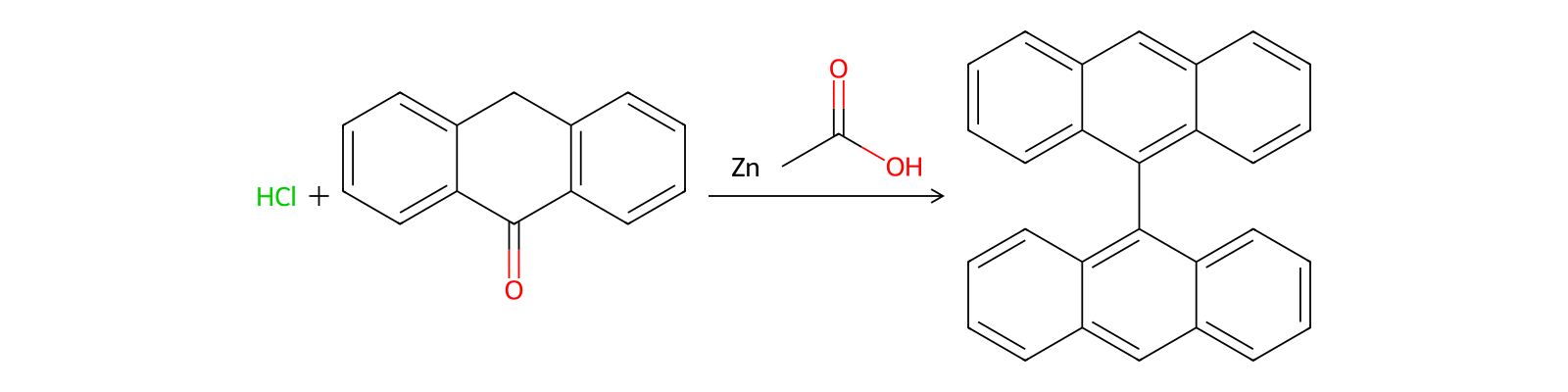
Methods of ManufacturingFROM ANTHRAQUINONE BY REDN WITH TIN, GLACIAL ACETIC ACID AND HYDROCHLORIC ACID. BY CYCLIZATION OF O-BENZYLBENZOIC ACID WITH LIQ HF.
General Manufacturing Information9(10H)-Anthracenone: ACTIVE
応用分野
解説アントロン結晶.融点154 ℃.ベンゼンに熱時溶ける.水酸化アルカリ水溶液には溶けないが,加熱すると9-アントロールになって溶ける.容易に酸化されてアントラキノンとなり,また種々のアルデヒドと縮合する.いわゆるアントロン系建染め染料の原料となり,また糖の定量,検出にも用いられる.森北出版「化学辞典(第2版)
用途糖の検出、定量に利用される。
用途糖の検出、定量用。
用途アントロン(anthrone)は、三環式の芳香族ケトンである。セルロースの化学分析や、炭水化物の比色測定に使われる。
使用Anthrone is a tricyclic aromatic ketone and related compound of anthracene. Anthrone is used as a reagent in the colorometric determination of carbohydrates.
一般的な説明Anthrone has the ability to reduce aldehyde containing reducing sugars such as streptose and N-acetyl glucosamine present in streptomycin, into acids. It develops a red- violet color. Therefore, it is used to determine streptomycin quantitatively. Anthrone has been used to detect carbohydrate containing lipids and to measure sugar content such as sucrose and trehalose in the liquid medium.
調製方法
純化方法This stable keto tautomer of 9-anthranol (above) provides yellow crystals from a 3:1 mixture of *C6H6/pet ether (b 60-80o) (10-12mL/g), or successively from *C6H6 then EtOH. Dry it in vacuo. [Meyer Org Synth Coll Vol I 60 1941, Beilstein 6 IV 4930.]
上流・下流製品情報
上流原料
下流製品
補足説明
定義ChEBI: A member of the class of anthracenes that is 9,10-dihydroanthracene carrying an oxo group at C-9.
関連反応
22 件


化合物ノート
読み込み中…