ホームMCPワークベンチSkills
ホームワークベンチ通知マイページ
llms.txt · MCPガイドプライバシーポリシー · 利用規約 · サポートv1.8.0
  1. ホーム
  2. /化合物

2,4-ジニトロアニリン

2,4-Dinitroaniline

HCID 7321
ノートを作成反応を作成見積依頼を出す
印刷プレビュー

データを補完しています。しばらくしてからページを更新すると最新の内容を表示できます

基本情報概要名称と識別子物性安全と法規制化学と産業関連反応化合物ノート
部分構造検索類似構造を探す

基本情報

CAS
97-02-9
標準SMILES
Nc1ccc([N+](=O)[O-])cc1[N+](=O)[O-]
InChIKey
LXQOQPGNCGEELI-UHFFFAOYSA-N
分子式
C6H5N3O4
平均分子量
183.12 g/mol
単同位体質量
183.02800564

概要

2,4-dinitroaniline appears as yellow powder or crystals with a musty odor. Sinks in water. (USCG, 1999)

名称と識別子

優先名称
2,4-Dinitroaniline
IUPAC
2,4-dinitroaniline
現地名
2,4-ジニトロアニリン
英語名
2,4-Dinitroaniline
分子式
C6H5N3O4
分子量
183.12

名称と別名

2,4-DINITROANILINE97-02-9Benzenamine, 2,4-dinitro-2,4-Dinitrobenzenamine1-Amino-2,4-dinitrobenzene2,4-Dinitroanilin2,4-Dinitroanilina2,4-Dinitraniline2,4-DinitrophenylamineAniline, 2,4-dinitro-2,4-dinitroaminobenzeneDTXSID1021823
名称をさらに表示
2,4-ジニトロアニリン2,4-ジニトロベンゼンアミン(2,4-ジニトロフェニル)アミン2,4ジニトロアニリン」2,4ジニトロアニリンジニトロアニリン2,4‐ジニトロアニリン2,4-Dinitroaniline,~99%2.4-Dinitr2,4-DinitroaniL2,4-Nitroaniline4-Dinitroanilinedinitro-2,4aniline2,4-dinitro-anilin
5BI780R6W6NSC-8731DTXCID501823CHEBI:34242RefChem:82564202-553-5NCI-C60753NSC 8731

データベース識別子

CAS
97-02-9
PubChem CID
7321
DTXSID
DTXSID1021823
ChEMBL
CHEMBL354318
ChEBI
CHEBI:34242
UNII
5BI780R6W6
EC Number
202-553-5
Nikkaji
J3.975F

物性

構造計算による物性補完中

XLogP
1
極性表面積
118 Ų
水素結合供与体数
1
水素結合受容体数
5
回転可能結合数
0
重原子数
13
形式電荷
0
複雑度
221

実験および物理化学的性質

Chemical ClassesNitrogen Compounds -> Other Aromatics (Nitrogen)
SpringerMaterials PropertiesChemical shift
LogP · 2 件

1.84 (estimated)

1.9

OdorMusty odor
Density · 4 件

1.615 at 59 °F (USCG, 1999) - Denser than water; will sink

1.615 g/ml @ 14 °C

1.62 g/cm³

1.615 @25 °C

Color/FormYELLOW NEEDLES FROM DIL ACETONE, GREENISH-YELLOW PLATES FROM ALCOHOL.
Solubility · 4 件

less than 0.1 mg/mL at 73 °F (NTP, 1992)

SOL IN HOT HYDROCHLORIC ACID

PRACTICALLY INSOL IN COLD WATER; VERY SPARINGLY SOL IN BOILING WATER; 5.8 PARTS SOL IN 100 PARTS 88% ALCOHOL @ 18 °C; 1 PART SOL IN 132.6 PARTS OF 95% ALCOHOL @ 21 °C

Solubility in water: none

Flash Point · 4 件

435 °F (NTP, 1992)

223 °C

435 °F (CLOSED CUP)

222-224 °C c.c.

Boiling Point56.7 °C

安全と法規制

安全情報は参考情報です。供給元の安全データシート(SDS)、適用法令、専門家による評価に代わるものではありません。

GHS分類

GHS Classification · 6 件

Danger

H300: Fatal if swallowed [Danger Acute toxicity, oral]

P260, P262, P264, P270, P271, P273, P280, P284, P301+P316, P302+P352, P304+P340, P316, P319, P320, P321, P330, P361+P364, P391, P403+P233, P405, and P501 (click each P-code to see the statement)

Danger

H300 (100%): Fatal if swallowed [Danger Acute toxicity, oral]

P260, P262, P264, P270, P271, P273, P280, P284, P301+P316, P302+P352, P304+P340, P316, P319, P320, P321, P330, P361+P364, P391, P403+P233, P405, and P501 (click each P-code to see the statement)

危険有害性情報

Regulatory Information · 2 件

Chemical: Benzenamine, 2,4-dinitro-

2,4-Dinitroaniline: HSNO Approval: HSR004142 Approved with controls

DOT LabelPoison
Fire Hazards · 2 件

Special Hazards of Combustion Products: Vapors and combustion gases are irritating

Combustible. Gives off irritating or toxic fumes (or gases) in a fire.

Fire PotentialSLIGHT, WHEN EXPOSED TO HEAT OR FLAME.
Health HazardsMay cause headache, nausea, stupor. Irritating to skin and mucous membrane. (USCG, 1999)
Hazards Summary · 1 件

A skin, eye, and respiratory tract irritant; Can induce methemoglobinemia; May be absorbed through skin; [ICSC] A skin, eye, and respiratory tract irritant; Oral administration to rats induces methemoglobinemia (weak effect); Inhalation of 17 mg/m3/4hr/day in the first week of pregnancy caused increased embryo mortality and decreased embryo length in rats; Emergency treatment: Aniline; Aniline can induce methemoglobinemia and secondary hemolytic anemia and liver damage. [HSDB] Explosive; A skin and mucous membrane irritant; [CAMEO] Very toxic by inhalation, ingestion, and skin contact; [eChemPortal: ESIS] An irritant; Can be absorbed through skin; May induce methemoglobinemia; [Alfa Aesar MSDS]

化学と産業

薬理情報

Absorption, Distribution and Excretion · 1 件

The disposition of 2,4-dinitroaniline was studied in rats. Male Fisher 344 rats were administered 0 to 90.0 umol/kg (14)C labeled 2,4-dinitroaniline orally or 10.0 umol/kg intravenously. Urine, feces, and bile samples from cannulated rats were analyzed for (14)C activity up to 3 days after pretreatment. Selected rats were killed between 15 minutes and 3 days after dosing and the tissue distribution of 2,4-dinitroaniline was determined. Urine and bile samples were analyzed for metabolites. 2,4-Dinitroaniline was rapidly distributed to all major tissues. Muscle, skin, and adipose tissue contained 65 to 70% of the (14)C activity in the body during the 45 minutes after dosing. Clearance from all tissues was rapid, approximately 70 to 85% of the doses being cleared from most tissues within 6 hours after administration. Three days after administration the major tissues contained very low concentrations of (14)C and variations with dose and route of administration were minimal. Urinary excretion of (14)C activity accounted for 30% of the doses after 6 hours and 63% after 24 hours. Fecal excretion over 3 days accounted for 23% of the dose. Elimination of 2,4-dinitroaniline derived (14)C activity in the bile amounted to 12.5% of the dose after 5 hours. Nine metabolites were detected. 2,4-Dinitrophenylhydroxylamine was the main metabolite. 2,4-Dinitrophenylhydroxylamine was excreted in the urine as the sulfate conjugate and in bile as the glucuronide. /It was/ concluded that 2,4-dinitroaniline appears to have little potential for bioaccumulation in animal tissues. Amine hydroxylation and sulfation of 2,4-dinitroaniline are probable detoxification processes that occur rapidly and facilitate clearance.

用途と製造

Uses · 3 件

Used as an intermediate for azo pigments, toner pigment in printing inks, and corrosion inhibitor; [Hawley]

PREPN OF AZO DYES

... Toner pigment in printing inks, corrosion inhibitor.

U.S. Imports · 3 件

(1972) 3.09X10+8 GRAMS (PRINCPL CUSTMS DISTS)

(1975) 5.10X10+7 GRAMS (PRINCPL CUSTMS DISTS)

(1983) 5.02X10+7 g

U.S. Production

関連反応

29 件
反応記録を作成
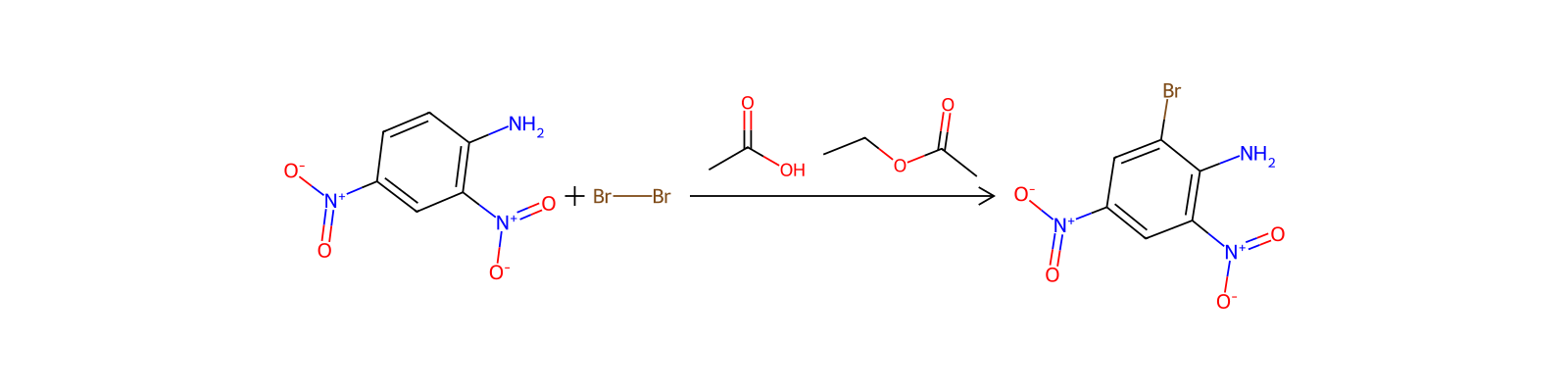
HRID 34254 の反応式
HRID 34254反応物としてuspto-grants-1988_08
HRID 268270 の反応式
HRID 268270反応物としてuspto-grants-1976_03
HRID 318014 の反応式
HRID 318014反応物としてTraining data from https://doi.org/10.1039/C8SC04228D (8/10)
HRID 429577 の反応式
HRID 429577反応物としてuspto-grants-2001_11
HRID 712155 の反応式
HRID 712155反応物としてuspto-grants-2015_11
HRID 986818 の反応式
HRID 986818反応物としてuspto-grants-1987_12
HRID 1007193 の反応式
HRID 1007193反応物としてuspto-grants-2004_09
HRID 1050494 の反応式
HRID 1050494反応物としてuspto-grants-2016_07
1 / 4 ページ

化合物ノート

読み込み中…

このページの内容基本情報概要名称と識別子物性安全と法規制化学と産業関連反応化合物ノート
その他の操作
ノートを作成反応を作成見積依頼を出す
Decomposition
WHEN HEATED TO DECOMP, IT EMITS HIGHLY TOXIC FUMES.
Melting Point · 4 件

349 to 352 °F (NTP, 1992)

187.5-188 °C

187-188 °C

188 °C

Vapor Density · 2 件

6.31 (NTP, 1992) - Heavier than air; will sink (Relative to Air)

6.31 (AIR= 1)

物理化学的性質

融点
177 °C · 177 °C
沸点
316.77 °C · 316.77°C (rough estimate)
比重(密度)
1 · 1,61 g/cm3
蒸気圧
0.001 hPa · <0.001 hPa ( 25 °C)
屈折率
1.691 · 1.6910 (estimate)
闪点
224 °C · 224 °C
貯蔵温度
Flammables area
溶解性
DMSO (Slightly), Methanol (Slightly)
酸解離定数(Pka)
1 · pK1:-14.25(+1) (25°C)
外見
結晶性粉末
色
黄色から黄緑色または黄褐色
PH
7 · 7 (1g/L in H2O)
水溶解度
0.06 g/L · 0.06g/L(20℃)
Merck
14 · 14,3270
BRN
982999 · 982999
Henry's Law Constant
6.5 · 6.5×104 mol/(m3Pa) at 25℃, HSDB (2015)
安定性
安定。酸化剤と相容れない。高温で激しく分解することがある。
InChI
1S/C6H5N3O4/c7-5-2-1-4(8(10)11)3-6(5)9(12)13/h1-3H,7H2
InChIKey
LXQOQPGNCGEELI-UHFFFAOYSA-N
SMILES
Nc1ccc(cc1[N+]([O-])=O)[N+]([O-])=O
CAS データベース
97 · 97-02-9(CAS DataBase Reference)
NISTの化学物質情報
2 · Benzenamine, 2,4-dinitro-(97-02-9)
EPAの化学物質情報
2 · 2,4-Dinitroaniline (97-02-9)

化学的性質

化学的特性yellow crystalline solid

Reactive GroupNitro, Nitroso, Nitrate, and Nitrite Compounds, Organic
EC ClassificationSymbol: T+, N; R: 26/27/28-33-51/53; S: (1/2)-28-36/37-45-61
UN ClassificationUN Hazard Class: 6.1; UN Pack Group: II
TSCA Requirements · 2 件

Pursuant to section 8(d) of TSCA, EPA promulgated a model Health and Safety Data Reporting Rule. The section 8(d) model rule requires manufacturers, importers, and processors of listed chemical substances and mixtures to submit to EPA copies and lists of unpublished health and safety studies. Benzenamine, 2,4-dinitro- is included on this list.

Section 8(a) of TSCA requires manufacturers of this chemical substance to report preliminary assessment information concerned with production, use, and exposure to EPA as cited in the preamble of the 51 FR 41329.

Reactivity AlertsExplosive
Reactivity Profile · 1 件

2,4-DINITROANILINE may decompose violently at elevated temperatures. This compound can react with oxidizing materials, i.e. chlorine/hydrochloric acid. (NTP, 1992). In mixture with powdered charcoal ignited upon heating, [Cahiers, 1980, (99), 278].

安全と保護具

Fire Fighting · 2 件

Fire Extinguishing Agents Not to Be Used: Water or foam may cause frothing

Use water spray, powder, foam, carbon dioxide. In case of fire: keep drums, etc., cool by spraying with water.

First Aid Measures · 4 件

Fresh air, rest. Refer for medical attention.

Remove contaminated clothes. Rinse skin with plenty of water or shower. Refer for medical attention .

First rinse with plenty of water for several minutes (remove contact lenses if easily possible), then refer for medical attention.

Rinse mouth. Give one or two glasses of water to drink. Induce vomiting (ONLY IN CONSCIOUS PERSONS!). Refer for medical attention .

First Aid · 1 件

EYES: First check the victim for contact lenses and remove if present. Flush victim's eyes with water or normal saline solution for 20 to 30 minutes while simultaneously calling a hospital or poison control center. Do not put any ointments, oils, or medication in the victim's eyes without specific instructions from a physician. IMMEDIATELY transport the victim after flushing eyes to a hospital even if no symptoms (such as redness or irritation) develop.

Safe StorageSeparated from strong oxidants and food and feedstuffs. Well closed.
Fire Fighting Procedures · 2 件

WATER, CARBON DIOXIDE, DRY CHEMICAL

Use water spray, dry chemical, foam, or carbon dioxide. Water or foam may cause frothing. Approach fire from upwind to avoid hazardous vapors and toxic decomposition products. /Nitropropanes/

Storage Conditions · 2 件

Store in a cool, dry, well ventilated location. Separate from acids and oxidizing materials. Detached storage must be used.

MATERIALS WHICH ARE TOXIC AS STORED OR WHICH CAN DECOMPOSE INTO TOXIC COMPONENTS ... SHOULD BE STORED IN A COOL WELL VENTILATED PLACE, OUT OF THE DIRECT RAYS OF THE SUN, AWAY FROM AREAS OF HIGH FIRE HAZARD, & SHOULD BE PERIODICALLY INSPECTED. INCOMPATIBLE MATERIALS SHOULD BE ISOLATED ... .

Nonfire Spill Response · 1 件

SMALL SPILLS AND LEAKAGE: If a spill of this chemical occurs, FIRST REMOVE ALL SOURCES OF IGNITION, then you should dampen the solid spill material with acetone and transfer the dampened material to a suitable container. Use absorbent paper dampened with acetone to pick up any remaining material. Seal your contaminated clothing and the absorbent paper in a vapor-tight plastic bag for eventual disposal. Solvent wash all contaminated surfaces with acetone followed by washing with a soap and water solution. Do not reenter the contaminated area until the Safety Officer (or other responsible person) has verified that the area has been properly cleaned.

Spillage Disposal · 1 件

Personal protection: particulate filter respirator adapted to the airborne concentration of the substance. Do NOT let this chemical enter the environment. Sweep spilled substance into covered containers. If appropriate, moisten first to prevent dusting. Carefully collect remainder. Then store and dispose of according to local regulations.

Preventive Measures · 1 件

SRP: Local exhaust ventilation should be applied wherever there is an incidence of point source emissions or dispersion of regulated contaminants in the work area. Ventilation control of the contaminant as close to its point of generation is both the most economical and safest method to minimize personnel exposure to airborne contaminants.

Isolation and EvacuationExcerpt from ERG Guide 153 [Substances - Toxic and/or Corrosive (Combustible)]:
Eye PreventionWear safety goggles.
Fire PreventionNO open flames.

毒性情報

Ecotoxicity Values · 1 件

LC50 Pimephales promelas (fathead minnow) 14.2 mg/l/96 hr (Confidence limit 13.5 to 15.0 mg/l). Affected fish lost schooling behavior and swam near the tank surface with half being hyperactive and half hypoactive. They had increased respiration and hemorrhaging, were darkly colored, and lost equilibrium prior to death.

Environmental Fate · 3 件

TERRESTRIAL FATE: When released to soil, 2,4-dinitroaniline may undergo covalent chemical bonding with humic materials which can result in its chemical alteration to a latent form and tight adsorption. When covalently bound in this latent form, leaching in soil systems is not generally expected to occur. This covalent bonding proceeds in two steps; a rapid and reversible bonding followed by a slower and much less reversible reaction(1,SRC). Leaching in soil may be possible prior to the occurrence of the slower bonding reaction. In the absence of covalent bonding, moderate leaching may be possible (estimated Koc value of 240)(3,4,SRC). Although one biological screening study showed no biodegradation in river and sea water(2), insufficient data are available to assess the relative importance of biodegradation of 2,4-dinitroaniline in soil(SRC).

AQUATIC FATE: By analogy to the aromatic amine chemical class(2), 2,4-dinitroaniline in the water column may be susceptible to photooxidation via hydroxyl and peroxy radicals(SRC). Aromatic amines have also been shown to undergo covalent bonding with humic materials in the water column and in sediment(1); partitioning from the water column to sediment and suspended material may therefore be important(SRC). Although one biological degradation study found evidence of no microbial degradation(3), insufficient data are available to assess the relative importance of biodegradation of 2,4-dinitroaniline in water. An estimated BCF value of 15(4,SRC) suggests that it will not bioconcentrate significantly in aquatic organisms(SRC). Aquatic hydrolysis and volatilization do not appear to be environmentally important(SRC).

ATMOSPHERIC FATE: Based upon an estimated vapor pressure of 5.94X10⁻⁷ mm Hg at 25 °C(1), 2,4-dinitroaniline may exist in both the vapor and the particulate-phase in the ambient atmosphere(2,SRC). It is degraded relatively rapidly in the vapor phase in an average ambient atmosphere by reaction with photochemically produced hydroxyl radicals at an estimated half-life of about 17.7 hr(3,SRC).

Adverse EffectsOccupational hepatotoxin - Secondary hepatotoxins: the potential for toxic effect in the occupational setting is based on cases of poisoning by human ingestion or animal experimentation.
Exposure RoutesThe substance can be absorbed into the body by inhalation of its aerosol, through the skin and by ingestion.
Signs and Symptoms · 3 件

Cough. Sore throat.

MAY BE ABSORBED! Redness. Pain.

Redness. Pain.

ICSC Environmental DataThe substance is harmful to aquatic organisms.
Soil Adsorption/Mobility · 1 件

Aromatic amines have been observed to undergo rapid and reversible covalent bonding with humic materials in aqueous solution; the initial bonding reaction is followed by a slower and much less reversible reaction believed to represent the addition of the amine to quinoidal structures followed by oxidation of the product to give an amino-substituted quinone; these processes represent pathways by which aromatic amines may be converted to latent forms in the biosphere(3). In the absence of covalent bonding, a Koc of approximately 240 can be estimated for 2,4-dinitroaniline based on an estimated log Kow of 1.84(2) and a recommended regression-derived equation(1,SRC); this Koc value suggests medium soil mobility(4).

Artificial Pollution Sources2,4-Dinitroaniline may be released to the environment during its production and use in the preparation of azo dyes(1,SRC).
Environmental Biodegradation2,4-Dinitroaniline at an initial concn of 100 ppm showed no biodegradation in river and sea water after 3 days using a cultivation test method(1).
Environmental Bioconcentration · 1 件

Based on an estimated log Kow of 1.84(2), the bioconcentration factor (BCF) for 2,4-dinitroaniline can be estimated to be about 15 from a recommended regression-derived equation(1,SRC). This BCF value suggests that bioconcentration in aquatic organisms may not be significant(SRC).

Volatilization from Water/Soil · 1 件

The Henry's Law constant for 2,4-dinitroaniline can be estimated to be approximately 1.51X10⁻¹⁰ atm-cu m/mole at 25 °C using a chemical structure estimation method(2,SRC). This value of Henry's Law constant suggests that 2,4-dinitroaniline is essentially nonvolatile from water(1).

Non-Human Toxicity Excerpts · 5 件

2,4-DINITROANILINE ADMIN ORALLY TO RATS SHOWED LOW TOXICITY. AFFECTED NERVOUS SYSTEM, CAUSED WEAK MET- & SULF-HEMOGLOBINEMIA, & DECR LEVEL OF THIOL GROUPS IN BLOOD.

THE DNA DAMAGE INDUCED BY IN VIVO ADMINISTRATION OF 2,4-DINITROANILINE WAS DETERMINED ... . THE TARGET ORGANS FOR ULTIMATE CARCINOGENS PRODUCED IN MICE APPEAR TO BE THE LIVER AND THE KIDNEY. THE VALUES OBTAINED AFTER TREATMENT WITH 2,4-DINITROANILINE FALL IN THE RANGE OF CONTROL MICE.

INHALATION OF 17 MG 2,4-DINITROANILINE/CU M FOR 4 HR/DAY WITHIN THE 1ST 19 OR 7 DAYS OF PREGNANCY INCREASED THE MORTALITY OF RAT EMBRYOS FROM 9.9 TO 18.8 AND 25.3%, RESPECTIVELY, AND DECREASED THE EMBRYO LENGTH ON THE 20TH DAY OF PREGNANCY FROM 29.0 TO 24.9 AND 25.2 MM, RESPECTIVELY. THE 7-DAY EXPOSURE ALSO DECREASED THE ALPHA2-GLOBULIN PERCENTAGE FROM 18.6 TO 14.2%. ...

TWO FRAME-SHIFT HISTIDINE MUTANTS (TA1537 AND TA98) AND 2 BASE-PAIR SUBSTITUTED HISTIDINE MUTANTS (TA1535 AND TA100) OF SALMONELLA TYPHIMURIUM WERE EMPLOYED. BOTH THE SPOT TEST AND PLATE-INCORPORATION ASSAY INDICATED THAT /2,4-DINITROANILINE/ WAS MUTAGENIC WITH THREE OF THE TEST STRAINS. ...

For more Non-Human Toxicity Excerpts (Complete) data for 2,4-DINITROANILINE (6 total), please visit the HSDB record page.

法規制情報

TSCA Requirements · 2 件

Pursuant to section 8(d) of TSCA, EPA promulgated a model Health and Safety Data Reporting Rule. The section 8(d) model rule requires manufacturers, importers, and processors of listed chemical substances and mixtures to submit to EPA copies and lists of unpublished health and safety studies. Benzenamine, 2,4-dinitro- is included on this list.

Section 8(a) of TSCA requires manufacturers of this chemical substance to report preliminary assessment information concerned with production, use, and exposure to EPA as cited in the preamble of the 51 FR 41329.

安全データ

wgk
2
tsca
TSCA listed
rtecs
BX9100000
ridadr
UN 1596 (DINITROANILINES)
PRTR法
第二種指定化学物質
hs_code
29214210
risk_code
26/27/28-33-51/53
化審法
(3)-403
安衛法
変異原性物質
消防法
危-5-II
hazard_code
T+,N
safety_code
28-36/37-45-61-28A
hazard_class
6.1
packing_group
II
自然発火温度
>365°C
Hazard Classifications
Acute Tox. 1 DermalAcute Tox. 2 InhalationAcute Tox. 2 OralAquatic Chronic 2STOT RE 2
ストレージクラス
6.1A - Combustible acute toxic Cat. 1 and 2very toxic hazardous materials
有毒物質データの
97-02-9(Hazardous Substances Data)
· 2 件

(1972) GREATER THAN 4.54X10+5 GRAMS

(1974) 2.62X10+8 GRAMS

Consumption PatternsESSENTIALLY 100% AS A CHEM INT IN PIGMENT MANUFACTURE (1975)
Methods of Manufacturing · 2 件

REACTION OF 2,4-DINITROCHLOROBENZENE WITH AMMONIA

NITRATION OF PARA-NITROANILINE WITH HOT MIXED ACID.

General Manufacturing InformationBenzenamine, 2,4-dinitro-: ACTIVE
応用分野 · 3 件

用途顔料、染料の合成中間体

用途有機合成原料(染料、顔料)。

一般的な説明Yellow powder or crystals with a musty odor. Sinks in water.

調製方法 · 2 件

2,4-Dinitrochlorobenzene is aminated with aqueous ammonia initially at 70 ℃; then the temperature is allowed to rise gradually to 120 ℃ to complete the reaction. Only a low-pressure autoclave is required, compared with the amination of 2- chloro- and 4- chloronitrobenzene.

純化方法Crystallise the nitroaniline from boiling EtOH by adding one-third volume of H2O and cooling slowly. Dry it on a steam oven. The N-acetyl derivative has m 180o. [Beilstein 12 IV 1689.]

上流・下流製品情報

上流原料

4-クロロベンズアルデヒドブチルナフタレンスルホン酸ナトリウムSodium sulfonateIndustrial ammonia1-クロロ-2,4-ジニトロベンゼンアンモニア

下流製品

2'-(アセチルアミノ)-4'-[ビス(2-アセトキシエチル)アミノ]-6-ブロモ-2,4-ジニトロ-5'-エトキシアゾベンゼン4-ニトロ-1,2-フェニレンジアミンC.I.サルファーイエロー9N-(2,4-ジニトロフェニル)アセトアミドパーマネントオレンジ2-ブロモ-4,6-ジニトロアニリンベンダムスチン塩酸塩2,4,6-トリニトロアニリン7-Bromo-1H-benzimidazol-5-amine6-クロロ-2,4-ジニトロアニリン2,4-ジニトロジフェニルアミン2-[ブチル[4-[(2,4-ジニトロフェニル)アゾ]-3-メチルフェニル]アミノ]エタノール8-[(4-アミノ-2-ニトロフェニル)アゾ]-7-ヒドロキシ-N,N,N-トリメチル-2-ナフタレンアミニウム·クロリドDisperse Orange 562-[ブチル[4-[(2,4-ジニトロフェニル)アゾ]フェニル]アミノ]エタノールDisperse Violet 913-[[4-[(2,4-ジニトロフェニル)アゾ]フェニル](2-ヒドロキシエチル)アミノ]プロパンニトリルDisperse Red 8

補足説明

定義ChEBI: 2,4-dinitroaniline is a nitroaniline consisting of an aniline core having two nitro substituents located at the 2- and 4-positions.