
アクリル酸オキシラニルメチル
Glycidyl acrylate
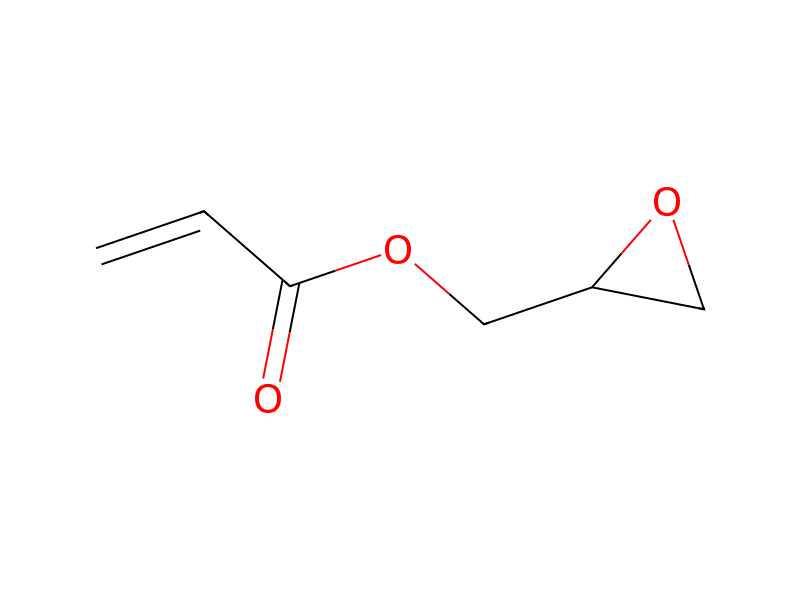
基本情報
- CAS
106-90-1- 標準SMILES
C=CC(=O)OCC1CO1- InChIKey
RPQRDASANLAFCM-UHFFFAOYSA-N- 分子式
- C6H8O3
- 平均分子量
- 128.13 g/mol
- 単同位体質量
- 128.04734412
概要
Glycidyl acrylate is a light amber liquid. (NTP, 1992)
名称と識別子
- 優先名称
- Glycidyl acrylate
- IUPAC
- oxiran-2-ylmethyl prop-2-enoate
- 現地名
- アクリル酸オキシラニルメチル
- 英語名
- Glycidyl acrylate
- 分子式
- C6H8O3
- 分子量
- 128.13
名称と別名
GLYCIDYL ACRYLATE106-90-12,3-Epoxypropyl acrylateGlycidyl propenateoxiran-2-ylmethyl prop-2-enoateAcrylic acid glycidyl esterAcrylic acid, 2,3-epoxypropyl ester2-Propenoic acid, oxiranylmethyl esterMethacyclic acid, 2,3-epoxypropyl ester1-Propanol, 2,3-epoxy-, acrylateglycidyl propenoateGlycidylester kyseliny akrylove
名称をさらに表示
プロペン酸オキシラニルメチルアクリル酸グリシジル2-[(アクリロイルオキシ)メチル]オキシランオキシラニルメチルアクリラートアクリル酸オキシラニルメチル(オキシラン-2-イル)メチル プロパ-2-エノアートglycidylOxiran-2-ylmethyl acrylateSR 378NSC 24151NSC 67196glycidylpropenateacrylatedeglycidyle
M 581epoxypropyl acrylateNSC-24151L8N627D5ZC2-Propenoic acid, 2-oxiranylmethyl esterNSC-67196DTXSID5025360RefChem:143827
データベース識別子
- CAS
106-90-1- PubChem CID
- 7836
- DTXSID
DTXSID5025360- UNII
- L8N627D5ZC
- EC Number
- 203-440-3
- Nikkaji
- J33.797H
物性
構造計算による物性
- XLogP
- 0.4
- 極性表面積
- 38.8 Ų
- 水素結合供与体数
- 0
- 水素結合受容体数
- 3
- 回転可能結合数
- 4
- 重原子数
- 9
- 形式電荷
- 0
- 複雑度
- 130
実験および物理化学的性質
Chemical ClassesFlammable agents - 2nd degree
PolymersPlastics & Rubber -> (Meth)acrylates
Density
1.1 (NTP, 1992) - Denser than water; will sink
1.1074 @ 20 °C/20 °C
1.1074 @ 20°C
Color/FormLiquid
Solubility
10 to 50 mg/mL at 68.9 °F (NTP, 1992)
Insoluble in water
Flash Point
141 °F (NTP, 1992)
141 °F (61 °C) (open cup)
Boiling Point
135 °F at 2 mmHg (NTP, 1992)
57 °C @ 2 mm Hg
Polymerization occurs at boiling point
DecompositionWhen heated to decomp it emits acrid smoke and fumes.
Melting PointFreezing point: -41.5 °C
Vapor Density
4.4 (NTP, 1992) - Heavier than air; will sink (Relative to Air)
4.4 (air= 1)
Vapor Pressure2.97 [mmHg]
Physical Description
Glycidyl acrylate is a light amber liquid. (NTP, 1992)
Light amber liquid; [CAMEO] Colorless liquid; [CHEMINFO] Clear deep red liquid; [MSDSonline]
物理化学的性質
- 融点
- -42 °C · -42 °C
- 沸点
- 60 °C · 60°C 16mm
- 比重(密度)
- 1.1163 g/cm3 · 1.1163 g/cm3
- 屈折率
- 1.4508 · 1.4508 (589.3 nm 20℃)
- 闪点
- 61 °C · 61°C(lit.)
- 貯蔵温度
- -20 °C · -20°C Freezer
- 溶解性
- Chloroform (Sparingly), Methanol (Slightly)
- 外見
- clear liquid
- 色
- Colorless to Light orange to Yellow
- 安定性
- 安定性可燃性。強力な酸化剤とは相容れない。重合しやすい可能性があります。
- InChI
- InChI=1S/C6H8O3/c1-2-6(7)9-4-5-3-8-5/h2,5H,1,3-4H2
- InChIKey
- RPQRDASANLAFCM-UHFFFAOYSA-N
- SMILES
- C(OCC1CO1)(=O)C=C
- EPAの化学物質情報
- Glycidyl acrylate (106-90-1)
化学的性質
化学的特性amber liquid
安全と法規制
安全情報は参考情報です。供給元の安全データシート(SDS)、適用法令、専門家による評価に代わるものではありません。
GHS分類
GHS Classification
Danger
H301: Toxic if swallowed [Danger Acute toxicity, oral]
P260, P261, P262, P264, P270, P271, P272, P280, P301+P316, P301+P330+P331, P302+P352, P302+P361+P354, P304+P340, P305+P354+P338, P316, P321, P330, P333+P317, P361+P364, P362+P364, P363, P403+P233, P405, and P501 (click each P-code to see the statement)
Danger
H301 (100%): Toxic if swallowed [Danger Acute toxicity, oral]
P260, P261, P262, P264, P270, P271, P272, P280, P301+P316, P301+P330+P331, P302+P352, P302+P361+P354, P304+P340, P305+P354+P338, P316, P321, P330, P333+P317, P361+P364, P362+P364, P363, P403+P233, P405, and P501 (click each P-code to see the statement)
危険有害性情報
Regulatory Information
Chemical: 2-Propenoic acid, oxiranylmethyl ester
TP - indicates a substance that is the subject of a proposed TSCA section 4 test rule.
The New Jersey Worker and Community Right to Know Act requires public and private employers to provide information about hazardous substances at their workplaces. (N.J.S.A. 34:5A-1 et. seq.)
Other Safety InformationEvaluation - Glycidyl acrylate and glycidyl methacrylate
DOT LabelFlammable Liquid Poison
Fire HazardsThis chemical is combustible. (NTP, 1992)
Fire PotentialFlammable liquid when exposed to heat or flame.
Health HazardsExcerpt from ERG Guide 131 [Flammable Liquids - Toxic]:
Hazards Summary
A skin and eye irritant; [Hawley] External application to rabbit eyes scored 10 on a scale of 1-10 (10 being most severe) for degree of injury after 24 hours; [HSDB] May polymerize; [CAMEO] Corrosive to skin and eyes, based on animal studies; [CHEMINFO] Can cause burns; May cause skin sensitization; [eChemPortal: ESIS] A corrosive substance that can cause injury to the skin, eyes, and respiratory tract; May cause skin sensitization; Can be absorbed through skin; Inhalation may cause chemical pneumonitis and pulmonary edema; [MSDSonline] See ACRYLIC RESINS (MONOMERS).
Reactive GroupEpoxides
Reactivity AlertsHighly Flammable
Reactivity ProfileGLYCIDYL ACRYLATE may be sensitive to polymerizing conditions and/or catalysts. This compound will react with oxidizers. (NTP, 1992)
Air and Water ReactionsWater soluble.
NFPA Hazard Classification
0 - Materials that, under emergency conditions, would offer no hazard beyond that of ordinary combustible materials.
2 - Materials that must be moderately heated or exposed to relatively high ambient temperatures before ignition can occur. Materials would not under normal conditions form hazardous atmospheres with air, but under high ambient temperatures or under moderate heating could release vapor in sufficient quantities to produce hazardous atmospheres with air.
0 - Materials that in themselves are normally stable, even under fire conditions.
安全と保護具
Fire FightingFires involving this chemical should be extinguished with a foam, dry chemical or carbon dioxide extinguisher. (NTP, 1992)
First Aid
EYES: First check the victim for contact lenses and remove if present. Flush victim's eyes with water or normal saline solution for 20 to 30 minutes while simultaneously calling a hospital or poison control center. Do not put any ointments, oils, or medication in the victim's eyes without specific instructions from a physician. IMMEDIATELY transport the victim after flushing eyes to a hospital even if no symptoms (such as redness or irritation) develop.
Storage Conditions
The effectiveness of phenolic inhibitors is dependent on the presence of oxygen and the monomers must be stored under air rather than an inert atmosphere. Temp must be kept low to minimize formation of peroxides and other products. ... The acrylic esters may be stored in mild or stainless steel, or aluminum. /Acrylic acid & derivatives/
Nonfire Spill Response
SMALL SPILLS AND LEAKAGE: If you spill this chemical, use absorbent paper to pick up all liquid spill material. Your contaminated clothing and absorbent paper should be sealed in a vapor-tight plastic bag for eventual disposal. Solvent wash all contaminated surfaces with alcohol followed by washing with a strong soap and water solution. Do not reenter the contaminated area until the Safety Officer (or other responsible person) has verified that the area has been properly cleaned.
Disposal Methods
SRP: At the time of review, criteria for land treatment or burial (sanitary landfill) disposal practices are subject to significant revision. Prior to implementing land disposal of waste residue (including waste sludge), consult with environmental regulatory agencies for guidance on acceptable disposal practices.
Preventive Measures
Awareness of the dangers and of good engineering design are essential to safety. Employees should be instructed about the necessity of cleansing the skin if it is contaminated by materials which are irritants or skin-absorbed. With careful design, however, and complete enclosure of those processes where toxic chemicals or intermediates occur, dangerous exposures can be avoided. /Acrylic acid & derivatives/
SRP: Contaminated protective clothing should be segregated in such a manner so that there is no direct personal contact by personnel who handle, dispose, or clean the clothing. Quality assurance to ascertain the completeness of the cleaning procedures should be implemented before the decontaminated protective clothing is returned for reuse by the workers. Contaminated clothing should not be taken home at end of shift, but should remain at employee's place of work for cleaning.
SRP: The scientific literature for the use of contact lenses in industry is conflicting. The benefit or detrimental effects of wearing contact lenses depend not only upon the substance, but also on factors including the form of the substance, characteristics and duration of the exposure, the uses of other eye protection equipment, and the hygiene of the lenses. However, there may be individual substances whose irritating or corrosive properties are such that the wearing of contact lenses would be harmful to the eye. In those specific cases, contact lenses should not be worn. In any event, the usual eye protection equipment should be worn even when contact lenses are in place.
Isolation and EvacuationExcerpt from ERG Guide 131 [Flammable Liquids - Toxic]:
Protective Action Criteria (PAC)
0.081 [ppm]
0.89 [ppm]
5.4 [ppm]
Personal Protective Equipment (PPE)
RECOMMENDED RESPIRATOR: Where the neat test chemical is weighed and diluted, wear a NIOSH-approved half face respirator equipped with an organic vapor/acid gas cartridge (specific for organic vapors, HCl, acid gas and SO2) with a dust/mist filter. (NTP, 1992)
SUITABLE PROTECTIVE CLOTHING & SELF CONTAINED RESP PROTECTIVE APPARATUS SHOULD BE AVAILABLE FOR USE OF THOSE WHO MAY HAVE TO RESCUE PERSONS OVERCOME BY FUMES. /ACRYLIC ACID & DERIVATIVES/
Protection required for safe handling of acrylic acid and esters commonly includes use of impervious gloves, shoe soles, and clothing; splash-proof goggles ... . /Acrylic acid & derivatives/
毒性情報
Adverse EffectsDermatotoxin - Skin burns.
Human Toxicity Excerpts
THE ACUTE TOXICITY OF THE ACRYLATES DECREASES WITH INCREASING MOLECULAR WEIGHT. ... HUMAN SIGNS & SYMPTOMS FOLLOWING INGESTION OF ACRYLIC MONOMERS INCL COLLAPSE, SEVERE RESPIRATORY DIFFICULTIES, & CNS STIMULATION. ACUTE INHALATION OF HIGHER CONCN MAY CAUSE MARKED IRRITATION, SALIVATION, CONJUNCTIVAL IRRITATION, & PRONOUNCED PULMONARY IRRITATION OR EDEMA. PROLONGED SKIN OR EYE CONTACT MAY RESULT IN SEVERE TISSUE DAMAGE. THE PATHOLOGY FROM SINGLE EXPOSURE IS NONSPECIFIC, CONTRARY TO REPEATED EXPOSURE EFFECTS, WHICH INCL PULMONARY CONGESTION OR HEMORRHAGE & CLOUDY SWELLING OF LIVER & KIDNEY. /ACRYLATES/
Non-Human Toxicity Excerpts
GLYCIDYL ACRYLATE ADMIN @ 0.5 MG/100 G IP, SHOWED NO INHIBITORY EFFECT ON TRANSPLANTED WALKER TUMORS IN RATS 24 HR AFTER DOSE, BONE MARROW SHOWED 2% ANAPHASES IN EXCESS OF CONTROLS WITH STICKY CHROMOSOME BRIDGES.
Acrylic acid 2,3-epoxypropyl ester has been tested externally on the eyes of rabbits & ... rated 10 on scale of 1 to 10 according to the degree of injury observed after 24 hr. The most severely injurious substances have been rated 10.
Contact sensitivity was produced in guinea pigs with mono-, di-, and tri- acrylate compounds. /Mono-, di-, and tri- acrylate compounds/
Antidote and Emergency Treatment
Basic treatment: Establish a patent airway. Suction if necessary. Watch for signs of respiratory insufficiency and assist ventilations if necessary. Administer oxygen by nonrebreather mask at 10 to 15 L/min. Monitor for pulmonary edema and treat if necessary ... . Monitor for shock and treat if necessary ... . For eye contamination, flush eyes immediately with water. Irrigate each eye continuously with normal saline during transport ... . Do not use emetics. For ingestion, rinse mouth and administer 5 mL/kg up to 200 mL of water for dilution if the patient can swallow, has a strong gag reflex, and does not drool. Administer activated charcoal ... . /Esters and related compounds/
Advanced treatment: Consider orotracheal or nasotracheal intubation for airway control in the patient who is unconscious. Positive-pressure ventilation techniques with a bag-valve-mask device may be beneficial. Monitor cardiac rhythm and treat arrhythmias if necessary ... . Start an IV with D5W TKO /SRP: "To keep open", minimal flow rate/. Use lactated Ringer's if signs of hypovolemia are present. Watch for signs of fluid overload. For hypotension with signs of hypovolemia, administer fluid cautiously. Consider vasopressors if patient is hypotensive with a normal fluid volume. Watch for signs of fluid overload ... . Consider drug therapy for pulmonary edema ... . Use proparacaine hydrochloride to assist eye irrigation ... . /Esters and related compounds/
Toxicity DataLCLo (rat) = 125 ppm/4h
Non-Human Toxicity Values
LD50 Rat oral 210 mg/kg
LD50 Rabbit skin 400 mg/kg
安全データ
- tsca
- TSCA listed
- rtecs
- AS9275000
- ridadr
- 2810
- hs_code
- 2916.12.5050
- risk_code
- 23/24/25-34-43
- 化審法
- (2)-1000
- 消防法
- 危-4-2-III
- hazard_code
- T
- safety_code
- 26-36/37/39-45
- hazard_class
- 6.1(b)
- packing_group
- III
- 有毒物質データの
- 106-90-1(Hazardous Substances Data)
化学と産業
用途と製造
Uses
Used as monomer (polymers for adhesives and coatings), crosslinking agent (polymers of trialkyltin esters), and epoxy resin diluent; [HSDB]
Painting (Pigments, Binders, and Biocides) [Category: Paint]
MONOMER FOR POLYMERS USED IN ADHESIVES & COATINGS
CROSSLINKING AGENT FOR POLYMERS OF TRIALKYLTIN ESTERS
EPOXY RESIN DILUENT
U.S. Imports(1983) 1.36x10+9 g /Acrylates & Acrylic Acid/
U.S. Production(1977) AT LEAST 4.54X10+7 G
Methods of Manufacturing
Acrylates can be prepared by ... dehydration of the corresponding hydroxyalkanoic acid, saponification of the alkene nitrile, catalytic hydration of acetylene and carbon monoxide, or the reaction of acetone with hydrocyanic acid. /Acrylates/
In ... propylene oxidation process acrolein is first formed by the catalytic oxidation of propylene vapor at high temp in the presence of steam. The acrolein is then oxidized to acrylic acid. ... The acrylic acid is esterified with alcohol to the ... acrylic ester in a separate process. /Acrylic ester monomers/
Epichlorohydrin + acrylic acid (esterification)
Formulations/Preparations... Hydroquinone or monomethyl ether hydroquinone are added to acrylic monomers to stabilize them ... . /Acrylic ester monomers/
General Manufacturing Information2-Propenoic acid, 2-oxiranylmethyl ester: ACTIVE
応用分野
用途反応性モノマー、有機合成中間原料
説明Glycidyl acrylate (GA) is a monomer that polymerizes in the presence of a free-radical initiator to form polyacrylic acid. This compound is used as a cross-linking agent for coatings, adhesives, and sealing compounds. GA is an excellent starting material for the preparation of cationic polymers with high reactivity and good stability. It has been used as a control agent in the synthesis of polycarboxylic acids and fatty acids. The hydroxyl group on this molecule allows it to be used as a water-repellent coating or sealant.
使用Glycidyl Acrylate 85% can be used as an adhesive composition.
一般的な説明Light amber liquid.
関連反応
19 件


化合物ノート
読み込み中…