
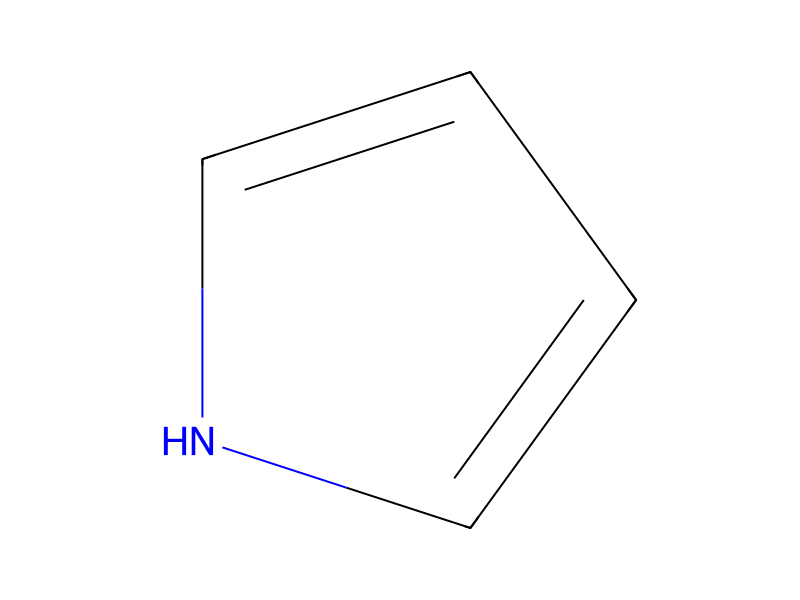
基本情報
- 標準SMILES
c1cc[nH]c1- InChIKey
KAESVJOAVNADME-UHFFFAOYSA-N- 分子式
- C4H5N
- 平均分子量
- 67.09 g/mol
- 単同位体質量
- 67.04219916
概要
1H-pyrrole is a tautomer of pyrrole that has the double bonds at positions 2 and 4. It is a secondary amine and a pyrrole. It is a tautomer of a 3H-pyrrole and a 2H-pyrrole.
名称と識別子
- 優先名称
- Pyrrole
- IUPAC
- 1H-pyrrole
- 現地名
- ピロール
- 英語名
- Pyrrole
- 分子式
- C4H5N
- 分子量
- 67.09
名称と別名
PYRROLE1H-Pyrrole109-97-7AzoleDivinylenimineImidolePyrrolMonopyrroleDivinyleneimine1-Aza-2,4-cyclopentadieneFEMA No. 3386Pyrroles
名称をさらに表示
ピロールジビニレンイミンモノピロール1H-ピロールアゾールイミドールピロール標準品ピロルピロール, 98+%ピロール, 50 µg/mL in Toluene1-アザ-2,4-シクロペンタジエンPyrrolineFEMA 3386Parzate1H-Pyrrole 98%Pyrrole, 99%, extra purePYRROLE FOR SYNTHESIS 100 ML
DTXSID5021910NSC-6277786S1ZD6L2CCHEBI:19203DTXCID201910Pyrrole 1539RefChem:6188CHEBI:26455
データベース識別子
- CAS
109-97-7、30604-81-0- PubChem CID
- 8027
- DTXSID
DTXSID5021910- ChEMBL
CHEMBL16225- ChEBI
CHEBI:19203- UNII
- 86S1ZD6L2C
- EC Number
- 203-724-7
- Nikkaji
- J371I
物性
構造計算による物性
- XLogP
- 0.7
- 極性表面積
- 15.8 Ų
- 水素結合供与体数
- 1
- 水素結合受容体数
- 0
- 回転可能結合数
- 0
- 重原子数
- 5
- 形式電荷
- 0
- 複雑度
- 22.8
実験および物理化学的性質
Chemical ClassesNitrogen Compounds -> Pyrroles
SpringerMaterials Properties15N nuclear magnetic resonance spectrum
LogP
log Kow = 0.75
0.75
0.75
OdorAgreeable empyreumatic odor resembling that of chloroform
TasteBurning, pungent taste
Food AdditivesFLAVORING AGENT OR ADJUVANT -> FDA Substance added to food
Density
0.9698 @ 20 °C
0.955-0.975
0.9698 @ 20°C
Flavoring AgentsEU Flavoring substances
Viscosity4.1123X10-3 Pa.s @ 249.74K
Color/Form
Colorless liquid when fresh
Yellowish or brown oil
Solubility
Soluble in alcohol, ether and dilute acids. Also soluble in most organic chemicals.
Water solubility: 4.5X10+4 mg/l @ 25 °C
45 mg/mL at 25 °C
Soluble in most fixed oils; Slightly soluble in water
Soluble (in ethanol)
Flash Point102 °F (39 °C) (CLOSED CUP)
物理化学的性質
- 融点
- -23 °C · -23 °C (lit.)
- 沸点
- 131 °C · 131 °C (lit.)
- 比重(密度)
- 0.967 g/mL · 0.967 g/mL at 25 °C (lit.)
- 蒸気密度
- 2.31 · 2.31 (vs air)
- 蒸気圧
- 8.7 hPa · 8.7 hPa (20 °C)
- FEMA
- 3386 · 3386 | PYRROLE
- 屈折率
- 20 · n20/D 1.508(lit.)
- 闪点
- 92 °F · 92 °F
- 貯蔵温度
- 2 °C · Store at +2°C to +8°C.
- 溶解性
- 60 g/リットル · 60g/リットル
- 酸解離定数(Pka)
- 15 · 15(at 25℃)
- 外見
- 液体
- 色
- ほぼ無色~茶色がかった透明
- PH
- 6 · >6 (10g/l, H2O, 20℃)
- 臭い (Odor)
- 0.1 %。甘くて温かいナッツのような空気感 · プロピレングリコール中0.10%。甘くて温かいナッツのような空気感
- においのタイプ
- ナッティ
- 由来生物
- synthetic
- 爆発限界(explosive limit)
- 3.1 · 3.10-14.8%(V)
- 水溶解度
- 60 g/L · 60g/L(20℃)
- 比熱容量
- 1.9 J/ · Cp(liquid): 1.9 J/(g·K), at 25℃
- JECFA Number
- 1314 · 1314
- Merck
- 14 · 14,8014
- BRN
- 1159 · 1159
- Henry's Law Constant
- 5.5 · 5.5×10-1 mol/(m3Pa) at 25℃, Hawthorne et al. (1985)
- Dielectric constant
- 7.5 · 7.5(17℃)
- 安定性
- 安定。強酸、強酸化剤とは相容れない。可燃性。
- 主な用途
- フレーバーそして香料
- InChI
- 1S/C4H5N/c1-2-4-5-3-1/h1-5H
- InChIKey
- KAESVJOAVNADME-UHFFFAOYSA-N
- SMILES
- c1cc[nH]c1
- LogP
- 0.85 · 0.85
- 表面張力
- 36.6 mN/m · 36.6mN/m at 20°C
- CAS データベース
- 109 · 109-97-7(CAS DataBase Reference)
- NISTの化学物質情報
- Pyrrole(109-97-7)
- EPAの化学物質情報
- 1 H-Pyrrole · 1H-Pyrrole (109-97-7)
化学的性質
化学的特性Six π-electrons are distributed over the five ring atoms of pyrrole. Delocalization of these electrons stabilizes the ring and the lone pair of electrons on the nitrogen atom, which is responsible for the usual basicity of nitrogen compounds, is involved in the electron cloud, and is not available for sharing. Hence, pyrrole is an extremely weak base and the pyrrolic nitrogen is not readily susceptible to electrophilic enzymic attack (Damani, 1985). There is a high electron density, however, at all positions of the ring, which causes pyrrole to be reactive toward electrophilic substitution. In general, electrophilic substitution reactions on the neutral molecule occur preferentially at the C-2 or C-5 positions (Jones and Bean, 1977; Damani and Crooks, 1982).
化学性质黄赤色透明液体,融点?23℃,沸点131℃
安全と法規制
GHS分類
GHS Classification
Warning
H226 (10.7%): Flammable liquid and vapor [Warning Flammable liquids]
P210, P233, P240, P241, P242, P243, P264, P270, P280, P301+P317, P303+P361+P353, P330, P370+P378, P403+P235, and P501 (click each P-code to see the statement)
Aggregated GHS information provided per 1442 reports by companies from 11 notifications to the ECHA C&L Inventory. Each notification may be associated with multiple companies.
Warning
H226: Flammable liquid and vapor [Warning Flammable liquids]
危険有害性情報
Regulatory Information
Chemical: 1H-Pyrrole
Commission Regulation (EC) No 1565/2000 (Repealed by Com. Implementing Reg. (EU) No 872/2012)
Status: Active Update: 22-05-2020 https://echa.europa.eu/registration-dossier/-/registered-dossier/31075
1H-Pyrrole: Does not have an individual approval but may be used under an appropriate group standard
Fire PotentialFlammable liquid when exposed to heat or flame ...
Hazards Summary
A CNS depressant; May cause liver injury; Effects of high doses administered by IP injection in dogs include convulsions and liver injury; [HSDB] Safe when used as a flavoring agent in food; [JECFA] Causes convulsions and muscle contractions in oral lethal-dose studies of rabbits; [RTECS]
NFPA Hazard Classification
2 - Materials that, under emergency conditions, can cause temporary incapacitation or residual injury.
2 - Materials that must be moderately heated or exposed to relatively high ambient temperatures before ignition can occur. Materials would not under normal conditions form hazardous atmospheres with air, but under high ambient temperatures or under moderate heating could release vapor in sufficient quantities to produce hazardous atmospheres with air.
0 - Materials that in themselves are normally stable, even under fire conditions.
Hazard Classes and Categories
Flam. Liq. 3 (10.7%)
Flammable liquids - Category 3
Critical Temperature and PressureCritical temperature: 366.75 °C; Critical pressure: 6.21X10+6 Pa
Hazardous Reactivities and Incompatibilities
... CAN REACT WITH OXIDIZING MATERIALS.
Violent reaction with 2-nitrobenzaldehyde.
安全と保護具
Fire Fighting ProceduresFOAM, CARBON DIOXIDE, DRY CHEMICAL.
Disposal Methods
SRP: At the time of review, criteria for land treatment or burial (sanitary landfill) disposal practices are subject to significant revision. Prior to implementing land disposal of waste residue (including waste sludge), consult with environmental regulatory agencies for guidance on acceptable disposal practices.
Protective Action Criteria (PAC)
0.32 [mg/m3]
3.5 [mg/m3]
21 [mg/m3]
Personal Protective Equipment (PPE)IN VIEW OF THE COMPOUND'S RELATIVELY LOW TOXICITY, ORDINARY HANDLING PRECAUTIONS INCLUDING USE OF GLOVES & GOOD VENTILATION ARE ADEQUATE TO PREVENT INJURY.
毒性情報
Environmental Fate
TERRESTRIAL FATE: Based on a classification scheme(1), an estimated Koc value of 61(SRC), determined from a log Kow of 0.75(2) and a regression-derived equation(3), indicates that pyrrole is expected to have high mobility in soil(SRC). Volatilization of pyrrole from moist soil surfaces is expected to be an important fate process(SRC) given a Henry's Law constant of 1.8X10⁻⁵ atm-cu m/mole(4). The potential for volatilization of pyrrole from dry soil surfaces may exist(SRC) based upon a vapor pressure of 8.35 mm Hg(5). Pyrrole does not readily undergo biodegradation in water unless there exists bacteria that have had previous exposure to pyrrole. Given this need for acclimation, the decomposition of pyrrole may be very slow(6).
AQUATIC FATE: Based on a classification scheme(1), an estimated Koc value of 61(SRC), determined from a log Kow of 0.75(2), indicates that pyrrole is not expected to adsorb to suspended solids and sediment in water(SRC). Volatilization from water sources is expected(3) based upon a Henry's Law constant of 1.80X10⁻⁵ atm-cu m/mole(4). Volatilization half-lives for a model river and model lake are 42 hrs and 368 hrs, respectively(SRC), using an estimation method(3). According to a classification scheme(5), an estimated BCF of 2(3,SRC) from a log Kow of 0.75(2) suggests the potential for bioconcentration in aquatic organisms is low. Experiments have shown that pyrrole is actually degraded by gasoline-adapted ground water cultures when present as a single substrate. Adaption time was 480 hrs and degradation time was 600 hrs(6). Pyrrole was not degraded in a mixture of compounds in water after 1100-1300 hrs at 10 °C and at a concentration of 0.2-1 mg/l(6).
ATMOSPHERIC FATE: According to a model of gas/particle partitioning of semivolatile organic compounds in the atmosphere(1), pyrrole, which has a vapor pressure of 8.35 mm Hg at 25 °C(2), is expected to exist solely as a vapor in the ambient atmosphere. Vapor-phase pyrrole is degraded in the atmosphere by reaction with photochemically-produced hydroxyl radicals(SRC); the half-life for this reaction in air is estimated to be 4 days(SRC) from its rate constant of 1X10⁻¹⁰ cu cm/molecule sec(3). In a comparison of room temperature rate constants and loss rates of selected organics in the presence of 7.2X10+11 molecule/cu cm of ozone, 5X10+5 molecule/cu cm of hydroxyl radicals, and 2.4X10+8 molecules/cu cm of NO3 radicals, pyrrole displayed the following rate constants: 1.6X10⁻¹⁷ cu cm/molecule sec with a loss rate of 1 day, 1.2X10⁻¹¹ cu cm/molecule sec with a loss rate of 5.2 days, and 4.9X10⁻¹¹ cu cm/molecule sec with a loss rate of 1000 days, respectively(4).
Food Survey Values
Pyrrole has been detected in "popped" popcorn at a level of 26 ug/kg in a dry capture method and 44 ug/kg in a wet capture method(1). Fresh chicken breast with bone was cut into 1.5 inch cubes, coated with flour and fried in Fri-al shortening. During a 48 hour period in which the chicken was fried, pyrrole was detected (detection level not specified)(2).
Adverse EffectsNeurotoxin - Other CNS neurotoxin
Effluent Concentrations
Results of a study of several sites show that prior to coal gasification by ground water, pyrrole was not detected (limits of detection were 0.1 ppb). However, once coal gasification began, pyrrole was detected at 208 ppm in Hanna, Wyoming and 111 ppm Gillete, Wyoming. Pyrrole was not detected from low-Btu gasification of Rosebud coal but was detected at 23 ppm from an in situ oil shale process (limits of detection were 0.1 ppb)(1). Two retort wastewaters selected for study were produced from January to May, 1979 in the modified in situ retort 6 at the Occidental Oil Shale, Inc. facility at Logan Wash, CO. In the condensate retort water, 4.9 mg/l of pyrrole was detected while no pyrrole was detected at the process retort water (detection limits not specified)(2). Pyrrole was detected from shale oil wastewaters used to cool hot spent shale, both in gas condensate water and process retort water units not specified(3).
Medical Surveillance...PERSONS WITH ABNORMAL RESPIRATORY, CIRCULATORY OR LIVER CONDITIONS SHOULD NOT BE EXPOSED TO THIS SUBSTANCE.
Soil Adsorption/Mobility
The Koc of pyrrole is estimated as approximately 61(SRC), using a log Kow of 0.75(1) and a regression-derived equation(2). According to a classification scheme(3), this estimated Koc value suggests that pyrrole is expected to have high mobility in soil.
Atmospheric Concentrations
SOURCE DOMINATED: Pyrrole was detected at <1 ng/ml of air above 1 ml of water in 10 ml samples from two process retort wastewaters collected at Laramie Energy Technology Center during May 1982 and at the Logan Wash site of Occidental Oil Shale Inc. during December 1987; it was also detected in the gas-condensate retort wastewaters at 3.1 and 5.0 ng/ml of air above 1 ml of water at both sites(1). Pyrrole has been found in stock emission during incineration of municipal waste units not specified(2). URBAN/SUBURBAN: Pyrrole was not detected in ambient air at either Logan Wash, CO or at Boulder, CO(1).
Human Toxicity Excerpts
IT HAS A DEPRESSANT ACTION ON THE CENTRAL NERVOUS SYSTEM AND, IN SEVERE INTOXICATION, IS INJURIOUS TO THE LIVER.
NO CASES OF OCCUPATIONAL DISEASE DUE TO PYRROLE HAVE BEEN REPORTED; HOWEVER TESTS INDICATE THAT IT HAS A MODERATE CUMULATIVE TOXICITY.
Artificial Pollution SourcesPyrrole's production and presence in creosote(1), chemical intermediate in drug manufacturing(2) may result in its release to the environment through various waste streams(SRC).
Environmental Biodegradation
AEROBIC: Pyrrole was not degraded in a mixture of compounds in water after 1100-1300 hrs at 10 °C and at a concentration of 0.2-1 mg/l. Experiments have shown that pyrrole is actually degraded by gasoline-adapted ground water cultures when present as a single substrate. Adaption time was 480 hrs and degradation time was 600 hrs. Pyrrole inhibits benzene biodegradation strongly even at pyrrole concentrations of 100-200 ug/l(1). Degradation of pyrrole seems to be enhanced with the concomitant degradation of other compounds in an aqueous environment. No degradation of pyrrole was observed under denitrifying conditions during 846 days of incubation(2). In an aerobic enrichment culture that originated from groundwater at a creosote-contaminated aquifer in Fredensbury Denmark, pyrrole was completely removed after 49 days. It is suggested that microorganisms have to adapt to pyrrole before they can begin to degrade it and that the lag phase can be very long(3).
ANAEROBIC: Anaerobic research of pyrrole using primary digestive sludge, having an average inflow of 100 cu m/day and a mean retention time of 20 days, displayed negative gas production during the first 11 weeks of incubation. This corresponds to no biodegradation of pyrrole under anaerobic conditions(1).
Sediment/Soil ConcentrationsPyrrole is a constituent of creosote which is a compound used as a wood preservative, especially in electric poles. Due to this, pyrrole may be found in soil in locations where creosote has been used(1).
Environmental BioconcentrationAn estimated BCF of 2 was calculated for pyrrole(SRC), using a log Kow of 0.75(1). According to a classification scheme(2), this BCF suggests the potential for bioconcentration in aquatic organisms is low.
安全データ
- F
- 8-10-23
- wgk
- 2
- tsca
- TSCA listed
- rtecs
- UX9275000
- ridadr
- UN 1992 3/PG 3
- 毒性
- LD50 orally in Rabbit: 137 mg/kg
- hs_code
- 29339900
- risk_code
- 10-20-25-41
- 化審法
- (5)-100
- 消防法
- 危-4-2-III
- hazard_code
- T
- safety_code
- 26-37/39-45-39-24-16
- hazard_class
- 3
- packing_group
- III
- 自然発火温度
- 550 °C
- Hazard Classifications
- Acute Tox. 3 OralAcute Tox. 4 InhalationEye Dam. 1Flam. Liq. 3
- ストレージクラス
- 3 - Flammable liquids
- 有毒物質データの
- 109-97-7(Hazardous Substances Data)
化学と産業
薬理情報
Cellular LocationsCytoplasm
用途と製造
Uses
Found in coal tar and bone oil; [Merck Index] Used as an intermediate (pharmaceuticals, dyes, herbicides, and perfumes) and curing agent for resins; [HSDB]
Intermediate especially in drug manufacture
CHEM INT FOR DYES, HERBICIDES, PERFUMES, CROSS-LINKING AGENT FOR RESINS
Methods of Manufacturing
REACTION OF AMMONIA AND ACETYLENE OR BUTADIENE
Fractional distillation of bone-oil with sulfuric acid. Later converted into the potassium compound (C4H4NK), washing with ether, and treatment with water, followed by drying and distillation.
Thermal decomposition of ammonium mucate with glycerol or mineral oil. Also formed on heating of albumin; on heating sheep's wool with aqueous barium hydroxide solution; by pyrolysis of gelatin.
Formulations/PreparationsGRADE: TECHNICAL.
Use Classification
Flavouring Agent -> FLAVOURING_AGENT -> JECFA Functional Classes
Flavoring Agents -> JECFA Flavorings Index
Flavouring Agent -> FLAVOURING_AGENT -> JECFA Functional Classes
Flavouring Agent -> FLAVOURING_AGENT -> JECFA Functional Classes
Flavouring Agent -> FLAVOURING_AGENT -> JECFA Functional Classes
General Manufacturing Information
1H-Pyrrole: ACTIVE
STUDY OF FREE RADICALS PRODUCED IN PYRROLE BY X IRRADIATION & TRITIUM ATOM DECAY.
A constituent of coal tar & bone oil ... .
Pyrrole was found to be potentially useful as a tracer for determining the contribution of environmental tobacco smoke to concentrations of volatile organic compounds in indoor environments with smoking.
The ability of 10 pyrroles to block the acidic nitrosation of morpholine has been determined by using an assay that measures their effectiveness in the presence of a 10-fold excess of amine. The log (% N-nitrosomorpholine) formed is a linear function of blocking agent concentrations ranging from 0.0 to 1.5 times the equivalents of initial nitrate. The negative slopes of these plots allow a ranking of the effectiveness of the blocking agent. Several of the pyrroles have been found to be much more effective than establishing blocking agents such as ascorbic acid. The following order blocking ability has been determined: 2,5-dimethylpyrrole = 1-benzyl-2,5-dimethylpyrroleic acid = 1,2-phenylenediamine = pyrrole > 1,2,5-tribenzylpyrrole = 1-benzylpyrrole = octamethylporphine hydrazine = 2,5-diphenylpyrrolecarboxylic acid. Pyrroles give complex mixtures devoid of N-nitroso compounds upon nitrosation.
応用分野
解説ピロール,アゾールともいう.コールタール中に少量,骨油中にかなり多量に存在する.2-フランカルボン酸アンモニウムの加熱,フランとアンモニアをAl2O3上で加熱,あるいはスクシンイミドを亜鉛末と蒸留するなどの方法で生成する.クロロホルム様の特有な臭気をもつ無色の液体.沸点130~131 ℃.d204 0.9691.n20D 1.5085.λmax 209,240 nm(ε 6730,300).有機溶媒に易溶,水に難溶.空気中で着色する.そのNH基の塩基性はきわめて弱い(pKb 13.6)が,反応性は高く,酸性では重合が起こって樹脂化しやすい.金属化合物はピロール誘導体の合成に用いられる.たとえば,ピロール環は芳香族性を有し,環の水素のハロゲン置換,ジアゾニウム塩のカップリング,酸無水物によるアシル化などが容易に進行する.ピロールという名称はギリシア語の“火のように赤い”という意味であり,ピロールおよびその誘導体は希塩酸溶液中でピロール赤を生成する.亜セレン酸による酸化反応やケイ酸,モリブデン酸アンモニウムおよび硫酸の混合溶液との反応では濃青色のピロール青を呈するので,これらの検出にも用いられる.
用途有機合成、腐食防止剤、ポリマーの製造、電解質、溶剤。
用途亜セレン酸、ケイ酸の検出試薬。亜セレン酸により酸化されてピロール青の濃青色を呈する。リン酸、鉄(3)を共存させ、これを酸化触媒として用いた場合、限界濃度0.1ppm。ケイ酸、モリブデン酸アンモニウム、硫酸の混合溶液は試薬と反応して青色を呈する。
一般的な説明Pyrrole is one of the flavor compounds that is formed in thermally processed foods due to the Maillard reaction.
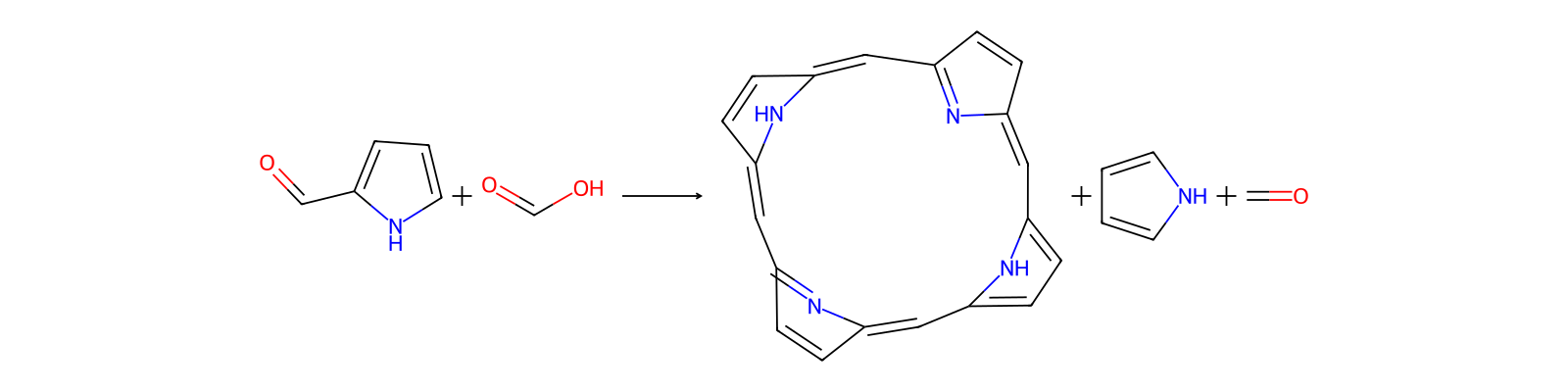
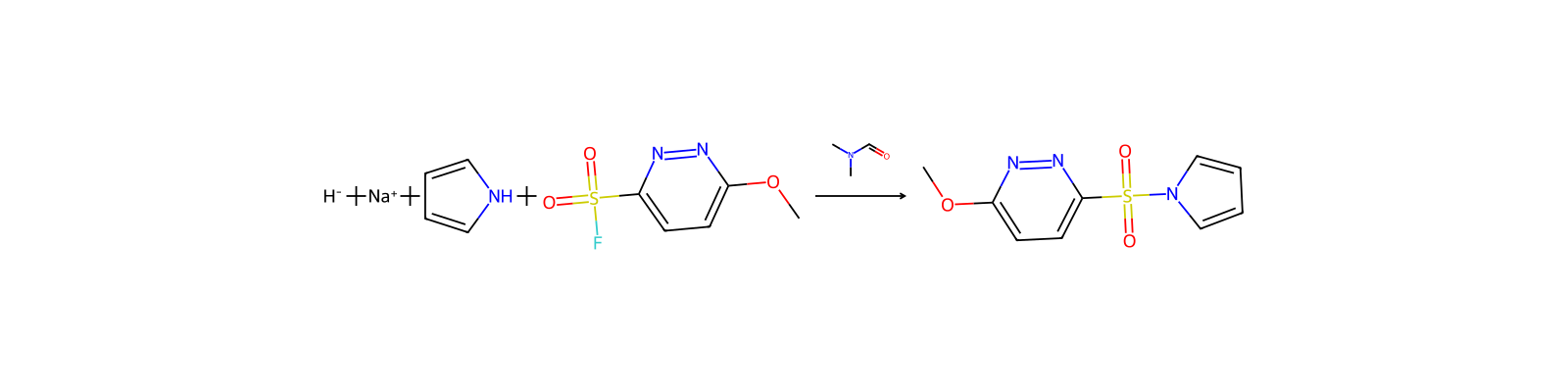
使用用途ピロールは、有機合成やポリマーの製造、鉄鋼材料の腐食防止剤、などの電解質、および溶剤として利用されています。 また、ピロールとアルデヒドを酸性条件で縮合するとポルフィリンが合成可能です。ポルフィリンは、導電性や発光性などの特徴を持っています。 この性質により、実験でとして用いられるとともに、太陽電池や有機ELの発光材料への応用などが検討されています。そのほか、ピロールは、亜セレン酸やケイ酸の検出試薬としても使用可能です。
調製方法
製造方法By fractional distillation of bone oil (bone oil is obtained by destructive distillation of animal bone) and subsequent purification via the corresponding potassium salt; by thermal decomposition of ammonium mucate in glycerol or mineral oil.
Pyrrole originally was prepared industrially by fractional distillation of coal tar, bone oil or other protein material, and purified through formation of its potassium derivative (Runge, 1834; Michelman, 1925). Later it was produced by heating ammonium mucate with glycerol or mineral oil (Blicke and Powers, 1927; McElvain and Bollinger, 1941). It is now manufactured by addition of ammonia to either acetylene or butadiene. Good yields of pyrrole also may be obtained from the reaction of ammonia with the corresponding heterocyclic compound (furan) in a vapor-phase process at 480° to 500°C, using alumina as a catalyst (Thompson, 1972) or by catalytic reaction of furan with ammonia over a molybdenum or vanadium oxide catalyst at 350-400°C (Bishop and Denton, 1950).
純化方法Dry pyrrole with NaOH, CaH2 or CaSO4. Fractionally distil it under reduced pressure from CaH2. Store it under nitrogen as it turns brown in air. Redistil it immediately before use. The picrate forms orange-red crystals with m 69o(dec). [Beilstein 20 H 4, 20 I 3, 20 II 3, 20 III/IV 61, 20/5 V 3.]
上流・下流製品情報
上流原料
下流製品
サプライヤー30 社
郑州阿尔法化工有限公司+86-18530059196 · [email protected]
艾吉析科技(上海)有限公司17717235263 · [email protected]
江苏星科元信息科技有限公司400-605-7200 15335295587
湖北云镁科技有限公司027-59206672 18995657604 · [email protected]
Aladdin Scientific[email protected]
安耐吉化学&3A(安徽泽升科技有限公司)021-58432009 400-005-6266 · [email protected]
上海相辉医药科技有限公司13761987713; 13761987713 · [email protected]
上海麦克林生化科技股份有限公司15221275939 15221275939 · [email protected]
Sigma-Aldrich西格玛奥德里奇(上海)贸易有限公司021-61415566 800-8193336 · [email protected]
广东翁江化学试剂有限公司0751-2886766 13927870850 · [email protected]
上海玻尔化学试剂有限公司19102157732 · [email protected]
上海阿拉丁生化科技股份有限公司6206333 13167063860 · [email protected]
北京华威锐科化工科技有限公司89508211 18501085097 · [email protected]
上海源叶生物科技有限公司13636370518 · [email protected]
安徽酷尔生物工程有限公司0551-65171243 13856024262 · [email protected]
郑州汇聚化工有限公司0371-55900031 18137872243 · [email protected]
Shanghai Acmec Biochemical Technology Co., Ltd.+86-18621343501 · [email protected]
湖北诺纳科技有限公司59209883 17386169806 · [email protected]
江苏艾康生物医药研发有限公司025-58851090 13913916777 · [email protected]
上海易恩化学技术有限公司400-400-1332688 18019345275 · [email protected]
天津希恩思生化科技有限公司400-6387771-6039 18920764717 · [email protected]
上海迈瑞尔生化科技有限公司18621169109 · [email protected]
SHANGHAI KEAN TECHNOLOGY CO., LTD.+8613817748580 · [email protected]
BOC Sciences+1-631-485-4226 · [email protected]
上海皓鸿生物医药科技有限公司400-8210725 4008210725 · [email protected]
湖北诺纳科技有限公司027-59209883 17386138556 · [email protected]
湖北云镁科技有限公司59206672 18327059871 · [email protected]
湖北鑫红利化工有限公司027-027-59106151 15172325309 · [email protected]
上海易恩化学技术有限公司400-1332688 18019345275 · [email protected]
陕西缔都化学有限公司17691182729 17392216275 · [email protected]
補足説明
定義ChEBI: 1H-pyrrole is a tautomer of pyrrole that has the double bonds at positions 2 and 4. It is a pyrrole and a secondary amine. It is a tautomer of a 2H-pyrrole and a 3H-pyrrole.
関連反応
481 件


関連ノート
読み込み中…