
HRID 450960反応物として
Tetrallylstannane
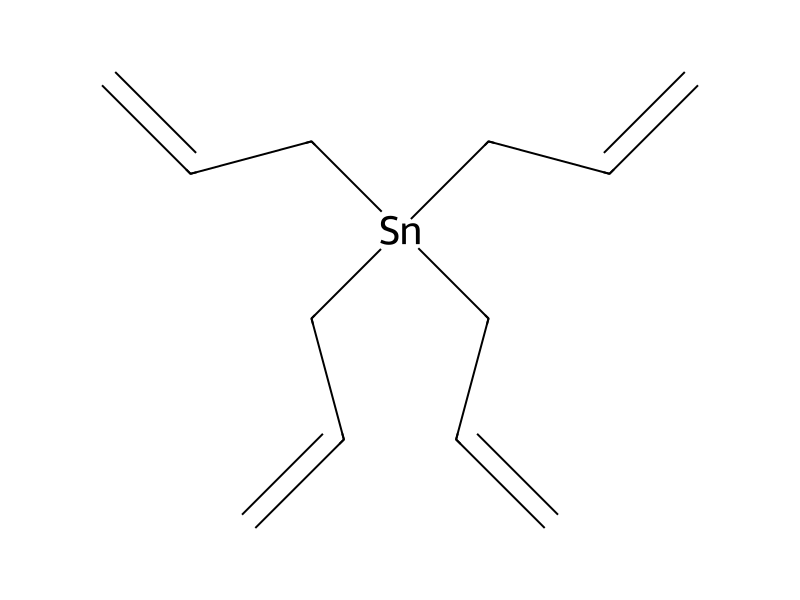
7393-43-3C=C[CH2][Sn]([CH2]C=C)([CH2]C=C)[CH2]C=CXJPKDRJZNZMJQM-UHFFFAOYSA-N7393-43-3DTXSID80224580化学的特性Clear Colorless liquid
安全情報は参考情報です。供給元の安全データシート(SDS)、適用法令、専門家による評価に代わるものではありません。
Danger
H301 (100%): Toxic if swallowed [Danger Acute toxicity, oral]
P260, P261, P262, P264, P264+P265, P270, P271, P273, P280, P284, P301+P316, P302+P352, P304+P340, P305+P351+P338, P316, P320, P321, P330, P332+P317, P337+P317, P361+P364, P362+P364, P391, P403+P233, P405, and P501 (click each P-code to see the statement)
Aggregated GHS information provided per 6 reports by companies from 2 notifications to the ECHA C&L Inventory. Each notification may be associated with multiple companies.
使用Applied as allyl transfer reagent.
製造方法Tetraallyltin is synthesized by the reaction of Allylmagnesium Bromide with Tin(IV) Chloride in THF.
純化方法Possible contaminants are allyl chloride and allyltin chloride. Check the 1H NMR and IR [Fishwick & Wallbridge J Organomet Chem 25 69 1970], and if impure, dissolve it in Et2O and shake it with a 5% aqueous solution of NaF which precipitates allyltin fluoride. Separate the Et2O layer, dry (MgSO4) and distil it at ~ 0.2mm. It decomposes slightly on repeated distillation. [O'Brien et al. Inorg Synth XIII 75 1972, Fishwick et al. J Chem Soc (A) 57 1971, Beilstein 4 III 1922.]


