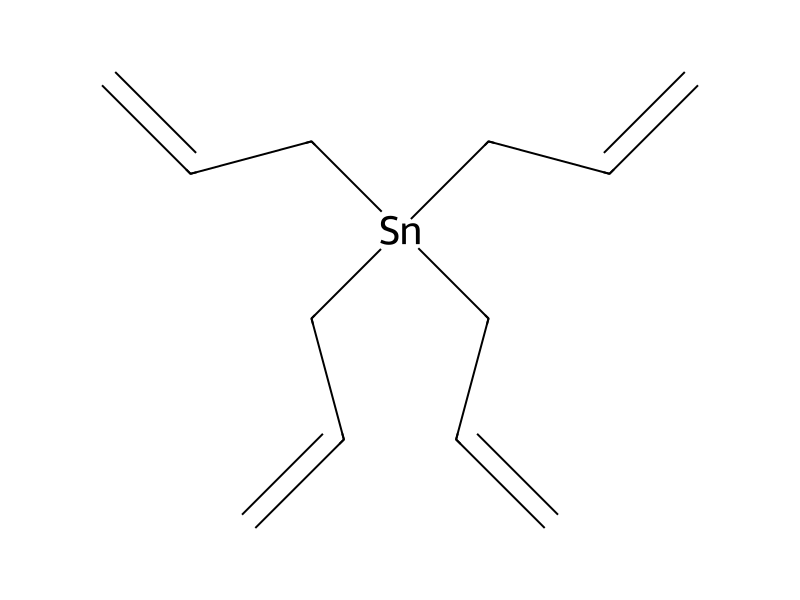
[CH:1]1[CH:6]=C2C=CC(O)=C(C3C4C(=CC=CC=4)C=CC=3O)C2=C[CH:2]=1.CC(O)C.C([Sn](CC=C)(CC=C)CC=C)C=C.[Cl:40][CH2:41][CH2:42][C:43]([C:45]1[CH:50]=[CH:49][C:48]([F:51])=[CH:47][CH:46]=1)=[O:44]>CC(C)[O-].[Ti+4].CC(C)[O-].CC(C)[O-].CC(C)[O-].C(Cl)Cl>[Cl:40][CH2:41][CH2:42][C:43]([C:45]1[CH:46]=[CH:47][C:48]([F:51])=[CH:49][CH:50]=1)([OH:44])[CH2:6][CH:1]=[CH2:2]To a solution of 1,1′-bi-2-naphthol (0.2280 g, 0.80 mmol, 0.26 equiv), CH2Cl2 (5 mL) and titanium(IV) isopropoxide (0.2243 g, 0.79 mmol, 0.26 equiv) were added 2-propanol (3.1620 g, 52.6 mmol, 17 equiv), tetraallylstannane (1.2538 g, 4.43 mmol, 1.43 equiv), and 3-chloro-1-(4-fluorophenyl)propan-1-one (0.5760 g, 3.09 mmol, 1.0 equiv) successively. The reaction mixture was stirred at rt under nitrogen for 22 h. The reaction was quenched with satd aq NH4Cl and extracted with EtOAc. The organic layer was dried over Na2SO4. After the solvents were evaporated, the residue was purified by chromatography on silica gel eluted with hexanes/EtOAc to afford 1-chloro-3-(4-fluorophenyl)hex-5-en-3-ol as an oil.