
1-ヒドロキシアントラキノン
1-Hydroxyanthraquinone
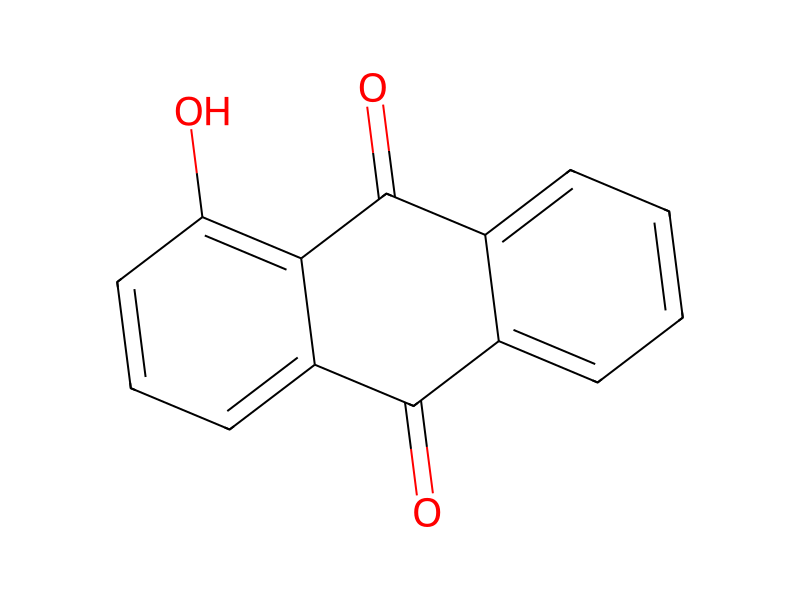
基本情報
- CAS
129-43-1- 標準SMILES
O=C1c2ccccc2C(=O)c2c(O)cccc21- InChIKey
BTLXPCBPYBNQNR-UHFFFAOYSA-N- 分子式
- C14H8O3
- 平均分子量
- 224.21 g/mol
- 単同位体質量
- 224.04734411
概要
1-Hydroxyanthraquinone can cause cancer according to California Labor Code.
名称と識別子
- 優先名称
- 1-Hydroxyanthraquinone
- IUPAC
- 1-hydroxyanthracene-9,10-dione
- 現地名
- 1-ヒドロキシアントラキノン
- 英語名
- 1-Hydroxy anthraquinone
- 分子式
- C14H8O3
- 分子量
- 224.21
名称と別名
1-HYDROXYANTHRAQUINONE129-43-11-hydroxyanthracene-9,10-dione9,10-Anthracenedione, 1-hydroxy-1-Hydroxy-9,10-anthraquinoneHydroxyanthraquinone1-HydroxyanthrachinonAnthraquinone, 1-hydroxy-alpha-HydroxyanthraquinoneLFU129OE9H1-hydroxy-9,10-anthracenedioneCHEBI:28877
名称をさらに表示
1-ヒドロキシアントラキノン1-ヒドロキシ-アントラセン-9,10-ジオン1-ヒドロキシアントラセン-9,10-ジオン1-ヒドロキシ-9,10-アントラキノン9,10-ジヒドロ-9,10-ジオキソアントラセン-1-オール1-ヒドロキシ-9,10-アントラセンジオン1ヒドロキシアントラキノン[[[1-ヒドロキシアントラキノン1‐ヒドロキシアントラキノン1-HAQNISTC129431I-0syanthrachinon1-hydroxy-anthraquinonerythroxyanthraquinone
NSC-8640DTXSID1020722RefChem:76013DTXCID70722204-946-71-Hydroxy anthraquinone1-Hydroxyanthra-9,10-quinoneMFCD00058946
データベース識別子
- CAS
129-43-1- PubChem CID
- 8512
- DTXSID
DTXSID1020722- ChEMBL
CHEMBL501834- ChEBI
CHEBI:28877- UNII
- LFU129OE9H
- EC Number
- 204-946-7
- Nikkaji
- J53.422F
物性
構造計算による物性
- XLogP
- 3.5
- 極性表面積
- 54.4 Ų
- 水素結合供与体数
- 1
- 水素結合受容体数
- 3
- 回転可能結合数
- 0
- 重原子数
- 17
- 形式電荷
- 0
- 複雑度
- 349
実験および物理化学的性質
Chemical ClassesDyes -> Anthraquinone Dyes
SpringerMaterials Properties13C nuclear magnetic resonance spectrum
LogP
log Kow = 3.52
3.52
Color/Form
Orange red needles
Red-orange needles from ethyl alcohol
Orange-red to fine yellow crystals in ethanol
Solubility
Soluble in ethanol, ethyl ether, and benzene.
Soluble in oxygenated solvents
Slightly soluble in liquid NH3
In water, 8.5 mg/L @ 25 °C
Boiling PointSublimes
DecompositionWhen heated to decomposition it emits acrid smoke and fumes.
Melting Point193.8 °C
Vapor Pressure
0.00000021 [mmHg]
2.09X10⁻⁷ mm Hg @ 25 °C
Henry's Law ConstantHenry's Law constant = 7.2X10⁻⁹ atm-cu m/mole @ 25 °C /Estimated/
Physical DescriptionOrange-red to yellow solid; [HSDB] Orange powder; [MSDSonline]
Other Experimental PropertiesHydroxyl radical reaction rate constant = 1.4X10⁻¹¹ cu cm/molecul-sec @ 25 °C /Estimated/
物理化学的性質
- 融点
- 194 °C · 194°C
- 沸点
- 325.61 °C · 325.61°C (rough estimate)
- 比重(密度)
- 1.2337 · 1.2337 (rough estimate)
- 屈折率
- 1.54 · 1.5400 (estimate)
- 貯蔵温度
- Inert atmosphere,Room Temperature
- 溶解性
- 30 mg/ml · Chloroform: 30 mg/ml
- 外見
- powder to crystal
- 酸解離定数(Pka)
- 7.15 · 7.15±0.20(Predicted)
- 色
- Light yellow to Brown
- Henry's Law Constant
- 1.4 · 1.4×103 mol/(m3Pa) at 25℃, Duchowicz et al. (2020)
- InChI
- 1S/C14H8O3/c15-11-7-3-6-10-12(11)14(17)9-5-2-1-4-8(9)13(10)16/h1-7,15H
- InChIKey
- BTLXPCBPYBNQNR-UHFFFAOYSA-N
- SMILES
- Oc1cccc2C(=O)c3ccccc3C(=O)c12
- CAS データベース
- 129 · 129-43-1(CAS DataBase Reference)
- NISTの化学物質情報
- 9 · 9,10-Anthracenedione, 1-hydroxy-(129-43-1)
- EPAの化学物質情報
- 9 · 9,10-Anthracenedione, 1-hydroxy- (129-43-1)
安全と法規制
安全情報は参考情報です。供給元の安全データシート(SDS)、適用法令、専門家による評価に代わるものではありません。
GHS分類
GHS Classification
Warning
H319 (100%): Causes serious eye irritation [Warning Serious eye damage/eye irritation]
P203, P264+P265, P280, P305+P351+P338, P318, P337+P317, P405, and P501 (click each P-code to see the statement)
Aggregated GHS information provided per 40 reports by companies from 3 notifications to the ECHA C&L Inventory. Each notification may be associated with multiple companies.
Warning
H320: Causes eye irritation [Warning Serious eye damage/eye irritation]
危険有害性情報
Regulatory InformationHazard Traits - Carcinogenicity
Hazards SummaryAnthraquinones are toxic by ingestion: vomiting, diarrhea, kidney and liver damage, and coma; Deaths have been reported after children ingested Rhamnus berries; [HSDB] An eye irritant; [HSDB] An irritant; [MSDSonline]
Hazard Classes and Categories
Eye Irrit. 2 (100%)
Serious eye damage/eye irritation - Category 2B
Shipment Methods and Regulations
PRECAUTIONS FOR "CARCINOGENS": Procurement ... of unduly large amt ... should be avoided. To avoid spilling, carcinogens should be transported in securely sealed glass bottles or ampoules, which should themselves be placed inside strong screw-cap or snap-top container that will not open when dropped & will resist attack from the carcinogen. Both bottle & the outside container should be appropriately labelled. ... National post offices, railway companies, road haulage companies & airlines have regulations governing transport of hazardous materials. These authorities should be consulted before ... material is shipped. /Chemical Carcinogens/
PRECAUTIONS FOR "CARCINOGENS": When no regulations exist, the following procedure must be adopted. The carcinogen should be enclosed in a securely sealed, watertight container (primary container), which should be enclosed in a second, unbreakable, leakproof container that will withstand chem attack from the carcinogen (secondary container). The space between primary & secondary container should be filled with absorbent material, which would withstand chem attack from the carcinogen & is sufficient to absorb the entire contents of the primary container in the event of breakage or leakage. Each secondary container should then be enclosed in a strong outer box. The space between the secondary container & the outer box should be filled with an appropriate quantity of shock-absorbent material. Sender should use fastest & most secure form of transport & notify recipient of its departure. If parcel is not received when expected, carrier should be informed so that immediate effort can be made to find it. Traffic schedules should be consulted to avoid ... arrival on weekend or holiday ... /Chemical Carcinogens/
Skin, Eye, and Respiratory IrritationsAn eye irritant.
安全と保護具
Storage Conditions
PRECAUTIONS FOR "CARCINOGENS": Storage site should be as close as practical to lab in which carcinogens are to be used, so that only small quantities required for ... expt need to be carried. Carcinogens should be kept in only one section of cupboard, an explosion-proof refrigerator or freezer (depending on chemicophysical properties ...) that bears appropriate label. An inventory ... should be kept, showing quantity of carcinogen & date it was acquired ... Facilities for dispensing ... should be contiguous to storage area. /Chemical Carcinogens/
Cleanup Methods
PRECAUTIONS FOR "CARCINOGENS": A high-efficiency particulate arrestor (HEPA) or charcoal filters can be used to minimize amt of carcinogen in exhausted air ventilated safety cabinets, lab hoods, glove boxes or animal rooms ... Filter housing that is designed so that used filters can be transferred into plastic bag without contaminating maintenance staff is avail commercially. Filters should be placed in plastic bags immediately after removal ... The plastic bag should be sealed immediately ... The sealed bag should be labelled properly ... Waste liquids ... should be placed or collected in proper containers for disposal. The lid should be secured & the bottles properly labelled. Once filled, bottles should be placed in plastic bag, so that outer surface ... is not contaminated ... The plastic bag should also be sealed & labelled. ... Broken glassware ... should be decontaminated by solvent extraction, by chemical destruction, or in specially designed incinerators. /Chemical Carcinogens/
Disposal Methods
SRP: The most favorable course of action is to use an alternative chemical product with less inherent propensity for occupational exposure or environmental contamination. Recycle any unused portion of the material for its approved use or return it to the manufacturer or supplier. Ultimate disposal of the chemical must consider: the material's impact on air quality; potential migration in soil or water; effects on animal, aquatic, and plant life; and conformance with environmental and public health regulations.
PRECAUTIONS FOR "CARCINOGENS": There is no universal method of disposal that has been proved satisfactory for all carcinogenic compounds & specific methods of chem destruction ... published have not been tested on all kinds of carcinogen-containing waste. ... summary of avail methods & recommendations ... /given/ must be treated as guide only. /Chemical Carcinogens/
PRECAUTIONS FOR "CARCINOGENS": ... Incineration may be only feasible method for disposal of contaminated laboratory waste from biological expt. However, not all incinerators are suitable for this purpose. The most efficient type ... is probably the gas-fired type, in which a first-stage combustion with a less than stoichiometric air:fuel ratio is followed by a second stage with excess air. Some ... are designed to accept ... aqueous & organic-solvent solutions, otherwise it is necessary ... to absorb soln onto suitable combustible material, such as sawdust. Alternatively, chem destruction may be used, esp when small quantities ... are to be destroyed in laboratory. /Chemical Carcinogens/
毒性情報
Interactions... In addition, 1-HAQ has a synergistic effect with methylazoxymethaol (MAM) acetate on colon carcinogenesis.
Environmental Fate
TERRESTRIAL FATE: Based on a classification scheme(1), an estimated Koc value of 2,000(SRC), determined from a log Kow of 3.52(2) and a regression-derived equation(3), indicates that 1-hydroxyanthraquinone is expected to have slight mobility in soil(SRC). Volatilization of 1-hydroxyanthraquinone from moist soil surfaces is not expected to be an important fate process(SRC) given an estimated Henry's Law constant of 7.2X10⁻⁹ atm-cu m/mole(SRC), derived from its vapor pressure, 2.09X10⁻⁷ mm Hg(4), and water solubility, 8.5 mg/l(5). 1-Hydroxyanthraquinone is not expected to volatilize from dry soil surfaces(SRC) based upon it's vapor pressure(4). Biodegradation in soil is not expected to be an important environmental fate process based on a 1-5% theoretical BOD using activated sludge and the Japanese MITI test(6).
AQUATIC FATE: Based on a classification scheme(1), an estimated Koc value of 2,000(SRC), determined from a log Kow of 3.52(2) and a regression-derived equation(3), indicates that 1-hydroxyanthraquinone is expected to adsorb to suspended solids and sediment(SRC). Volatilization from water surfaces is not expected(3) based upon an estimated Henry's Law constant of 7.2X10⁻⁹ atm-cu m/mole(SRC), derived from its vapor pressure, 2.09X10⁻⁷ mm Hg(4), and water solubility, 8.5 mg/l(5). According to a classification scheme(6), BCFs ranging from 55-318(7), suggest the potential for bioconcentration in aquatic organisms is moderate to high(SRC). Biodegradation in water is not expected to be an important environmental fate process based on a 1-5% theoretical BOD using activated sludge and the Japanese MITI test(8). However, in most anoxic sediments, uncharged simple anthraquinone dyes exhibit half-lives of less than 10 days(8).
ATMOSPHERIC FATE: According to a model of gas/particle partitioning of semivolatile organic compounds in the atmosphere(1), 1-hydroxyanthraquinone, which has a vapor pressure of 2.09X10⁻⁷ mm Hg at 25 °C(2), will exist in both the vapor and particulate phases in the ambient atmosphere. Vapor-phase 1-hydroxyanthraquinone is degraded in the atmosphere by reaction with photochemically-produced hydroxyl radicals(SRC); the half-life for this reaction in air is estimated to be 28 hrs(SRC), calculated from its rate constant of 1.4X10⁻¹¹ cu cm/molecule-sec at 25 °C(SRC) that was derived using a structure estimation method(3). Particulate-phase 1-hydroxyanthraquinone may be removed from the air by wet and dry deposition(SRC). 1-Hydroxyanthraquinone isomers photodecomposed under irradiation with visible light in aerated alkaline solution, with phthalic acid as the main product(4).
安全データ
- wgk
- WGK 3
- tsca
- TSCA listed
- rtecs
- CB7178000
- hs_code
- 2914.69.9000
- risk_code
- 36/37/38-40-36
- 化審法
- (4)-703
- hazard_code
- Xn
- safety_code
- 26-36/37/39-45
- Hazard Classifications
- Carc. 2Eye Irrit. 2
- ストレージクラス
- 11 - Combustible Solids
- 有毒物質データの
- 129-43-1(Hazardous Substances Data)
化学と産業
薬理情報
Metabolism/Metabolites
... 1-Hydroxyanthraquinone was found to be absorbed when continuously administered to rats (strain not specified) by stomach tube (50 mg suspended in aqueous gum arabic), and its metabolites were identified by paper chromatography. Urine and feces were collected during 48 hours after treatment and extracted with diethyl ether. Of the 1-hydroxyanthraquinone originally present, 2.49% and 0.74% were converted into alizarin (1,2-dihydroxyanthraquinone), in urine and feces, respectively. The alizarin was then excreted after sulfation and glucuronidation.
MeSH Pharmacological ClassificationSubstances that increase the risk of NEOPLASMS in humans or animals. Both genotoxic chemicals, which affect DNA directly, and nongenotoxic chemicals, which induce neoplasms by other mechanism, are included.
Absorption, Distribution and Excretion
1-Hydroxyanthraquinone was found to be absorbed when continuously administered to rats (strain not specified) by stomach tube (50 mg suspended in aqueous gum arabic), and its metabolites were identified by paper chromatography. Urine and feces were collected during 48 hours after treatment and extracted with diethyl ether. Of the 1-hydroxyanthraquinone originally present, 2.49% and 0.74% were converted into alizarin (1,2-dihydroxyanthraquinone), in urine and feces, respectively. The alizarin was then excreted after sulfation and glucuronidation.
用途と製造
Uses
Used to make dyes and pharmaceuticals; [HSDB]
1-Hydroxyanthraquinone can be used as an intermediate in the production of dyes and drugs.
Methods of Manufacturing
A general method for synthesis of anthraquinones, including 1-hydroxy-anthraquinone, has been developed. The anthraquinones were obtained under mild conditions from ortho-dicarboxylic acid chlorides and suitable aromatic substrates via a FriedelCrafts process.
1-Hydroxyanthraquinone has been synthesized by diazotization of 1-aminoanthraquinone and heating the diazonium salt with concentrated sulfuric acid. After dilution with water, the precipitated crude product was diluted with acetone and purified by preparative thin-layer chromatography (TLC) in toluene:ethyl formate:formic acid (75:24:1).
1-Hydroxyanthraquinone has also been prepared in 96.4% yield by reacting 1-nitroanthraquinone with sodium formate in dimethylformamide at 130 C for 17 hours.
General Manufacturing Information
9,10-Anthracenedione, 1-hydroxy-: INACTIVE
1-Hydroxyanthraquinone has been isolated from the roots of Rubia cordifolia, Morinda officinalis and Damnacanthus indicus, from the heartwood of Tabebuia avellanedae and the herb Cassia occidentalis.
上流・下流製品情報
上流原料
下流製品
関連反応
7 件


化合物ノート
読み込み中…