ホームMCPワークベンチSkills
ホームワークベンチ通知マイページ
llms.txt · MCPガイドプライバシーポリシー · 利用規約 · サポートv1.8.0
  1. ホーム
  2. /化合物

(±)-trans-1,2-シクロヘキサンジカルボン酸無水物

Hexahydrophthalic anhydride

HCID 85689
ノートを作成反応を作成見積依頼を出す
印刷プレビュー
基本情報概要名称と識別子物性安全と法規制化学と産業関連反応化合物ノート
部分構造検索類似構造を探す

基本情報

CAS
14166-21-3
標準SMILES
O=C1OC(=O)C2CCCCC12
InChIKey
MUTGBJKUEZFXGO-UHFFFAOYSA-N
分子式
C8H10O3
平均分子量
154.16 g/mol
単同位体質量
154.06299418

概要

Hexahydrophthalic anhydride is a cyclic dicarboxylic anhydride that is the cyclic anhydride of hexahydrophthalic acid. It has a role as an allergen. It is a cyclic dicarboxylic anhydride and a tetrahydrofurandione.

名称と識別子

優先名称
Hexahydrophthalic anhydride
IUPAC
3a,4,5,6,7,7a-hexahydro-2-benzofuran-1,3-dione
現地名
(±)-trans-1,2-シクロヘキサンジカルボン酸無水物
英語名
(+/-)-trans-1,2-Cyclohexanedicarboxylic anhydride
分子式
C8H10O3
分子量
154.16

名称と別名

Hexahydrophthalic anhydride85-42-71,2-Cyclohexanedicarboxylic anhydrideHHPALekutherm Hardener H1,3-Isobenzofurandione, hexahydro-Araldite HT 907Hexahydrophthalic acid anhydrideCyclohexane-1,2-dicarboxylic anhydride1,2-Cyclohexanedicarboxylic acid anhydridehexahydro-1,3-isobenzofurandioneHexahydro-2-benzofuran-1,3-dione
名称をさらに表示
(±)-trans-1,2-シクロヘキサンジカルボン酸無水物3aα,4,5,6,7,7aβ-ヘキサヒドロ-1,3-イソベンゾフランジオン3aα,4,5,6,7,7aβ-ヘキサヒドロイソベンゾフラン-1,3-ジオンシクロヘキサン-1α,2β-ジカルボン酸無水物rac-1α*,2β*-シクロヘキサンジカルボン酸無水物(1S,6S)-8-オキサビシクロ[4.3.0]ノナン-7,9-ジオン1α,2β-シクロヘキサンジカルボン酸無水物trans-シクロヘキサン-1,2-ジカルボン酸無水物TRANS-1,2-シクロヘキサンジカルボン酸無水物(3aS,7aS)-オクタヒドロ-2-ベンゾフラン-1,3-ジオンtrans-cyclohexane-1,2-dicarboxylic anhydrideEinecs 238-009-9TRANS-HEXAHYDROPHTHALIC ANHYDRIDEtrans-Hexahydroisobenzofuran-1,3-dione1,3-Isobenzofurandione, hexahydro-, trans-TRANS-1,2-CYCLOHEXANEDICARBOXYLIC ANHYDRIDE1,2-Cyclohexanedicarboxylic anhydride, transrel-(3aR,7aR)-Hexahydroisobenzofuran-1,3-dionetrans-1,2-Cyclohexanedicarboxylic anhydride 97%(±)-trans-1,2-Cyclohexanedicarboxylic Anhydride

データベース識別子

CAS
14166-21-3、85-42-7
PubChem CID
85689
DTXSID
DTXSID8026515
ChEMBL
CHEMBL273968
ChEBI
CHEBI:103210
EC Number
201-604-9
Nikkaji
J70.181E

物性

構造計算による物性

XLogP
1.2
極性表面積
43.4 Ų
水素結合供与体数
0
水素結合受容体数
3
回転可能結合数
0
重原子数
11
形式電荷
0
複雑度
187

実験および物理化学的性質

PolymersPlastics & Rubber -> Acid Anhydrides, Cyclic
LogP21.4
Density · 2 件

1.19 at 40 °C

5.3

Color/Form · 2 件

Clear, colorless, viscous liquid

... becomes a glassy solid at 35-36 °C

Solubility · 2 件

Miscible with benzene, toluene, acetone, carbon tetrachloride, chloroform, ethanol, and ethyl acetate; slightly soluble in petroleum ether

Solubility in water: reaction

Flash Point · 2 件

149 °C (open cup)

300.2 °F

Boiling Point · 3 件

BP: 145 °C at 18 mm Hg

296 °C

564.8 °F

Decomposition · 2 件

Decomposition products: converts to hexahydrophthalic acid in the presence of water

Hazardous decomposition products formed under fire conditions. - Carbon oxides.

Melting Point · 3 件

32 °C

35-36 °C

89.6 °F

安全と法規制

安全情報は参考情報です。供給元の安全データシート(SDS)、適用法令、専門家による評価に代わるものではありません。

GHS分類

GHS Classification · 6 件

Danger

H317: May cause an allergic skin reaction [Warning Sensitization, Skin]

P233, P260, P261, P264+P265, P271, P272, P280, P284, P302+P352, P304+P340, P305+P354+P338, P317, P321, P333+P317, P342+P316, P362+P364, P403, and P501 (click each P-code to see the statement)

This chemical does not meet GHS hazard criteria for 0.2% (1 of 526) of reports.

Danger

H317 (99.8%): May cause an allergic skin reaction [Warning Sensitization, Skin]

危険有害性情報

Regulatory Information · 6 件

Chemical: 1,3-Isobenzofurandione, hexahydro-

Hazard Traits - Respiratory Toxicity

1,3-Isobenzofurandione, hexahydro- is listed on the EPA's Chemical Data Reporting (CDR) system. Manufacturers and importers of 1,3-Isobenzofurandione, hexahydro- are required to report information about their production and use of this chemical to the EPA under the Toxic Substances Control Act (TSCA). (40 eCFR Part 711)

REACH registered substance: Cyclohexane-1,2-dicarboxylic anhydride (EC: 201-604-9)

Substance: Cyclohexane-1,2-dicarboxylic anhydride

1,3-Isobenzofurandione, hexahydro-: Does not have an individual approval but may be used under an appropriate group standard

Other Safety InformationIMAP assessments - 1,3-Isobenzofurandione, hexahydro-: Environment tier I assessment
Fire HazardsCombustible. Gives off irritating or toxic fumes (or gases) in a fire.
Hazards Summary · 1 件

Occupational asthma reported in chemical worker; [Malo] Toxic by inhalation; A strong skin and eye irritant; [Hawley] Slowly decomposed by water forming acids; A skin and severe eye irritant; May cause skin sensitization and asthma; [ICSC] Workers with occupational contact urticaria, rhinitis, and conjunctivitis from airborne exposure had resolution of symptoms after removal from work. [ACGIH] A skin sensitizer in guinea pig maximization test; Hypersensitivity effects of human exposure include asthma, urticaria, contact dermatitis, hemolysis, and late respiratory systemic syndrome; Allergic asthma is reportedly the major hypersensitivity reaction, with most cases apparently of the IgE form; [IUCLID] Several studies have shown respiratory sensitization in humans; Mildly irritating to skin and severely irritating or corrosive to eyes of rabbits; [EPA ChAMP] An irritant that may cause serious eye injury; May cause sensitization by skin contact and inhalation; [Alfa Aesar MSDS] See ACID ANHYDRIDES. See Trimellitic anhydride.

化学と産業

薬理情報

Biological Half-LifeBiological half-life of HHP acid in plasma was approximately 2 hr.
Metabolism/Metabolites · 1 件

Human volunteers /were/ exposed at vapor levels of 10, 40, or 80 ug/cu m for 8 hours. Inhaled /hexahydrophtalic anhydride/ (HHPA) was almost completely absorbed in the respiratory tract, probably as /hexahydrophthalic acid/ (HHP acid) after hydrolysis on the mucus membrane. HHP acid in plasma rapidly increased without reaching steady state during exposure and decreased rapidly following removal from exposure. HHP acid was excreted through the kidneys.

MeSH Pharmacological ClassificationAgents causing the narrowing of the lumen of a bronchus or bronchiole.
Absorption, Distribution and Excretion · 2 件

Six healthy volunteers were exposed to gaseous hexahydrophthalic anhydride (HHPA) ... for 8 hr. The respiratory uptake of the inhaled HHPA was almost complete. Rapid increases in plasma and urinary levels of hexahydrophthalic acid (HHP acid) were seen. During the first 4 hr after the end of exposure, the half-time of HHP acid in plasma was about 2 hr. A corresponding decay was seen in urine. The correlations (r > 0.90) between the air concentrations of HHPA and the levels of HHP acid in plasma and urine were close. They were even closer (r > 0.96) when the total respiratory uptake of HHPA was used. Urinary pH adjustment by intake of ammonium chloride or sodium hydrogen carbonate did not significantly alter the excretion of HHP acid. The results show that the analysis of HHP acid in plasma or urine is useful as a biological monitor for exposure to HHPA.

Human volunteers /were/ exposed at vapor levels of 10, 40, or 80 ug/cu m for 8 hours. Inhaled /hexahydrophtalic anhydride/ (HHPA) was almost completely absorbed in the respiratory tract, probably as /hexahydrophthalic acid/ (HHP acid) after hydrolysis on the mucus membrane. HHP acid in plasma rapidly increased without reaching steady state during exposure and decreased rapidly following removal from exposure. HHP acid was excreted through the kidneys.

用途と製造

関連反応

88 件
反応記録を作成
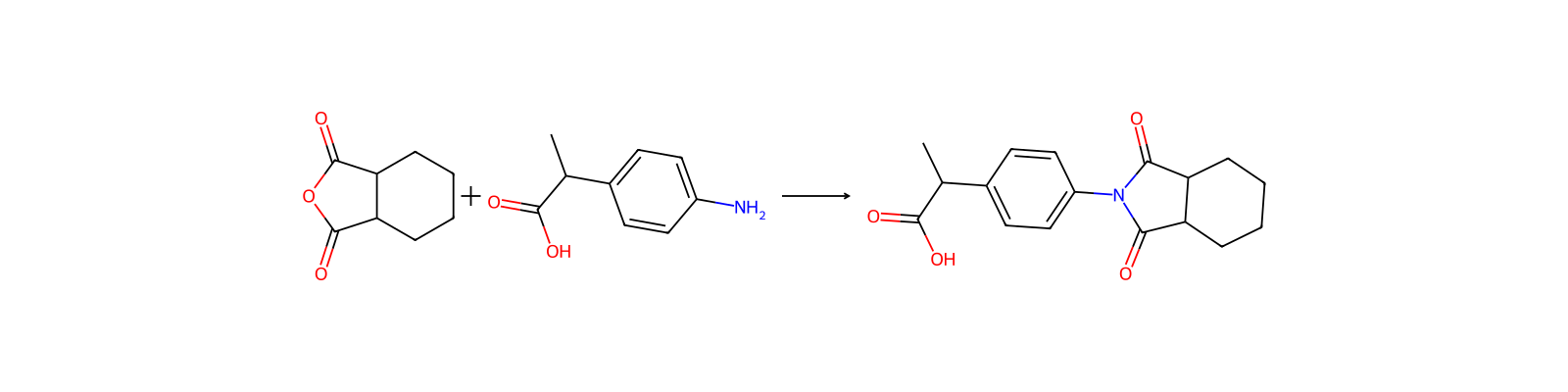
HRID 3068 の反応式
HRID 3068反応物としてuspto-grants-1998_03
HRID 3070 の反応式
HRID 3070反応物としてuspto-grants-1998_03
HRID 47006 の反応式
HRID 47006反応物としてuspto-grants-1979_11
HRID 47008 の反応式
HRID 47008反応物としてuspto-grants-1979_11
HRID 91314 の反応式
HRID 91314生成物としてTraining data from https://doi.org/10.1039/C8SC04228D (2/10)
HRID 95361 の反応式
HRID 95361反応物としてTraining data from https://doi.org/10.1039/C8SC04228D (2/10)
HRID 106587 の反応式
HRID 106587反応物としてTraining data from https://doi.org/10.1039/C8SC04228D (2/10)
HRID 154407 の反応式
HRID 154407反応物としてTraining data from https://doi.org/10.1039/C8SC04228D (9/10)
1 / 11 ページ

化合物ノート

読み込み中…

このページの内容基本情報概要名称と識別子物性安全と法規制化学と産業関連反応化合物ノート
その他の操作
ノートを作成反応を作成見積依頼を出す
DTXSID8026515CHEBI:103210DTXCID906515RefChem:146059Hexahydrophthalic anhydride, all isomers201-604-9Hexahydroisobenzofuran-1,3-dioneoctahydro-2-benzofuran-1,3-dione
Vapor Density · 2 件

Relative vapor density (air = 1): 5.3

1.19

Vapor Pressure · 3 件

0.05 [mmHg]

Vapor pressure, Pa at 25 °C: 0.9

5.35x10(-2)

Physical Description · 4 件

Dry Powder; Other Solid; Large Crystals; Liquid

Solid; [ICSC] Glassy solid; [EPA ChAMP] White solid; [Alfa Aesar MSDS]

SOLID IN VARIOUS FORMS.

Dry powder or solid in various forms, or clear, colorless, viscous liquid.

物理化学的性質

融点
145 · 145-147 °C(lit.)
沸点
283.4 · 283.4±0.0 °C(Predicted)
比重(密度)
1.235 · 1.235±0.06 g/cm3(Predicted)
貯蔵温度
2 · Sealed in dry,2-8°C
溶解性
アセトン(少々)、クロロホルム(少々)、DMSO(少々)
外見
個体
色
ホワイト~ペールベージュ
安定性
湿気に敏感
InChI
1S/C8H10O3/c9-7-5-3-1-2-4-6(5)8(10)11-7/h5-6H,1-4H2/t5-,6-/m0/s1
InChIKey
MUTGBJKUEZFXGO-WDSKDSINSA-N
SMILES
O=C1OC(=O)[C@H]2CCCC[C@H]12
CAS データベース
14166 · 14166-21-3
EC ClassificationNote: C; Symbol: Xn; R: 41-42/43; S: (2)-23-24-26-37/39
Chemical DangersDecomposes slowly on contact with water. This produces acid.
Hazard Classes and Categories · 5 件

Skin Sens. 1 (99.8%)

Eye damage - category 1

Serious eye damage/eye irritation - Category 1

Serious eye damage/eye irritation - Category 1

Eye Dam. 1

Skin, Eye, and Respiratory IrritationsStrong irritant to eyes and skin
Hazardous Reactivities and IncompatibilitiesMaterials to avoid: Strong oxidizing agents, strong acids, strong bases.

安全と保護具

Fire FightingUse water in large amounts.
First Aid Measures · 4 件

Fresh air, rest. Refer for medical attention.

Remove contaminated clothes. Rinse and then wash skin with water and soap.

First rinse with plenty of water for several minutes (remove contact lenses if easily possible), then refer for medical attention.

Rinse mouth. Refer for medical attention .

Safe StorageDry. Store in an area without drain or sewer access.
Fire Fighting Procedures · 2 件

Suitable extinguishing media: Use water spray, alcohol-resistant foam, dry chemical or carbon dioxide.

Special protective equipment for fire-fighter: Wear self contained breathing apparatus for fire fighting if necessary.

Storage ConditionsKeep container tightly closed in a dry and well-ventilated place.
Cleanup Methods · 2 件

ACCIDENTAL RELEASE MEASURES. Personal precautions: Use personal protective equipment. Avoid dust formation. Avoid breathing dust. Ensure adequate ventilation.

ACCIDENTAL RELEASE MEASURES. Methods and materials for containment and cleaning up: Pick up and arrange disposal without creating dust. Keep in suitable, closed containers for disposal.

Disposal Methods · 1 件

SRP: The most favorable course of action is to use an alternative chemical product with less inherent propensity for occupational harm/injury/toxicity or environmental contamination. Recycle any unused portion of the material for its approved use or return it to the manufacturer or supplier. Ultimate disposal of the chemical must consider: the material's impact on air quality; potential migration in soil or water; effects on animal and plant life; and conformance with environmental and public health regulations.

Spillage DisposalPersonal protection: complete protective clothing including self-contained breathing apparatus. Do NOT let this chemical enter the environment. Sweep spilled substance into covered containers.
Preventive Measures · 5 件

Avoid formation of dust and aerosols. Provide appropriate exhaust ventilation at places where dust is formed.

Skin and body protection: Choose body protection according to the amount and concentration of the dangerous substance at the work place.

Handle in accordance with good industrial hygiene and safety practice. Wash hands before breaks and at the end of workday.

SRP: The scientific literature for the use of contact lenses by industrial workers is inconsistent. The benefits or detrimental effects of wearing contact lenses depend not only upon the substance, but also on factors including the form of the substance, characteristics and duration of the exposure, the uses of other eye protection equipment, and the hygiene of the lenses. However, there may be individual substances whose irritating or corrosive properties are such that the wearing of contact lenses would be harmful to the eye. In those specific cases, contact lenses should not be worn. In any event, the usual eye protection equipment should be worn even when contact lenses are in place.

SRP: Local exhaust ventilation should be applied wherever there is an incidence of point source emissions or dispersion of regulated contaminants in the work area. Ventilation control of the contaminant as close to its point of generation is both the most economical and safest method to minimize personnel exposure to airborne contaminants. Ensure that the local ventilation moves the contaminant away from the worker.

Eye PreventionWear face shield or eye protection in combination with breathing protection.
Fire PreventionNO open flames.
Skin PreventionProtective gloves. Protective clothing.

毒性情報

Ecotoxicity Values · 3 件

LC50; Species: Daphnia magna (Crustacea); Conditions: static Concentration: 88 mg/L for 21 days

LC50; Species: Daphnia magna (Crustacea); Conditions: static Concentration: 103 mg/L for 24 hours

LC50; Species: Oryzias latipes (Medaka); Conditions: static freshwater; Concentration: > 500 mg/L for 48 hr; Dissolved Oxygen: 7.3-4.3 mg/L Test Temperature and Units: Value/Lower Range: 23 Upper Range: 27

Environmental Fate · 3 件

TERRESTRIAL FATE: Based on a classification scheme(1), an estimated Koc value of 10(SRC), determined from a structure estimation method(2), indicates that hexahydrophthalic anhydride is expected to have very high mobility in soil(SRC). Volatilization of hexahydrophthalic anhydride from moist soil surfaces is expected to be an important fate process(SRC) given an estimated Henry's Law constant of 2.1X10⁻⁵ atm-cu m/mole(SRC), using a fragment constant estimation method(3). Hexahydrophthalic anhydride is not expected to volatilize from dry soil surfaces(SRC) based upon an estimated vapor pressure of 5.3X10⁻² mm Hg at 25 °C(SRC), determined from a fragment constant method(4). Utilizing the Japanese MITI test, 4% of the Theoretical BOD was reached in 4 weeks(5) indicating that biodegradation is not a rapid environmental fate process in soil(SRC).

AQUATIC FATE: Based on a classification scheme(1), an estimated Koc value of 10(SRC), determined from a structure estimation method(2), indicates that hexahydrophthalic anhydride is not expected to adsorb to suspended solids and sediment(SRC). Volatilization from water surfaces is expected(3) based upon an estimated Henry's Law constant of 2.1X10⁻⁵ atm-cu m/mole(4)((SRC), developed using a fragment constant estimation method(4). Using this Henry's Law constant and an estimation method(3), volatilization half-lives for a model river and model lake are 2.3 and 20 days, respectively(SRC). According to a classification scheme(5), an estimated BCF of 13(SRC), from an estimated log Kow of 2.17(6) and a regression-derived equation(7), suggests the potential for bioconcentration in aquatic organisms is low(SRC). Hexahydrophthalic anhydride is expected to undergo hydrolysis in the environment due to the presence of functional groups that hydrolyze under environmental conditions(3). Utilizing the Japanese MITI test, 4% of the Theoretical BOD was reached in 4 weeks(8) indicating that biodegradation is not a rapid environmental fate process in water(SRC).

ATMOSPHERIC FATE: According to a model of gas/particle partitioning of semivolatile organic compounds in the atmosphere(1), hexahydrophthalic anhydride, which has an estimated vapor pressure of 5.3X10⁻² mm Hg at 25 °C(SRC), determined from a fragment constant method(2), is expected to exist solely as a vapor in the ambient atmosphere. Vapor-phase hexahydrophthalic anhydride is degraded in the atmosphere by reaction with photochemically-produced hydroxyl radicals(SRC); the half-life for this reaction in air is estimated to be 19 hrs(SRC), calculated from its rate constant of 6.8X10⁻¹² cu cm/molecule-sec at 25 °C(SRC) that was derived using a structure estimation method(3). Hexahydrophthalic anhydride does not contain chromophores that absorb at wavelengths >290 nm(4), and therefore is not expected to be susceptible to direct photolysis by sunlight(SRC).

Adverse EffectsHemolytic anemia - Decreased hemoglobin or number of red blood cells.
Exposure RoutesThe substance can be absorbed into the body by inhalation.
Signs and Symptoms · 4 件

Cough. Wheezing.

Redness.

Redness. Pain.

Sore throat. Burning sensation. Abdominal pain. Diarrhoea.

ICSC Environmental DataThe substance is harmful to aquatic organisms.
Medical Surveillance · 1 件

The objective of this study was to determine whether immunologic anhydride-induced respiratory disease could be predicted on the basis of the level of specific immunoglobulin E (IgE) or immunoglobulin G (IgG) antibody. Eighty-one anhydride-exposed employees in one plant were studied. Fourteen had disease and 67 did not. Immunologic studies were performed by enzyme-linked immunosorbent assay and expressed as titers. When optimal discriminant analysis was used, IgE < 1:5 and IgG \ 1:10 were found to be the optimal titers for separating employees with and without immunologic respiratory disease caused by anhydrides. When IgG \ 1:10 was used, 62 of 81 workers were correctly classified; the sensitivity was 100%, the positive predictive value was 45%, the specificity was 75%, and the negative predictive value was 100%. When IgE < 1:5 was used, 73 of 81 workers were correctly classified; the sensitivity was 86%, the positive predictive value was 67% ... /anhydrides/

Soil Adsorption/Mobility · 1 件

Using a structure estimation method based on molecular connectivity indices(1), the Koc of hexahydrophthalic anhydride can be estimated to be 10(SRC). According to a classification scheme(2), this estimated Koc value suggests that hexahydrophthalic anhydride is expected to have very high mobility in soil.

Human Toxicity Excerpts · 5 件

/HUMAN EXPOSURE STUDIES/ Six healthy volunteers were exposed to gaseous hexahydrophthalic anhydride (HHPA) ... for 8 hr. The respiratory uptake of the inhaled HHPA was almost complete. Rapid increases in plasma and urinary levels of hexahydrophthalic acid (HHP acid) were seen. During the first 4 hr after the end of exposure, the half-time of HHP acid in plasma was about 2 hr. A corresponding decay was seen in urine. The correlations (r > 0.90) between the air concentrations of HHPA and the levels of HHP acid in plasma and urine were close. They were even closer (r > 0.96) when the total respiratory uptake of HHPA was used. Urinary pH adjustment by intake of ammonium chloride or sodium hydrogen carbonate did not significantly alter the excretion of HHP acid. The results show that the analysis of HHP acid in plasma or urine is useful as a biological monitor for exposure to HHPA.

/HUMAN EXPOSURE STUDIES/ Organic acid anhydrides are potential sensitizers and cause occupational airway diseases. In an intervention study the efficacy of measures of hygiene at the workplace and possible selection bias were investigated. A first investigation with 110 workers exposed to hexahydrophthalic acid anhydride (HHPA) and methyltetrahydrophthalic acid anhydride (MTHPA) was carried out in July 1991. The results (skin prick test, specific serum IgE) showed that 20 people were sensitized, and in a challenge test the clinical relevance of the sensitization was confirmed in six subjects...

/HUMAN EXPOSURE STUDIES/ Nasal challenge tests were performed with a conjugate of hexahydro-1,3-isobenzofurandione (HHPA) and human serum albumin (HAS) at three increasing concentrations in exposed workers to test the pathogenetic relevance of serum antibodies (IgE and IgG) . Eleven subjects who reported work-related nasal symptoms and were IgE-sensitized against HHPA (Positive in skin-prick test and RAST against HHPA-HAS conjugate) had a decrease of nasal inspiratory peak flow and a significant increase of symptoms after the challenges. Eleven unsensitized subjects with no symptoms and nine unsensitized subjects who complained of work related nasal symptoms displayed no significant change in any parameter. The authors concluded that symptoms in some of the workers were caused by an IgE-mediated mast cell degranulation and ensuing inflammatory reaction involving eosinophil and neutrophil cells.

/HUMAN EXPOSURE STUDIES/ 53 humans. 5% suspension of hexahydro-1,3-isobenzofurandione in mineral oil (10 repeat test). Four out of fifty-three subjects gave a low grade sensitivity reaction and one marked reaction indicating sensitization. Interpretation of Results: Sensitizing .

For more Human Toxicity Excerpts (Complete) data for Hexahydrophthalic anhydride (14 total), please visit the HSDB record page.

Artificial Pollution SourcesHexahydrophthalic anhydride's production and use as a chemical intermediate and hardener in epoxy resins(1) may result in its release to the environment through various waste streams(SRC).
Environmental BiodegradationAEROBIC: Hexahydrophthalic anhydride reached 4% of its theoretical BOD in 28 days in the Japanese MITI test(1).
Environmental Bioconcentration · 1 件

An estimated BCF of 13 was calculated in fish for hexahydrophthalic anhydride(SRC), using an estimated log Kow of 2.17(1) and a regression-derived equation(2). According to a classification scheme(3), this BCF suggests the potential for bioconcentration in aquatic organisms is low(SRC).

安全データ

wgk
3
hs_code
29172090
risk_code
20/21/22-42/43-41
化審法
(3)-2416
hazard_code
Xn
safety_code
26-27-36/37/39-37/39-24-23
Hazard Classifications
Eye Dam. 1Resp. Sens. 1Skin Sens. 1
ストレージクラス
11 - Combustible Solids
Uses · 3 件

Used as a curing agent for epoxy resins and an intermediate for plasticizers and other chemicals; [Hawley] Used in the chemical, polymers, and paints, lacquers, and varnishes industries; [IUCLID]

Plastic Composites Manufacturing [Category: Industry]

Intermediate for alkyds, plasticizers, insect repellents, and rust inhibitors; hardener in epoxy resins.

U.S. Production · 4 件

2023: 10,000,000 - <50,000,000 lb

1,3-Isobenzofurandione, hexahydro- is listed as a High Production Volume (HPV) chemical (65FR81686). Chemicals listed as HPV were produced in or imported into the U.S. in >1 million pounds in 1990 and/or 1994. The HPV list is based on the 1990 Inventory Update Rule. (IUR) (40 CFR part 710 subpart B; 51FR21438).

Production volumes for non-confidential chemicals reported under the Inventory Update Rule. [Table#7749]

Production volume for non-confidential chemicals reported under the 2006 Inventory Update Rule. Chemical: 1,3-Isobenzofurandione, hexahydro-. Aggregated National Production Volume: 10 to < 50 million lbs.

Consumer UsesChelating agent
Industry UsesIntermediate
Methods of ManufacturingTetrahydrophthalic anhydride is formed by a Diels - Alder reaction with butadiene; hydrogenation of the anhydride yields hexahydrophthalic anhydride.
General Manufacturing Information · 2 件

Electrical Equipment, Appliance, and Component Manufacturing

1,3-Isobenzofurandione, hexahydro-: ACTIVE

応用分野 · 1 件

使用Trans-1,2-cyclohexanedicarboxylic anhydride can be used as a reagent to prepare hepatitis C virus (HCV) and granzyme B (indoline derivatives) inhibitors. It has also been employed in studies relating to the development of protein kinase C inhibitors.

調製方法 · 1 件

純化方法Crystallise the anhydride from *C6H6/Et2O. It has been obtained by heating the cis-acid or anhydride with HCl at 180o for 3hours. It can be obtained from the acid by heating in Ac2O. It sublimes at 125-135o/0.02mm. [Kohler & Jansen J Am Chem Soc 60 2145 1938, Fichter & Simon Helv Chim Acta 17 1218 1934, Beilstein 9 IV 2802.]

上流・下流製品情報

下流製品

cis-1,2-シクロヘキサンジカルボン酸無水物