
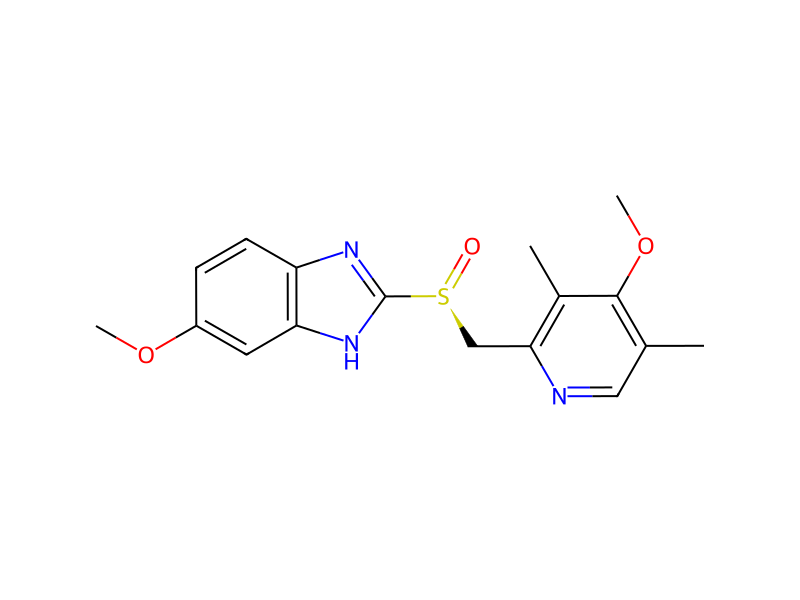
基本情報
- 標準SMILES
COc1ccc2nc([S@@](=O)Cc3ncc(C)c(OC)c3C)[nH]c2c1- InChIKey
SUBDBMMJDZJVOS-DEOSSOPVSA-N- 分子式
- C17H19N3O3S
- 平均分子量
- 345.424 g/mol
- 単同位体質量
- 345.11471247
名称と識別子
- 優先名称
- Esomeprazole
- IUPAC
- 6-Methoxy-2-[(S)-(4-methoxy-3,5-dimethylpyridin-2-yl)methanesulfinyl]-1H-benzimidazole
- 現地名
- エソメプラゾール
- 英語名
- Esomeprazole
- 分子式
- C17H19N3O3S
- 分子量
- 345.42
名称と別名
エソメプラゾールエソメプラゾールEsomeprazolEsoMaprozole5-Methoxy-2-(4-Methoxy-3,5-diMethyl-pyridin-2-ylMethanesulfinyl)-1H-benzoiMidazole5-Methoxy-2-(((4-Methoxy-3,5-diMethylpyridin-2-yl)Methyl)sulfinyl)-1H-benzo[d]iMidazole(R)-5-Methoxy-2-(((4-Methoxy-3,5-diMethylpyridin-2-yl)Methyl)sulfinyl)-1H-benzo[d]iMidazole(S)-6-Methoxy-2-(((4-methoxy-3,5-dimethylpyridin-2-yl)methyl)sulfinyl)-1H-benzo[d]imidazole(RelCpd F)119141-58-6EsomeprzoleEsomeprazole
データベース識別子
- CAS
119141-88-7- PubChem CID
- 9568614
- DTXSID
DTXSID4044292- ChEMBL
CHEMBL1201320- ChEBI
CHEBI:50275- UNII
- N3PA6559FT
- EC Number
- 643-098-6
物性
構造計算による物性
- XLogP
- 2.2
- 極性表面積
- 96.3 Ų
- 水素結合供与体数
- 1
- 水素結合受容体数
- 6
- 回転可能結合数
- 5
- 重原子数
- 24
- 形式電荷
- 0
- 複雑度
- 453
実験および物理化学的性質
LogP0.6
SolubilityVery slightly soluble in water
DecompositionHazardous decomposition products formed under fire conditions. - Carbon oxides, nitrogen oxides (NOx), Sulphur oxides, Magnesium oxide
Melting Point155
Physical DescriptionSolid
Other Experimental Properties
White to slightly colored crystalline powder. Slightly soluble in water; stability ... is a function of pH; it degrades rapidly in acidic media but has acceptable stability under alkaline conditions; half-lives of 19 and 8 hrs at 25 and 37 °C, respectively /Esomeprazole magnesium/
White to almost white crystalline powder; soluble in water /Esomeprazole strontium/
... for injection is supplied as a sterile, freeze-dried, white to off-white, porous cake or powder. ... The stability of esomeprazole sodium in aqueous solution is strongly pH dependent. /Esomeprazole sodium/
物理化学的性質
- 比旋光度
- 20 · D20 -155° (c = 0.5 in chloroform)
- 沸点
- 600 · 600.0±60.0 °C(Predicted)
- 比重(密度)
- 1.37 · 1.37±0.1 g/cm3(Predicted)
- 貯蔵温度
- Sealed in dry,Room Temperature
- 溶解性
- 30 mg/ml,DMSO: · DMF: 30 mg/ml,DMSO: 20 mg/ml,Ethanol: 10 mg/ml,PBS (pH 7.2): 10 mg/ml
- 外見
- A solid
- 酸解離定数(Pka)
- 8.5 · 8.50±0.10(Predicted)
- Henry's Law Constant
- 3.3 · 3.3×1013 mol/(m3Pa) at 25℃, HSDB (2015)
- InChI
- InChI=1S/C17H19N3O3S/c1-10-8-18-15(11(2)16(10)23-4)9-24(21)17-19-13-6-5-12(22-3)7-14(13)20-17/h5-8H,9H2,1-4H3,(H,19,20)/t24-/m0/s1
- InChIKey
- SUBDBMMJDZJVOS-DEOSSOPVSA-N
- SMILES
- C1([S@](CC2=NC=C(C)C(OC)=C2C)=O)NC2=CC(OC)=CC=C2N=1
- CAS データベース
- 119141 · 119141-88-7(CAS DataBase Reference)
安全と法規制
GHS分類
GHS Classification
Warning
H312 (100%): Harmful in contact with skin [Warning Acute toxicity, dermal];H315 (100%): Causes skin irritation [Warning Skin corrosion/irritation];H317 (100%): May cause an allergic skin reaction [Warning Sensitization, Skin];H319 (100%): Causes serious eye irritation [Warning Serious eye damage/eye irritation];H335 (100%): May cause respiratory irritation [Warning Specific target organ toxicity, single exposure; Respiratory tract irritation];H412 (100%): Harmful to aquatic life with long lasting effects [Hazardous to the aquatic environment, long-term hazard]
P261, P264, P264+P265, P271, P272, P273, P280, P302+P352, P304+P340, P305+P351+P338, P317, P319, P321, P332+P317, P333+P317, P337+P317, P362+P364, P403+P233, P405, and P501 (click each P-code to see the statement)
The GHS information provided by 1 company from 1 notification to the ECHA C&L Inventory.
危険有害性情報
Fire PotentialNot flammable or combustible.
FDA Requirements
The Approved Drug Products with Therapeutic Equivalence Evaluations identifies currently marketed prescription drug products, including esomeprazole magnesium, approved on the basis of safety and effectiveness by FDA under sections 505 of the Federal Food, Drug, and Cosmetic Act. /Esomeprazole magnesium/
The Approved Drug Products with Therapeutic Equivalence Evaluations identifies currently marketed prescription drug products, including esomeprazole sodium, approved on the basis of safety and effectiveness by FDA under sections 505 of the Federal Food, Drug, and Cosmetic Act. /Esomeprazole sodium/
The Approved Drug Products with Therapeutic Equivalence Evaluations identifies currently marketed prescription drug products, including esomeprazole strontium, approved on the basis of safety and effectiveness by FDA under sections 505 of the Federal Food, Drug, and Cosmetic Act. /Esomeprazole strontium/
Hazard Classes and CategoriesSkin Irrit. 2 (100%);Skin Sens. 1 (100%);Eye Irrit. 2 (100%);STOT SE 3 (100%);Aquatic Chronic 3 (100%)
Skin, Eye, and Respiratory IrritationsMay cause eye irritation. May be harmful if inhaled. May cause respiratory tract irritation. Harmful if absorbed through skin. May cause skin irritation.
安全と保護具
Storage ConditionsStore NEXIUM at room temperature between 68 °F to 77 °F (20 °C to 25 °C). Keep the container of NEXIUM closed tightly.
毒性情報
Interactions
In a single-dose study, concomitant administration of omeprazole 20 mg and sucralfate 1 g resulted in delayed absorption of omeprazole and decreased omeprazole bioavailability by 16%. Proton-pump inhibitors should be administered at least 30 minutes before sucralfate.
Pharmacokinetic interaction with omeprazole (decreased plasma concentrations and AUC of rilpivirine).32 343 Concomitant use of other proton-pump inhibitors also may result in decreased plasma concentration of rilpivirine.343 Concomitant use of rilpivirine and proton-pump inhibitors is contraindicated.
Concomitant use of omeprazole 40 mg once daily and atazanavir (with or without low-dose ritonavir) results in a substantial decrease in plasma concentrations of atazanavir and possible loss of the therapeutic effect of the antiretroviral agent or development of drug resistance. Concomitant use of omeprazole 40 mg once daily (administered 2 hours before atazanavir) and atazanavir 400 mg once daily decreased the AUC and peak plasma concentration of atazanavir by 94 and 96%, respectively. The manufacturer of esomeprazole states that concomitant administration with atazanavir is not recommended. If atazanavir is administered in an antiretroviral treatment-naive patient receiving a proton-pump inhibitor, a ritonavir-boosted regimen of 300 mg of atazanavir once daily with ritonavir 100 mg once daily with food is recommended. The dose of the proton-pump inhibitor should be administered approximately 12 hours before ritonavir-boosted atazanavir; the dose of the proton-pump inhibitor should not exceed omeprazole 20 mg daily (or equivalent). Concomitant use of proton-pump inhibitors with atazanavir is not recommended in antiretroviral treatment-experienced patients.
Concomitant use of omeprazole 20 mg once daily and digoxin in healthy individuals increased digoxin bioavailability by 10% (up to 30% in some individuals). Because esomeprazole is an enantiomer of omeprazole, concomitant use of esomeprazole with digoxin is expected to increase systemic exposure to digoxin; therefore, monitoring for manifestations of digoxin toxicity may be required during such concomitant use.
For more Interactions (Complete) data for Esomeprazole (7 total), please visit the HSDB record page.
Health Effects
Blurred vision, confusion, drowsiness, dry mouth, flushing headache, nausea, rapid heartbeat, sweating.
may include bone rebuild interference and B12 vitamin reduction. [Wikipedia]
Environmental Fate
TERRESTRIAL FATE: Based on a classification scheme(1), an estimated Koc value of 1500(SRC), determined from a structure estimation method(2), indicates that esomeprazole is expected to have low mobility in soil(SRC). The estimated pKa of esomeprazole is 4.78(3), indicating that this compound will exist partially in cation form in the environment and cations generally adsorb more strongly to soils containing organic carbon and clay than their neutral counterparts(4). Volatilization of neutral esomeprazole from moist soil surfaces is not expected to be an important fate process(SRC) given an estimated Henry's Law constant of 3.1X10⁻¹⁹ atm-cu m/mole(SRC), using a fragment constant estimation method(5). The cation form of esomeprazole will not volatilize(SRC). Esomeprazole is not expected to volatilize from dry soil surfaces(SRC) based upon an estimated vapor pressure of 1.2X10⁻¹¹ mm Hg at 25 °C(SRC), determined from a fragment constant method(2). Biodegradation data in soil were not available(SRC, 2013).
AQUATIC FATE: Based on a classification scheme(1), an estimated Koc value of 1500(SRC), determined from a structure estimation method(2), indicates that esomeprazole is expected to adsorb to suspended solids and sediment(SRC). An estimated pKa of 4.78(3) indicates esomeprazole will partially exist in the cation form at pH values of 5 to 9 and, therefore, volatilization from water surfaces of the ion form is not expected to be an important fate process(SRC). Volatilization of the neutral form from water surfaces is not expected(4) based upon an estimated Henry's Law constant of 3.0X10⁻¹⁹ atm-cu m/mole(SRC), developed using a fragment constant estimation method(5). According to a classification scheme(6), an estimated BCF of 14(SRC), from an estimated log Kow of 3.40(2) and a regression-derived equation(2), suggests the potential for bioconcentration in aquatic organisms is low(SRC). Biodegradation data in water were not available(SRC, 2013).
ATMOSPHERIC FATE: According to a model of gas/particle partitioning of semivolatile organic compounds in the atmosphere(1), esomeprazole, which has an estimated vapor pressure of 1.2X10⁻¹¹ mm Hg at 25 °C(SRC), determined from a fragment constant method(2), is expected to exist solely in the particulate phase in the ambient atmosphere. Particulate-phase esomeprazole may be removed from the air by wet and dry deposition(SRC). Esomeprazole does not contain chromophores that absorb at wavelengths >290 nm(4) and, therefore, is not expected to/may be susceptible to direct photolysis by sunlight(SRC).
Exposure Routes
Oral
The delayed-release capsule are enteric-coated (as omeprazole is acid-labile) so the absorption of omprazole begins once the granules leave the stomach. Absorption is rapid. Peak plasma levels occur within 0.5 - 3.5 hours. The absolute bioavailability (compared with intravenous administration) of the delayed-release capsule is 30-40% at doses of 20 - 40 mg, due to presystemic metabolism. This value increases slightly when given repeatedly. Based on a relative bioavailability study, the AUC and Cmax of PRILOSEC (omeprazole magnesium) for Delayed-Release Oral Suspension were 87% and 88% of those for PRILOSEC Delayed-Release Capsules, respectively. Interestingly, when the 40 mg delayed release capsule is given with or without applesauce, it is bioequivalent. However, when the 20 mg delayed release capsule is given with the same conditions, it is not bioequivalent. When the same capsule is given to the elderly, bioavailability increases. Omeprazole was 76% bioavailable.
Toxicity Summary
Esomeprazole is a proton pump inhibitor that suppresses gastric acid secretion by specific inhibition of the H<sup>+</sup>/K<sup>+</sup>-ATPase in the gastric parietal cell. By acting specifically on the proton pump, Esomeprazole blocks the final step in acid production, thus reducing gastric acidity.
Omeprazole is a proton pump inhibitor that suppresses gastric acid secretion by specific inhibition of the H<sup>+</sup>/K<sup>+</sup>-ATPase in the gastric parietal cell. By acting specifically on the proton pump, omeprazole blocks the final step in acid production, thus reducing gastric acidity.
Signs and Symptoms
Blurred vision, confusion, drowsiness, dry mouthflushingheadache, nausea, rapid heartbeat, sweating.
Symptoms of overdose include confusion, drowsiness, blurred vision, tachycardia, nausea, diaphoresis, flushing, headache, and dry mouth.
Soil Adsorption/Mobility
Using a structure estimation method based on molecular connectivity indices(1), the Koc of esomeprazole can be estimated to be 1500(SRC). According to a classification scheme(2), this estimated Koc value suggests that esomeprazole is expected to have low mobility in soil. The estimated pKa of esomeprazole is 4.78(3), indicating that this compound will partially exist in cation form in the environment and cations generally adsorb more strongly to soils containing organic carbon and clay than their neutral counterparts(4).
Artificial Pollution SourcesEsomeprazole's production and administration as an anti-ulcer agent(1) may result in its release to the environment through various waste streams(SRC).
Carcinogen Classification
No indication of carcinogenicity to humans (not listed by IARC).
No indication of carcinogenicity to humans (not listed by IARC).
Environmental Bioconcentration
An estimated BCF of 14 was calculated in fish for esomeprazole(SRC), using an estimated log Kow of 3.40(1) and a regression-derived equation(1). According to a classification scheme(2), this BCF suggests the potential for bioconcentration in aquatic organisms is low(SRC).
Volatilization from Water/Soil
An estimated pKa of 4.78(1) indicates esomeprazole will partially exist in the cation form at pH values of 5 to 9 and, therefore, volatilization from water and moist soil surfaces of the ion form is not expected to be an important fate process(SRC). The Henry's Law constant for esomeprazole is estimated as 3.0X10⁻¹⁹ atm-cu m/mole(SRC) using a fragment constant estimation method(2). This Henry's Law constant indicates that neutral form of esomeprazole is expected to be essentially nonvolatile from water and moist soil surfaces(3). Esomeprazole is not expected to volatilize from dry soil surfaces(SRC) based upon an estimated vapor pressure of 1.2X10⁻¹¹ mm Hg(SRC), determined from a fragment constant method(4).
Non-Human Toxicity Excerpts
/LABORATORY ANIMALS: Chronic Exposure or Carcinogenicity/ The carcinogenic potential of NEXIUM was assessed using studies of omeprazole, of which esomeprazole is an enantiomer. In two 24-month oral carcinogenicity studies in rats, omeprazole at daily doses of 1.7, 3.4, 13.8, 44, and 141 mg/kg/day (about 0.7 to 57 times the human dose of 20 mg/day expressed on a body surface area basis) produced gastric ECL cell carcinoids in a dose-related manner in both male and female rats; the incidence of this effect was markedly higher in female rats, which had higher blood levels of omeprazole. Gastric carcinoids seldom occur in the untreated rat. In addition, ECL cell hyperplasia was present in all treated groups of both sexes. In one of these studies, female rats were treated with 13.8 mg omeprazole/kg/day (about 5.6 times the human dose on a body surface area basis) for 1 year, then followed for an additional year without the drug. No carcinoids were seen in these rats. An increased incidence of treatment-related ECL cell hyperplasia was observed at the end of 1 year (94% treated vs. 10% controls). By the second year the difference between treated and control rats was much smaller (46% vs. 26%) but still showed more hyperplasia in the treated group. Gastric adenocarcinoma was seen in one rat (2%). No similar tumor was seen in male or female rats treated for 2 years. For this strain of rat no similar tumor has been noted historically, but a finding involving only one tumor is difficult to interpret. A 78-week mouse carcinogenicity study of omeprazole did not show increased tumor occurrence, but the study was not conclusive.
/LABORATORY ANIMALS: Developmental or Reproductive Toxicity/ Reproductive studies have been performed in rats at oral doses up to 280 mg/kg/day (about 57 times the human dose on a body surface area basis) and in rabbits at oral doses up to 86 mg/kg/day (about 35 times the human dose on a body surface area basis) and have revealed no evidence of impaired fertility or harm to the fetus due to esomeprazole.
/GENOTOXICITY/ Esomeprazole was negative in the Ames mutation test, in the in vivo rat bone marrow cell chromosome aberration test, and the in vivo mouse micronucleus test. Esomeprazole, however, was positive in the in vitro human lymphocyte chromosome aberration test.
法規制情報
FDA Requirements
The Approved Drug Products with Therapeutic Equivalence Evaluations identifies currently marketed prescription drug products, including esomeprazole magnesium, approved on the basis of safety and effectiveness by FDA under sections 505 of the Federal Food, Drug, and Cosmetic Act. /Esomeprazole magnesium/
The Approved Drug Products with Therapeutic Equivalence Evaluations identifies currently marketed prescription drug products, including esomeprazole sodium, approved on the basis of safety and effectiveness by FDA under sections 505 of the Federal Food, Drug, and Cosmetic Act. /Esomeprazole sodium/
The Approved Drug Products with Therapeutic Equivalence Evaluations identifies currently marketed prescription drug products, including esomeprazole strontium, approved on the basis of safety and effectiveness by FDA under sections 505 of the Federal Food, Drug, and Cosmetic Act. /Esomeprazole strontium/
安全データ
- hs_code
- 29339900
- 有毒物質データの
- 119141-88-7(Hazardous Substances Data)
化学と産業
薬理情報
ATC Code
A02BC05
A - Alimentary tract and metabolism;A02 - Drugs for acid related disorders;A02B - Drugs for peptic ulcer and gastro-oesophageal reflux disease (gord);A02BC - Proton pump inhibitors;A02BC05 - Esomeprazole
QA - Alimentary tract and metabolism;QA02 - Drugs for acid related disorders;QA02B - Drugs for peptic ulcer and gastro-oesophageal reflux disease (gord);QA02BC - Proton pump inhibitors;QA02BC05 - Esomeprazole
Protein BindingEsomeprazole is 97% bound to plasma proteins. Plasma protein binding is constant over the concentration range of 2 to 20 µmol/L.
Pharmacodynamics
Esomeprazole is a compound that inhibits gastric acid secretion and is indicated in the treatment of gastroesophageal reflux disease (GERD), the healing of erosive esophagitis, and <i>H. pylori</i> eradication to reduce the risk of duodenal ulcer recurrence. Esomeprazole belongs to a new class of antisecretory compounds, the substituted benzimidazoles, that do not exhibit anticholinergic or H2 histamine antagonistic properties, but that suppress gastric acid secretion by specific inhibition of the H<sup>+</sup>/K<sup>+</sup> ATPase at the secretory surface of the gastric parietal cell. By doing so, it inhibits acid secretion into the gsatric lumen. This effect is dose-related and leads to inhibition of both basal and stimulated acid secretion irrespective of the stimulus. Esomeprazole is the s-isomer of [DB00338], which is a racemate of the S- and R-enantiomer. Esomeprazole has been shown to inhibit acid secretion to a similar extent as [DB00338], without any significant differences between the two compounds _in vitro_. PPIs such as esomeprazole have also been shown to inhibit the activity of dimethylarginine dimethylaminohydrolase (DDAH), an enzyme necessary for cardiovascular health. DDAH inhibition causes a consequent accumulation of the nitric oxide synthase inhibitor asymmetric dimethylarginie (ADMA), which is thought to cause the association of PPIs with increased risk of cardiovascular events in patients with unstable coronary syndromes. Due to their good safety profile and as several PPIs are available over the counter without a prescription, their current use in North America is widespread. Long term use of PPIs such as esomeprazole has been associated with possible adverse effects, however, including increased susceptibility to bacterial infections (including gastrointestinal _C. difficile_), reduced absorption of micronutrients including iron and B12, and an increased risk of developing hypomagnesemia and hypocalcemia which may contribute to osteoporo
Mechanism of Action
Esomeprazole exerts its stomach acid-suppressing effects by preventing the final step in gastric acid production by covalently binding to sulfhydryl groups of cysteines found on the (H+, K+)-ATPase enzyme at the secretory surface of gastric parietal cells. This effect leads to inhibition of both basal and stimulated gastric acid secretion, irrespective of the stimulus. As the binding of esomeprazole to the (H+, K+)-ATPase enzyme is irreversible and new enzyme needs to be expressed in order to resume acid secretion, esomeprazole's duration of antisecretory effect that persists longer than 24 hours.
Esomeprazole is a proton pump inhibitor that suppresses gastric acid secretion by specific inhibition of the H+/K+-ATPase in the gastric parietal cell. The S- and R-isomers of omeprazole are protonated and converted in the acidic compartment of the parietal cell forming the active inhibitor, the achiral sulphenamide. By acting specifically on the proton pump, esomeprazole blocks the final step in acid production, thus reducing gastric acidity. This effect is dose-related up to a daily dose of 20 to 40 mg and leads to inhibition of gastric acid secretion.
Biological Half-Life1-1.5 hours
Metabolism/Metabolites
Esomeprazole is extensively metabolized in the liver by the cytochrome P450 (CYP) enzyme system. The metabolites of esomeprazole lack antisecretory activity. The major part of esomeprazole’s metabolism is dependent upon the CYP2C19 isoenzyme, which forms the hydroxy and desmethyl metabolites. The remaining amount is dependent on CYP3A4 which forms the sulphone metabolite. CYP2C19 isoenzyme exhibits polymorphism in the metabolism of esomeprazole, since some 3% of Caucasians and 15 to 20% of Asians lack CYP2C19 and are termed Poor Metabolizers. However, the influence of CYP 2C19 polymorphism is less pronounced for esomeprazole than for omeprazole. At steady state, the ratio of AUC in Poor Metabolizers to AUC in the rest of the population (Extensive Metabolizers) is approximately 2. Following administration of equimolar doses, the S- and R-isomers are metabolized differently by the liver, resulting in higher plasma levels of the S- than of the R-isomer. Nine major urinary metabolites have been detected. The two main metabolites have been identified as hydroxyesomeprazole and the corresponding carboxylic acid. Three major metabolites have been identified in plasma: the 5-O-desmethyl- and sulphone derivatives and hydroxyesomeprazole. The major metabolites of esomeprazole have no effect on gastric acid secretion.
Esomeprazole is extensively metabolized in the liver by the cytochrome P450 (CYP) enzyme system. The metabolites of esomeprazole lack antisecretory activity. The major part of esomeprazole's metabolism is dependent upon the CYP 2C19 isoenzyme, which forms the hydroxy and desmethyl metabolites. The remaining amount is dependent on CYP 3A4 which forms the sulphone metabolite. CYP 2C19 isoenzyme exhibits polymorphism in the metabolism of esomeprazole, since some 3% of Caucasians and 15 to 20% of Asians lack CYP 2C19 and are termed Poor Metabolizers. At steady state, the ratio of AUC in Poor Metabolizers to AUC in the rest of the population (Extensive Metabolizers) is approximately 2. Following administration of equimolar doses, the S- and R-isomers are metabolized differently by the liver, resulting in higher plasma levels of the S- than of the R-isomer.
Esomeprazole has known human metabolites that include Omeprazole sulfone, 5-Hydroxyomeprazole, and 5-O-Desmethylomeprazole.
Mainly hepatic. Esomeprazole is completely metabolized by the cytochrome P450 system via CYP2C19 and CYP3A4. Metabolism produces inactive hydroxy and desmethyl metabolites, which have no effect on gastric acid secretion. Less than 1% of the parent drug is excreted in urine. Route of Elimination: Approximately 80% of the administered dose of esomeprazole is excreted as metabolites in urine and the remaining 20% is excreted in feces. Half Life: 1-1.5 hours
Hepatic. Omeprazole is extensively metabolized by the cytochrome P450 (CYP) enzyme system. The two primary CYP isozymes involved are CYP2C19 and CYP3A4. Metabolism is stereoselective in which the S-isomer is converted to 5'O-desmethylomeprazole via CYP2C19. CYP3A4 converts the S-isomer to 3-hydroxyomeprazole. The R-isomer is converted to 5-hydroxyomeprazole by CYP2C19. CYP3A4 converts the R-isomer to any four different metabolites: 5-hydroxyomeprazole (5-OH OME), omeprazole sulfone (OME sulfone), 5'-O-desmethylomeprazole (5'-desmethyl OME), and 3-hydroxyomeprazole (3-OH OME). Route of Elimination: Urinary excretion is a primary route of excretion of omeprazole metabolites. Little, if any unchanged drug was excreted in the urine. The majority of the dose (about 77%) was eliminated in urine as at least six metabolites. Two were identified as hydroxyomeprazole and the corresponding carboxylic acid. The remainder of the dose was recovered in the feces. Half Life: 0.5-1 hour (healthy subjects, delayed-release capsule); 3 hours (hepatic impairment)
FDA Pharmacological Classification
N3PA6559FT
ESOMEPRAZOLE
Established Pharmacologic Class [EPC] - Proton Pump Inhibitor
Mechanisms of Action [MoA] - Proton Pump Inhibitors
Mechanisms of Action [MoA] - Cytochrome P450 2C19 Inhibitors
Esomeprazole is a Proton Pump Inhibitor. The mechanism of action of esomeprazole is as a Proton Pump Inhibitor and Cytochrome P450 2C19 Inhibitor.
MeSH Pharmacological Classification
Various agents with different action mechanisms used to treat or ameliorate PEPTIC ULCER or irritation of the gastrointestinal tract. This has included ANTIBIOTICS to treat HELICOBACTER INFECTIONS; HISTAMINE H2 ANTAGONISTS to reduce GASTRIC ACID secretion; and ANTACIDS for symptomatic relief.
Compounds that inhibit H(+)-K(+)-EXCHANGING ATPASE. They are used as ANTI-ULCER AGENTS and sometimes in place of HISTAMINE H2 ANTAGONISTS for GASTROESOPHAGEAL REFLUX.
Absorption, Distribution and Excretion
After oral administration, peak plasma levels (Cmax) occur at approximately 1.5 hours (Tmax). The Cmax increases proportionally when the dose is increased, and there is a three-fold increase in the area under the plasma concentration-time curve (AUC) from 20 to 40 mg. At repeated once-daily dosing with 40 mg, the systemic bioavailability is approximately 90% compared to 64% after a single dose of 40 mg. The mean exposure (AUC) to esomeprazole increases from 4.32 μmol*hr/L on Day 1 to 11.2 μmol*hr/L on Day 5 after 40 mg once daily dosing. The AUC after administration of a single 40 mg dose of Esomeprazole is decreased by 43% to 53% after food intake compared to fasting conditions. Esomeprazole should be taken at least one hour before meals. _Combination Therapy with Antimicrobials:_ Esomeprazole magnesium 40 mg once daily was given in combination with [DB01211] 500 mg twice daily and [DB01060] 1000 mg twice daily for 7 days to 17 healthy male and female subjects. The mean steady state AUC and Cmax of esomeprazole increased by 70% and 18%, respectively during triple combination therapy compared to treatment with esomeprazole alone. The observed increase in esomeprazole exposure during co-administration with clarithromycin and amoxicillin is not expected to produce significant safety concerns.
The plasma elimination half-life of esomeprazole is approximately 1 to 1.5 hours. Less than 1% of parent drug is excreted in the urine. Approximately 80% of an oral dose of esomeprazole is excreted as inactive metabolites in the urine, and the remainder is found as inactive metabolites in the feces.
The apparent volume of distribution at steady state in healthy volunteers is approximately 16 L.
The plasma elimination half-life of esomeprazole is approximately 1 to 1.5 hours. Less than 1% of parent drug is excreted in the urine. Approximately 80% of an oral dose of esomeprazole is excreted as inactive metabolites in the urine, and the remainder is found as inactive metabolites in the feces.
Esomeprazole is 97% bound to plasma proteins. Plasma protein binding is constant over the concentration range of 2 to 20 umol/L. The apparent volume of distribution at steady state in healthy volunteers is approximately 16 L.
NEXIUM Delayed-Release Capsules and NEXIUM For Delayed-Release Oral Suspension contain a bioequivalent enteric-coated granule formulation of esomeprazole magnesium. Bioequivalency is based on a single dose (40 mg) study in 94 healthy male and female volunteers under fasting condition. After oral administration peak plasma levels (Cmax) occur at approximately 1.5 hours (Tmax). The Cmax increases proportionally when the dose is increased, and there is a three-fold increase in the area under the plasma concentration-time curve (AUC) from 20 to 40 mg. At repeated once-daily dosing with 40 mg, the systemic bioavailability is approximately 90% compared to 64% after a single dose of 40 mg. The mean exposure (AUC) to esomeprazole increases from 4.32 umol*hr/L on Day 1 to 11.2 umol*hr/L on Day 5 after 40 mg once daily dosing.
Cellular LocationsMembrane
Metabolite PathwaysEsomeprazole Action Pathway;Esomeprazole Metabolism Pathway
用途と製造
Uses
MEDICATION
Anti-Ulcer Agents; Proton Pump Inhibitors
Use (kg; approx.) in Germany (2009): >1000;Use (kg) in USA (2002): 12000;Consumption (g per capita; approx.) in Germany (2009): 0.0122;Consumption (g per capita) in the USA (2002): 0.0425;Excretion rate: 0.005;Calculated removal (%): 9.8
Used in the treatment of acid-reflux disorders (GERD), peptic ulcer disease, H. pylori eradication, and prevention of gastroinetestinal bleeds with NSAID use. Used in the treatment of dyspepsia, peptic ulcer disease (PUD), gastroesophageal reflux disease (GORD/GERD) and Zollinger-Ellison syndrome. [Wikipedia]
Omeprazole is indicated for the treatment of duodenal ulcers, benign gastric ulcers, gastroesophageal reflux disease (GERD), heartburn and other symptoms associated with GERD, erosive esophagitis, and long-term treatment of pathological hypersecretory conditions like Zollinger-Ellison syndrome, multiple endocrine adenomas, and systemic mastocytosis.
Formulations/Preparations
Esomeprazole is available as delayed release capsules containing esomeprazole magnesium trihydrate ... Each capsule contains 20 or 40 mg of esomeprazole present as 22.3 or 44.5 mg of esomeprazole magnesium trihydrate. ... Esomeprazole is marketed under the trade name Nexium (AstraZeneca).
Table: Esomeprazole Magnesium Preparations [Table#8119]
Table: Esomeprazole Magnesium Combination Preparations [Table#8120]
Table: Esomeprazole Sodium Preparations [Table#8121]
応用分野
説明Esomeprazole, formulated as a magnesium salt, reached the market as a treatment for acid-related diseases such as gastro-esophageal reflux (GERD) disease including peptic ulcer disease and reflux esophagitis. Esomeprazole (formerly perprazole) is the active (S)- enantiomer of omeprazole (1988) and the first proton pump inhibitor developed as an optical isomer. It can be obtained by several routes such as asymmetric oxidation of the pro-chiral pyridylmethyl benzimidazole sulfide, separation from the racemic sulfoxide by chiral chromatography or separation of a diastereomeric mixture obtained from the racemic compound and a chiral acid, followed by hydrolysis. Biochemical studies have shown that esomeprazole irreversibly inhibits the gastric H+/K+-adenosine triphosphatase (ATPase), an enzyme system involved at the secretory surface of the stomach’s parietal cells responsible for the secretion of gastric acid. Compared with racemic omeprazole in healthy subjects, esomeprazole has higher bioavailability, is absorbed more rapidly and exhibits a more uniform and predictable dose-response with higher plasma levels, leading to less inter-individual variability between slow and rapid metabolizers. In extensive clinical trials in patients suffering from GERD symptoms, esomeprazole provided superior acid control and significantly reduced the healing time compared to omeprazole.
使用(-)-Omeprazole can be used to treat migraine.
使用Esomeprazole is used to treat certain stomach and esophagus problems (such as acid reflux, ulcers). It works by decreasing the amount of acid your stomach makes. It relieves symptoms such as heartburn, difficulty swallowing, and persistent cough.
上流・下流製品情報
上流原料
下流製品
サプライヤー50 社
北京华美互利生物化工010-56205725 · [email protected]
武汉卓元易创科技有限公司13476791851 13476791851 · [email protected]
Shanghai Yingrui Biopharma Co.,Ltd21-33585366 · [email protected]
陕西帕尼尔生物科技有限公司029-84385017; +8613259417953 · [email protected]
陕西帕尼尔生物科技有限公司029-84385017-8007 17602929471
重庆康洲智通医药科技有限公司173-08362167 17308362167 · [email protected]
Dayang Chem (Hangzhou) Co.,Ltd.+86-0571-88938639 17705817739 · [email protected]
广州隽唐科技有限公司020-36607679 13502246435 · [email protected]
Hebei Yanxi Chemical Co., Ltd.+86-17531190177 · [email protected]
LGM Pharma1-(800)-881-8210 · [email protected]
深圳市简一生物科技有限公司0755-84826604 · [email protected]
上海瀚鸿科技股份有限公司021-54306202 13764082696 · [email protected]
学研惠(武汉)科技有限公司15727060112 · [email protected]
上海泰坦科技股份有限公司400-6009262 15618770481 · [email protected]
南京爱珂医药科技有限公司025-58395930 · [email protected]
武汉丰泰威远科技有限公司+86-27-8746-5837 +86-18627785180 · [email protected]
上海瀚香生物科技有限公司177-54423994 17754423994 · [email protected]
武汉丰泰威远科技有限公司027-87465837 19945049750 · [email protected]
上海微巨实业有限公司021-34628682 18918069061 · [email protected]
BOC Sciences1-631-485-4226; 16314854226 · [email protected]
安徽海康药业有限责任公司86-0556-5800026 17709662922 · [email protected]
湖南汇百侍生物科技有限公司0731-85526065 13308475853 · [email protected]
武汉华邦化学新材料有限公司027-83229541 13971313286 · [email protected]
上海翱承生物科技有限公司19512299079,021-31371965,15000810423 19512299079;15000810423
Wuhan NCE Biomedical Co.,Ltd.4000-027-021 |24 +86-13986109188 | +86-15623472865 | +81-08033611988
上海遐瑞医药科技有限公司+86 21 61551611
深圳振强药物研发有限公司0755-66853366 13670046396 · [email protected]
上海诺宝化工有限公司+86(0)21 60484900
深圳康特腾科技有限公司86-0755-86635001 · [email protected]
Shenzhen Excellent Biotech Co., Ltd.13480692018 · [email protected]
广州爱纯医药科技有限公司020-39119399 18927568969 · [email protected]
南京生利德生物科技有限公司025-57798810 18652991625 · [email protected]
湖北鑫源顺医药化工有限公司13971561712, 13995564702, 027-50664929 · [email protected]
深圳菲斯生物科技有限公司0755-83725350 13380397412 · [email protected]
HBCChem, Inc.+1-510-219-6317 · [email protected]
天津普西唐生物医药科技有限公司010-60605840 · [email protected]
潍坊鲁泽新材料有限公司0536-7971999 13583611556 · [email protected]
上海寰川实业有限公司021-61478794 · [email protected]
上海孚一生物科技有限公司+86 (21) 61124340
池州凯隆进出口贸易有限公司[email protected]
TargetMol中国(陶术生物)021-021-33632979 15002134094 · [email protected]
Alfa Chemistry1-516-6625404 · [email protected]
上海陶术生物科技股份有限公司+1-781-999-5354; +1-00000000000 · [email protected]
湖北威德利化学科技有限公司027-83989310 18627915365
西安美川生物科技有限公司029-89275612 +8618991951683 · [email protected]
安耐吉化学&3A(安徽泽升科技股份有限公司)400-0056266 · [email protected]
西安天广源生物科技有限公司+86-029-86333380 +86-18829239519 · [email protected]
Alfa Chemistry+1-5166625404 · [email protected]
上海珈得尔化学技术有限公司021-4007787-550 400-7787-550 · [email protected]
sgtlifesciences pvt ltd+91-8790379245 · [email protected]
補足説明
定義ChEBI: A 5-methoxy-2-{[(4-methoxy-3,5-dimethylpyridin-2-yl)methyl]sulfinyl}-1H-benzimidazole that has S configuration at the sulfur atom. An inhibitor of gastric acid secretion, it is used (generally as its sodium or magnesium alt) for the treatment of gastro-oesophageal reflux disease, dyspepsia, peptic ulcer disease, and Zollinger-Ellison syndrome.
関連反応
89 件


関連ノート
読み込み中…