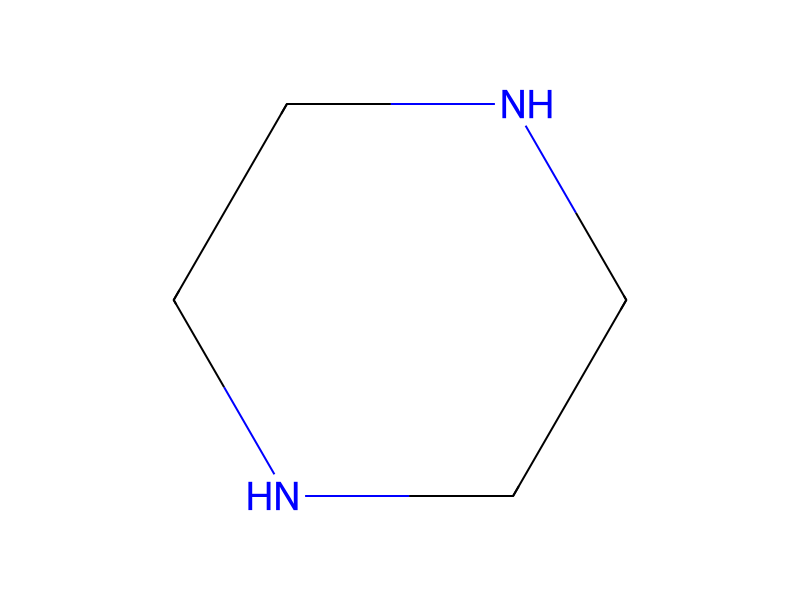
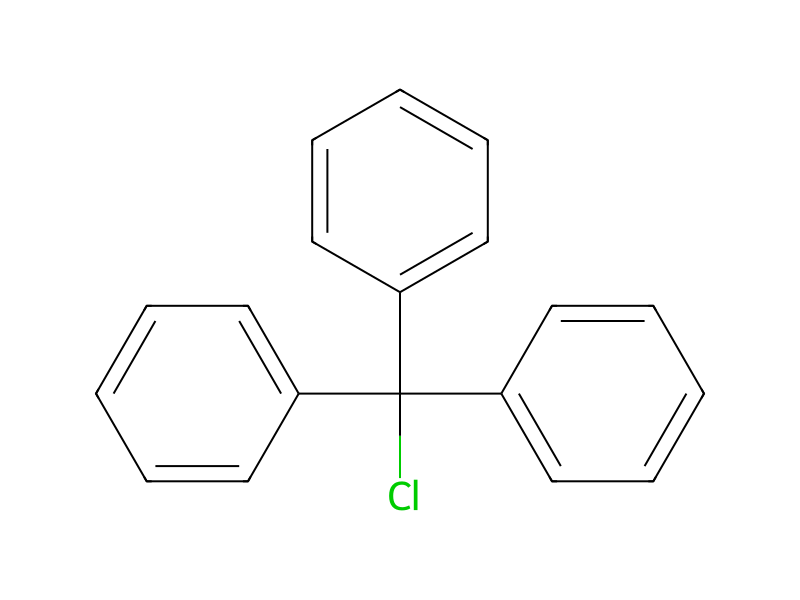
Piperazine → 1-Tritylpiperazine
HRID 1111327
反応式

[NH:1]1[CH2:6][CH2:5][NH:4][CH2:3][CH2:2]1.CCN(CC)CC.[C:14]1([C:20](Cl)([C:27]2[CH:32]=[CH:31][CH:30]=[CH:29][CH:28]=2)[C:21]2[CH:26]=[CH:25][CH:24]=[CH:23][CH:22]=2)[CH:19]=[CH:18][CH:17]=[CH:16][CH:15]=1>C(Cl)(Cl)Cl>[C:14]1([C:20]([C:21]2[CH:22]=[CH:23][CH:24]=[CH:25][CH:26]=2)([C:27]2[CH:28]=[CH:29][CH:30]=[CH:31][CH:32]=2)[N:1]2[CH2:6][CH2:5][NH:4][CH2:3][CH2:2]2)[CH:15]=[CH:16][CH:17]=[CH:18][CH:19]=1参加物
5



実験手順
Piperazine (5.0 g, 58.04 mmol) was dissolved in CHCl3 (100 ml) and Et3N (9 ml, 64.6 mmol) was added. This solution was heated to reflux and a solution of triphenylmethyl chloride (16.36 g, 58.68 mmol) in CHCl3 (100 ml) was added dropwise, via the reflux condenser, over a period of 4 hours. The reflux was then continued for 3 hours more and then was cooled and allowed to stand at room temperature overnight. A solid precipitated and was filtered off. The filtrate was evaporated to dryness to an oil which was partitioned between 10% aqueous Na2CO3 (150 ml) and CHCl3 (150 ml). The aqueous layer was washed with two additional portions of CHCl3 (2×150 ml) and the pooled organic layers were dried (MgSO4), filtered and evaporated to dryness to give a straw-colored syrup. This was purified on a silica gel 60 column (800 g) wet packed in CHCl3 and then developed with CHCl3 :MeOH (9:1) and then CHCl3 :MeOH (4:1). Fractions containing the required product were pooled and evaporated to dryness to give the title compound. Mass spec showed M+ at m/e 328. NMR (CDCl3, δ from TMS): 3.04 (br) piperazine methylenes; 7.06-7.58 (m) aromatics.