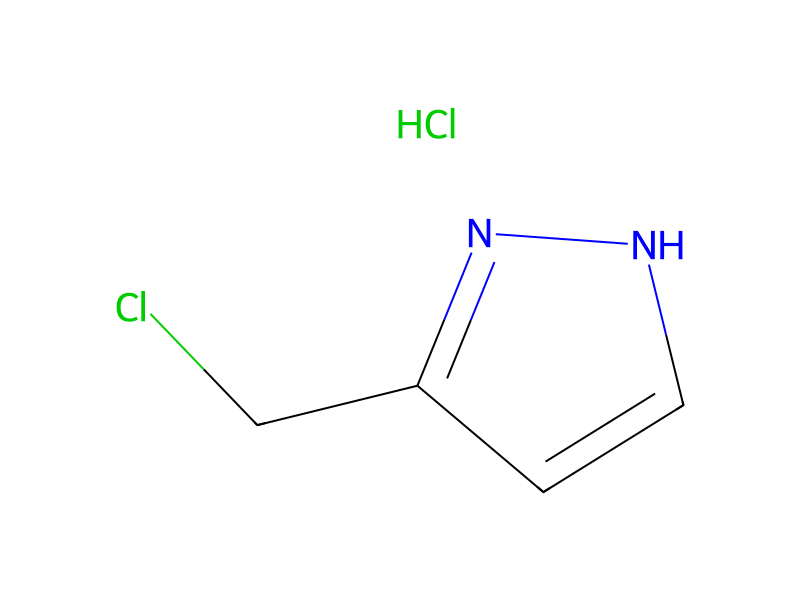
To a solution of tetrahydrofuran (100 ml) and triphenylphosphine (3.56 g, 13.6 mmol) at room temperature is added lithium (0.100 g, 14.5 mmol). The reaction mixture is stirred at room temperature for 2 hours at which time the lithium has dissolved. The bright red solution is cooled to 0° C., and 3-(chloromethyl)pyrazole hydrochloride (0.960 g, 6.8 mmol) is added at once. The ice bath is removed and the reaction solution is allowed to stir an additional 2 hours. Degassed ethanol (40 ml) is added to the reaction mixture followed by diethyl ether (100 ml). The organic phase is separated and the aqueous phase extracted with diethyl ether (2×25 ml). The organic phases are combined and dried over magnesium sulfate, filtered and concentrated. The crude residue is purified by chromatography (SiO2, 50% ethyl acetate/petroleum ether) to give purified 3-(diphenylphosphinomethyl)pyrazole as a cloudy white oil in 77% yield (2.81 g, 10.6 mmol). This material is characterized as follows: 1H NMR (CDCl3, 500 MHz) δ7.43 (m,4H), 7.41 (d, J=2.0 Hz, 1H), 7.34 (m, 6H), 5.99 (d, J=2.0 Hz, 1H), 3.47 (s, 2H); 13C{1H} NMR (CDCl3, 125 MHz) δ138.16 (d, 14.3 Hz), 132.97 (d, J=18.6 Hz), 129.11, 128.73 (d, J=6.6 Hz), 105.18 (d, J=5.1 Hz), 27.14 (d, J=6.2 Hz) MS m/z 265.9, 182.9 (M—C4H3N2).