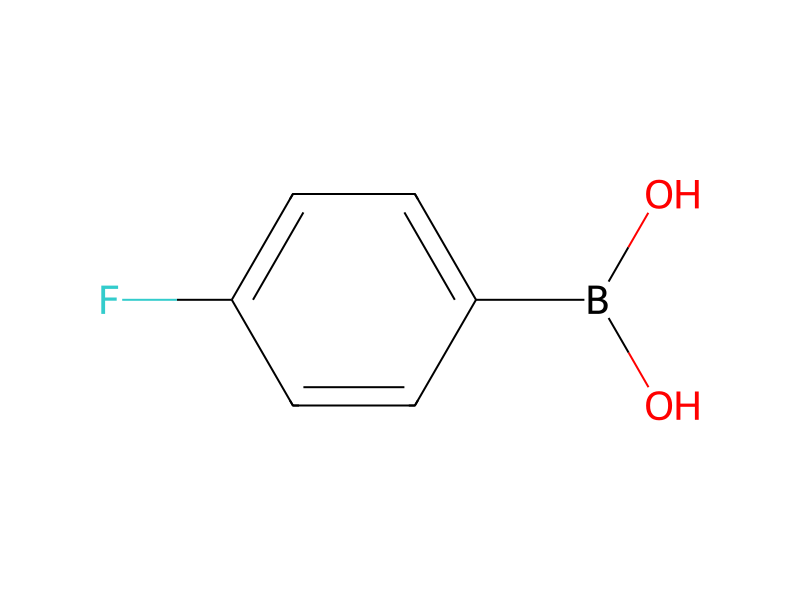
C(=O)([O-])O.[Na+].[CH3:6][O:7][C:8]1[CH:17]=[CH:16][C:11]([C:12]([O:14][CH3:15])=[O:13])=[C:10](OS(C(F)(F)F)(=O)=O)[CH:9]=1.[F:26][C:27]1[CH:32]=[CH:31][C:30](B(O)O)=[CH:29][CH:28]=1>COCCOC.[Pd].C1(P(C2C=CC=CC=2)C2C=CC=CC=2)C=CC=CC=1.C1(P(C2C=CC=CC=2)C2C=CC=CC=2)C=CC=CC=1.C1(P(C2C=CC=CC=2)C2C=CC=CC=2)C=CC=CC=1.C1(P(C2C=CC=CC=2)C2C=CC=CC=2)C=CC=CC=1>[CH3:6][O:7][C:8]1[CH:17]=[CH:16][C:11]([C:12]([O:14][CH3:15])=[O:13])=[C:10]([C:30]2[CH:31]=[CH:32][C:27]([F:26])=[CH:28][CH:29]=2)[CH:9]=1Saturated aqueous sodium hydrogen carbonate solution (50 ml) was added to a solution of methyl 4-methoxy-2-trifluoromethylsulfonyloxybenzoate (6.3 g; 0.02 mol) and 4-fluorobenzeneboronic acid (3.36 g; 0.024 mol) in DME (150 ml) at ambient temperature under an argon atmosphere. Tetrakis(triphenylphosphine) palladium (928 mg; 0.8 mmol) was then added and the reaction heated at reflux for 3.5 hours to give a homogeneous solution. After cooling to ambient temperature, the reaction was partitioned between ethyl acetate and water. The organic phase was washed with 2N HCl, water and brine, filtered through 1PS filter paper and the solvent removed in vacuo to give methyl 4-methoxy-2-(4-fluorophenyl)benzoate as a yellow oily solid (7.2 g) which was used without further purification.