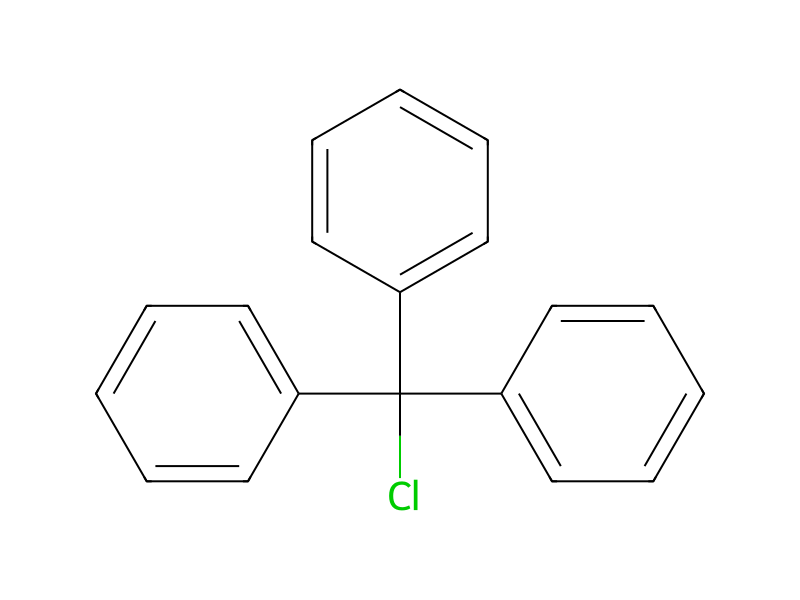
Trityl chloride → 6-Bromo-3-trityl-3H-benzooxazol-2-one
HRID 1280743
反応式

[Br:1][C:2]1[CH:11]=[CH:10][C:5]2[NH:6][C:7](=[O:9])[O:8][C:4]=2[CH:3]=1.[H-].[Na+].[C:14]1([C:20](Cl)([C:27]2[CH:32]=[CH:31][CH:30]=[CH:29][CH:28]=2)[C:21]2[CH:26]=[CH:25][CH:24]=[CH:23][CH:22]=2)[CH:19]=[CH:18][CH:17]=[CH:16][CH:15]=1>CN(C=O)C>[Br:1][C:2]1[CH:11]=[CH:10][C:5]2[N:6]([C:20]([C:14]3[CH:19]=[CH:18][CH:17]=[CH:16][CH:15]=3)([C:27]3[CH:28]=[CH:29][CH:30]=[CH:31][CH:32]=3)[C:21]3[CH:22]=[CH:23][CH:24]=[CH:25][CH:26]=3)[C:7](=[O:9])[O:8][C:4]=2[CH:3]=1参加物
5




実験手順
6-Bromo-3H-benzooxazol-2-one (0.165 g, 0.77 mmol) was added portionwise into a 0° C. suspension of NaH (44.8 mg, 1mmol, 55%) in dry DMF (4 ml). After 1 hour stirring at room temperature, a solution of triphenylmethylchloride (0.24 g, 0.85 mmol) in DMF (0.5 ml) was added. The reaction mixture was stirred 1 hour at room temperature then quenched with H2O (15 ml). The aqueous phase was extracted with ethyl acetate, the combined organic phases were washed with H2O and brine, dried over Na2SO4 and concentrated to provide 6-bromo -3-trityl-3H-benzooxazol-2-one (0.27 g, 77 %) as a beige solid, MS: m/e=457.1 (M+H+).