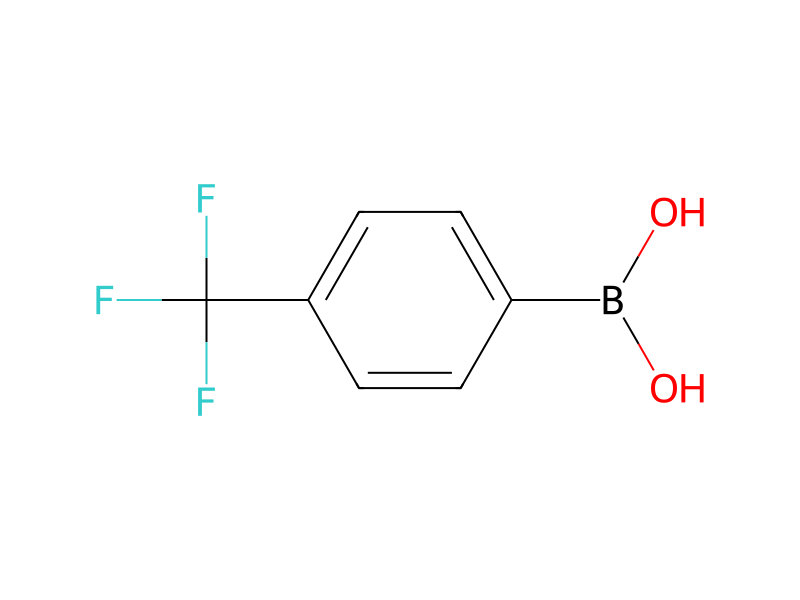
Br[C:2]1[N:7]=[C:6]([C:8](=[O:13])[CH2:9][CH2:10][CH2:11][CH3:12])[CH:5]=[CH:4][CH:3]=1.[F:14][C:15]([F:26])([F:25])[C:16]1[CH:21]=[CH:20][C:19](B(O)O)=[CH:18][CH:17]=1.C([O-])([O-])=O.[Na+].[Na+]>COCCOC.O.C1C=CC([P]([Pd]([P](C2C=CC=CC=2)(C2C=CC=CC=2)C2C=CC=CC=2)([P](C2C=CC=CC=2)(C2C=CC=CC=2)C2C=CC=CC=2)[P](C2C=CC=CC=2)(C2C=CC=CC=2)C2C=CC=CC=2)(C2C=CC=CC=2)C2C=CC=CC=2)=CC=1>[F:14][C:15]([F:26])([F:25])[C:16]1[CH:21]=[CH:20][C:19]([C:2]2[N:7]=[C:6]([C:8](=[O:13])[CH2:9][CH2:10][CH2:11][CH3:12])[CH:5]=[CH:4][CH:3]=2)=[CH:18][CH:17]=1A solution of 1-(6-bromo-2-pyridinyl)-1-pentanone (2.51 g, 10.37 mmol) in DME (13 mL) was treated with 4-(triflouromethyl)benzeneboronic acid (2.36 g, 12.43 mmol), Pd(PPh3)4 (1.19 g, 1.03 mmol) and then a slurry of Na2CO3 (3.29 g, 31.04 mmol) in water (13 mL). The resulting mixture was then heated to reflux over 30 minutes and then stirred at this temperature for 17 hours. The mixture was then allowed to cool to rt and was reduced and the residue partitioned between EtOAc (200 mL) and water (200 mL). The aqueous was re-extracted with EtOAc (100 mL) and the combined organic layer washed with saturated aqueous NaHCO3 (250 mL), brine (250 mL), dried (MgSO4), filtered and reduced to give a brown orange solid residue. Purification by Biotage™ chromatography (silica) eluting with cyclohexane:EtOAc (gradient 1:0 to 10:1) afforded the title compound as a white solid (3.02 g).