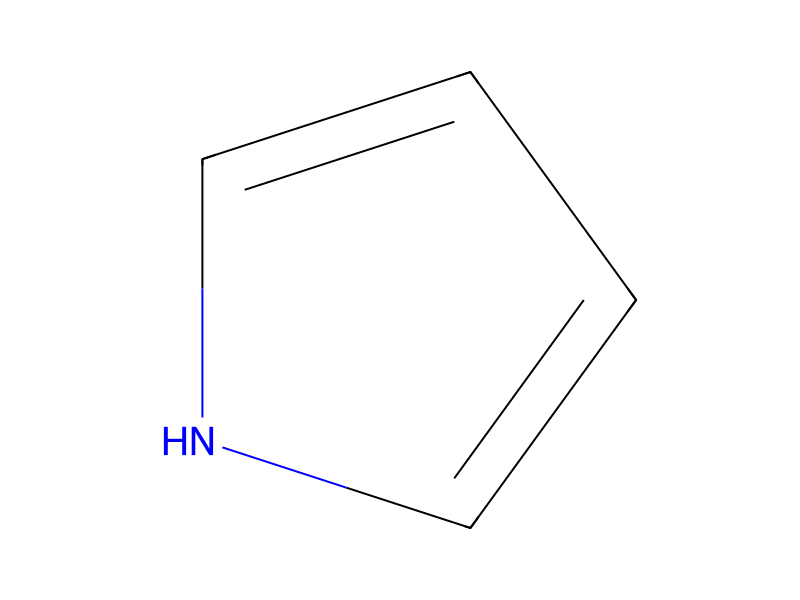
A mixture of 183 g (1 mole) of p-chloro-N,N-dimethylbenzamide and 153g (1 mole) of phophorous oxychloride in 300 ml of 1,2-dichloroethane is heated under reflux for 30 minutes, after which a solution of 67g (1 mole) of pyrrole in 300 ml of dichloroethane is added drop-wise. It is cooled and a solution of 408g (3 moles) of sodium acetate trihydrate in 1600 ml of water is added dropwise for 45 minutes, after which the mixture is again heated under reflux for 30 minutes. The resulting mixture is poured onto ice, the organic layer is separated, and the aqueous layer is washed with chloroform. The combined organic solutions are washed with sodium bicarbonate and brine and dried over magnesium sulfate. Evaporation of the solvent in vacuo gives a dark oil, which is distilled in vacuo through a heated Vigreaux column to give a white solid; mp 106°-9° C. It is recrystallized from cyclohexane to give 2-p-chlorobenzoylpyrrole as white needles; m.p. 110°-113° C.