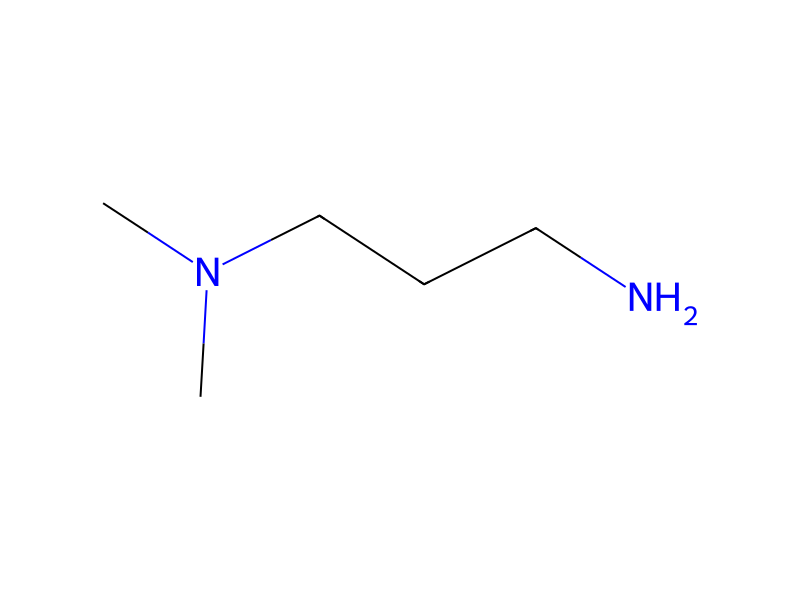
[Cl:1][C:2]1[CH:7]=[CH:6][N:5]=[C:4]([NH:8][C:9]2[CH:14]=[CH:13][CH:12]=[C:11]([C:15]3[N:16]=[C:17]([CH3:20])[S:18][CH:19]=3)[CH:10]=2)[N:3]=1.[CH3:21][N:22]([CH3:27])[CH2:23][CH2:24][CH2:25][NH2:26].C(N(C(C)C)CC)(C)C.Cl>C1COCC1.CO.O1CCOCC1.CCOCC>[ClH:1].[CH3:21][N:22]([CH3:27])[CH2:23][CH2:24][CH2:25][NH:26][C:2]1[CH:7]=[CH:6][N:5]=[C:4]([NH:8][C:9]2[CH:14]=[CH:13][CH:12]=[C:11]([C:15]3[N:16]=[C:17]([CH3:20])[S:18][CH:19]=3)[CH:10]=2)[N:3]=14-chloro-N-(3-(2-methylthiazol-4-yl)phenyl)pyrimidin-2-amine, 12, (400 mg, 1.30 mmol), N1,N1-dimethylpropane-1,3-diamine (0.25 mL, 2.0 mmol), and diisopropylethylamine (0.46 mL, 2.6 mmol) are dissolved in THF (10 mL) and heated to reflux for 20 hours. The reaction is cooled to room temperature and partitioned between EtOAc and water. The organic layer is dried (MgSO4), concentrated in vacuo, and purified over silica (5% MeOH ramped to 6% MeOH in CH2Cl2 with 0.7% added triethylamine) to give an oil. The oil is dissolved in MeOH (0.5 mL) and Et2O (20 mL) and cooled to 0° C. To this solution is added a solution of 4M HCl in dioxane (0.25 mL) in one portion. The white precipitate which forms is collected by filtration and dried at reduced pressure to afford the desired compound as a white solid: 1H NMR (CD3OD, 300 MHz) δ 2.03-2.08 (m, 2H), 2.79 (s, 6H), 2.80 (s, 3H), 3.10-3.15 (m, 2H), 3.65 (t, J=6.6 Hz, 2H), 6.30 (d, J=7.5 Hz, 1H), 7.45 (d, J=7.8 Hz, 1H), 7.54 (t, J=7.8 Hz, 1H), 7.70 (d. J=7.5 Hz, 1H), 7.77 (s, 1H), 7.82 (d, J=7.8 Hz, 1H), 8.19 (s, 1H); HRMS calcd for C19H24N6S, 369.1861 m/z (M+H)+; observed 369.1855 m/z.