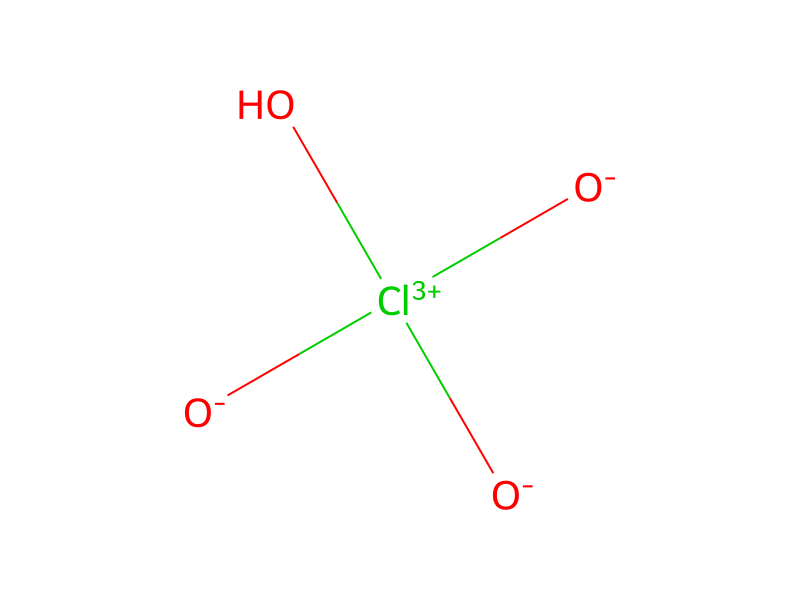
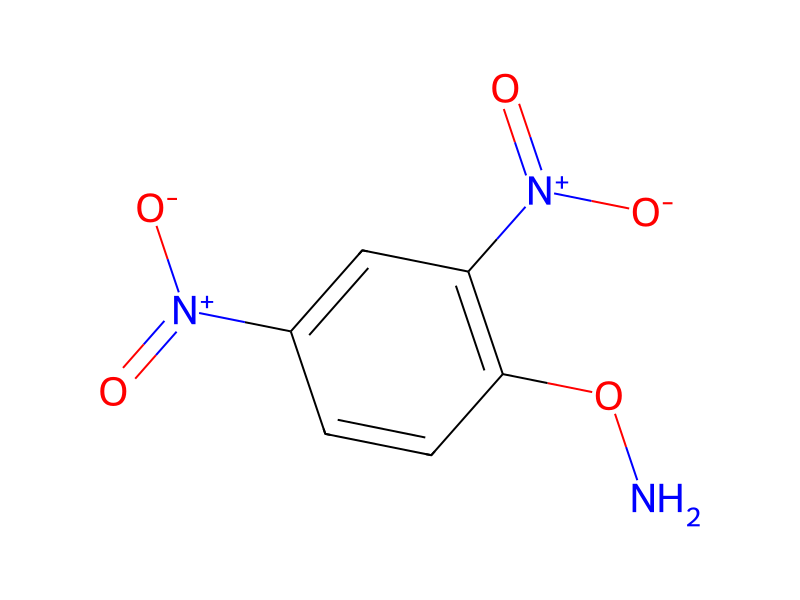
Perchloric Acid → O-(2,4-dinitrophenyl)hydroxylamine
HRID 1756494
反応式

[N+:1]([C:4]1[CH:16]=[C:15]([N+:17]([O-:19])=[O:18])[CH:14]=[CH:13][C:5]=1[O:6][N:7]=C(OCC)C)([O-:3])=[O:2].Cl(O)(=O)(=O)=O>O1CCOCC1>[N+:1]([C:4]1[CH:16]=[C:15]([N+:17]([O-:19])=[O:18])[CH:14]=[CH:13][C:5]=1[O:6][NH2:7])([O-:3])=[O:2]参加物
4


実験手順
To a suspension of 2.0 g (0.0074 mole) of ethyl N-(2,4-dinitrophenoxy)acetimidate in 10 mL of dioxane, cooled in an ice/water bath, was added dropwise 3 mL of 70% perchloric acid during a 10 minute period. The reaction mixture was stirred at 0°-5° C. for five hours and then was poured into 100 mL of ice water. This mixture was extracted three times with 40 mL of methylene chloride. The combined extracts were dried over anhydrous magnesium sulfate and filtered. The solvent was evaporated from the filtrate under reduced pressure, leaving 2.8 g of a brown oil. This oil was dissolved in 20 mL of diethyl ether, and 30 mL of petroleum ether was added to the solution, causing a precipitate to form. This precipitate was recovered by filtration. After being washed with petroleum ether and dried, 0.75 g of O-(2,4-dinitrophenyl)hydroxylamine was recovered as a yellow powder. The NMR spectrum was consistent with the proposed structure. This method is described by Y. Tamura et al., J. Org. Chem., 38, 1239 (1973).