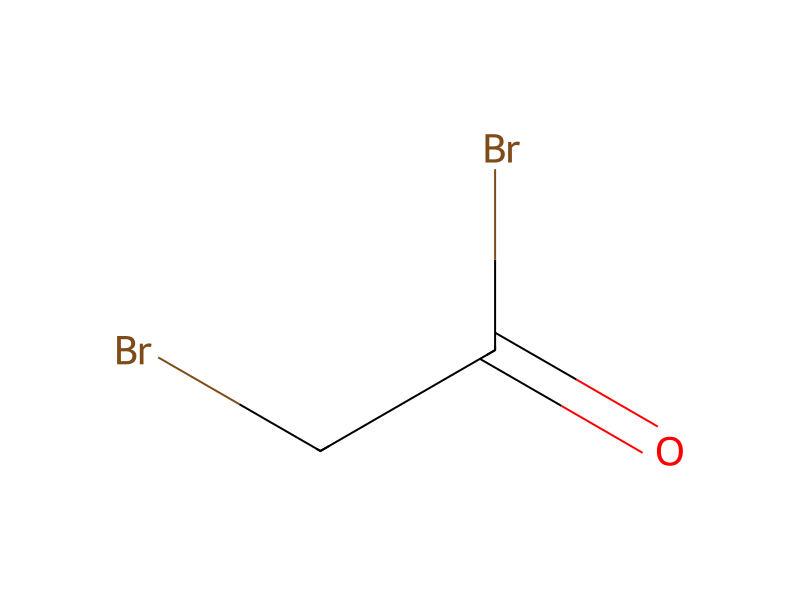
[NH2:1][C:2]1[CH:21]=[CH:20][C:5]([CH2:6][CH:7]([P:14](=[O:19])([O:17][CH3:18])[O:15][CH3:16])[P:8](=[O:13])([O:11][CH3:12])[O:9][CH3:10])=[CH:4][CH:3]=1.N1C=CC=CC=1.[Br:28][CH2:29][C:30](Br)=[O:31]>C(Cl)Cl>[Br:28][CH2:29][C:30]([NH:1][C:2]1[CH:3]=[CH:4][C:5]([CH2:6][CH:7]([P:14](=[O:19])([O:17][CH3:18])[O:15][CH3:16])[P:8](=[O:13])([O:11][CH3:12])[O:9][CH3:10])=[CH:20][CH:21]=1)=[O:31]A solution of 13 (0.959 g, 2.87 mmol) and pyridine (349 μL, 4.31 mmol) in CH2Cl2 was cooled in an ice-bath while stirring. A solution of bromoacetylbromide (250 μL, 2.87 mmol) in CH2Cl2 (5 mL) was added drop-wise and the resulting mixture was stirred for 4 h at that temperature. The reaction was quenched by the addition of water and the product was extracted with CH2Cl2. The combined organic layers were washed with brine, dried over sodium sulfate, filtered, and concentrated under reduced pressure. The crude yellow solid was purified by silica gel chromatography resulting in 14 as a colorless solid (0.897 g, 67%). 1H NMR (400 MHz, CDCl3) δ 2.65 (tt, J=6.2, 24.4, 1H), 3.22 (dt, J=6.2, 17.4, 2H), 3.72 (d, J=3.7, 6H), 3.75 (d, J=3.7, 6H), 4.01 (s, 2H), 7.26 (d, J=8.6, 2H), 7.47 (d, J=8.6, 2H), 8.15 (bs, 1H): 31P (162 MHz, CDCl3) δ 26.33 (s, 2P).