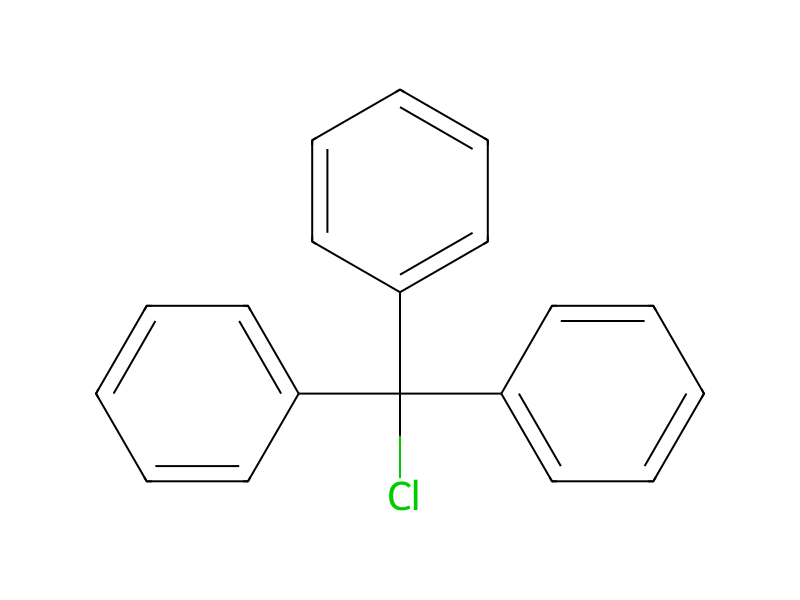
[NH2:1][C:2]1[C:11]2[C:6](=[CH:7][CH:8]=[CH:9][CH:10]=2)[N:5]=[CH:4][CH:3]=1.Cl[C:13]([C:26]1[CH:31]=[CH:30][CH:29]=[CH:28][CH:27]=1)([C:20]1[CH:25]=[CH:24][CH:23]=[CH:22][CH:21]=1)[C:14]1[CH:19]=[CH:18][CH:17]=[CH:16][CH:15]=1.C(N(CC)CC)C.C(=O)(O)[O-].[Na+]>C(Cl)Cl>[N:5]1[C:6]2[C:11](=[CH:10][CH:9]=[CH:8][CH:7]=2)[C:2]([NH:1][C:13]([C:14]2[CH:19]=[CH:18][CH:17]=[CH:16][CH:15]=2)([C:26]2[CH:27]=[CH:28][CH:29]=[CH:30][CH:31]=2)[C:20]2[CH:21]=[CH:22][CH:23]=[CH:24][CH:25]=2)=[CH:3][CH:4]=1A mixture of 4-aminoquinoline (H. Shinkai et al., J. Med. Chem., 2000, 43, pp. 4667-4677) (251 mg), chlorotriphenylmethane (533 mg), and triethylamine (266 μL) in methylene chloride (5 mL) was stirred at room temperature for 24 hours. The reaction mixture was then poured into saturated aqueous sodium bicarbonate solution and extracted twice with methylene chloride. The combined organic phases were dried over sodium sulfate, filtered, and concentrated in vacuo. The residue was purified by column chromatography with silica gel (eluted with 50% ethyl acetate-hexanes) to give quinolin-4-yltritylamine as a pale yellow foam (610 mg).