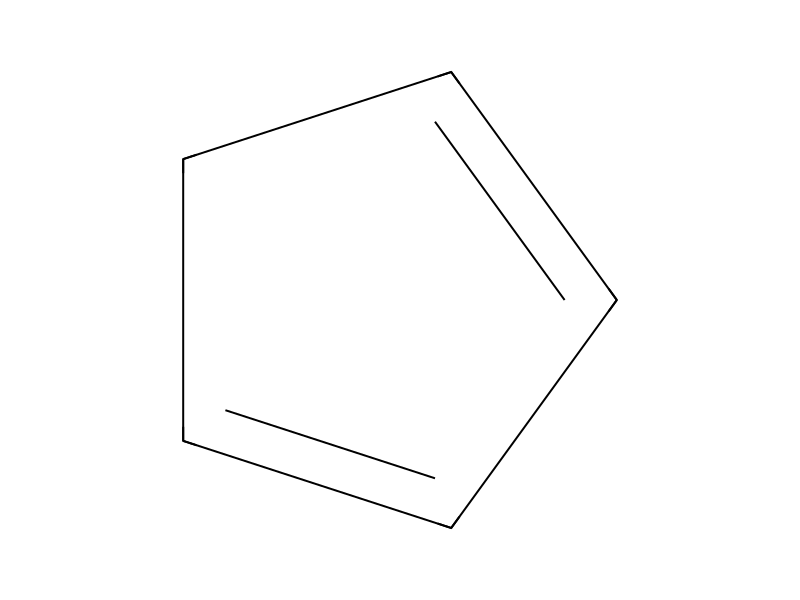
Into a 2-liter flask having a stirrer, a condenser and a thermometer, 366 g of 2,6-dimethylphenol, 360 g of toluene and 102 g of phosphoric acid were introduced, and a solution of mixture of 247 g of cyclopentadiene and 200 g of toluene was added dropwise over a period of 3 hours while stirring the mixture under ice cooling, followed by further stirring for 4 hours at room temperature. To the reaction solution thus obtained, tetrahydrofuran (hereinafter “THF”) and methyl isobutyl ketone (hereinafter “MIBK”) were added, and the resultant solution was washed with water until it turned neutral, followed by distillation under reduced pressure. After the reaction solvent had evaporated, unreacted 2,6-dimethylphenol evaporated. A fraction at 3 mmHg and 140° C. was 2,6-dimethyl-4-(2-cyclopenten-1-yl)phenol. The results of analysis by GPC thereof are shown in FIG. 1. Its yield determined by GPC was 94% (area ratio).