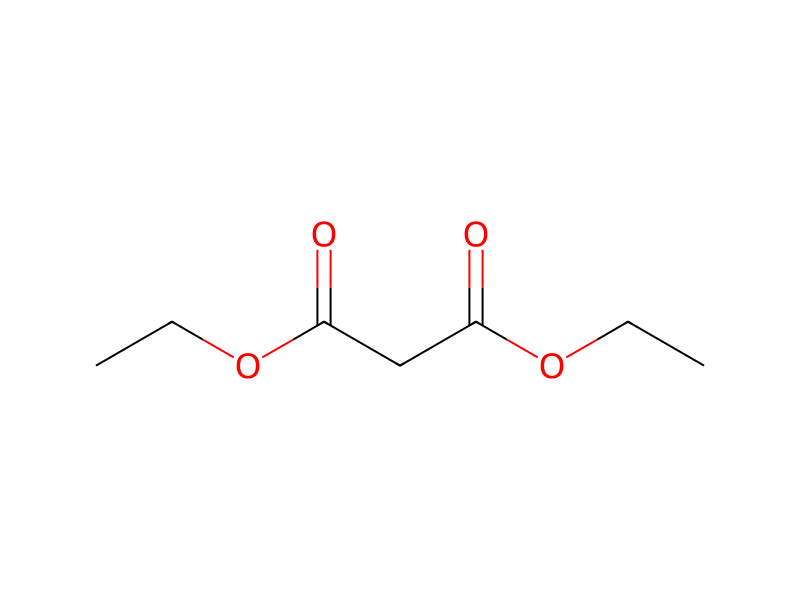
In a dry flask was placed sodium hydride as a 60% suspension in oil (3.1 g, 77.5 mmol). Most of the oil was removed by washing twice with hexanes. The remaining solid sodium hydride was then suspended in dry dimethylformamide (DMF) (100 mL) and cooled to 0° C. Diethyl malonate (11.8 mL, 77.7 mmol) was then added dropwise with stirring. The mixture was stirred at 0° C. for 1 hour after which a solution of 2-chloro-5-fluoro-3-nitropyridine (5.21 g, 29.5 mmol) in DMF (40 mL) was added. Stirring at room temperature was continued overnight and the reaction mixture was poured into ice/water. Following acidification to pH 3 with 6N HCl solution, the mixture was extracted with ethyl acetate. The organic phase was washed with brine, dried over MgSO4 and concentrated in vacuo to leave a red oil. This was subjected to flash chromatography on silica gel using 3:7 ethyl acetate/hexanes, as eluant. All fractions containing the desired product were combined and concentrated to yield an oil containing 2-bis(ethoxycarbonyl)methyl-5-fluoro-3-nitropyridine and diethyl malonate in a molar ratio of approximately 11:9 weighing 11.5 g. The yield of 2-bis(ethoxycarbonyl)methyl-5-fluoro-3-nitropyridine was calculated to be approximately 8 g (90%).