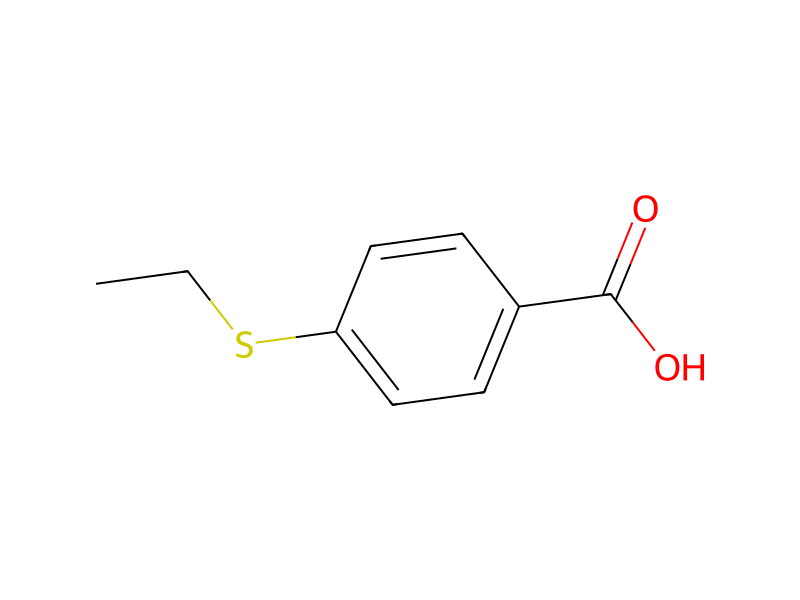
The starting 4-(ethylthio)benzyl alcohol was prepared as follows. A mixture of lithium aluminum hydride (5.2 g) and tetrahydrofuran (250 mL) was cooled to 0° C. with stirring under N2 atmosphere. A solution of 4-(ethylthio)benzoic acid (25 g) in tetrahydrofuran (300 mL) was added at a rate so as to control H2 evolution. The reaction mixture was then allowed to warm to room temperature and stirred 15 hours. The mixture was cooled in ice and a solution of 15% aqueous sodium hydroxide solution was added, (6 mL) followed by water (21 mL). The mixture was stirred at ice temperature for 1 hour and for 2 hours at ambient temperature. The solution was decanted, diluted with diethyl ether and washed with saturated aqueous NaCl solution. The organic phase was dried over MgSO4, filtered through a celite pad and concentrated to give 4-(ethylthio)benzyl alcohol (20 g). This material was converted to the corresponding bromide as in Example 1 except that diethyl ether and hexane were used for the triturations rather than heptane and petroleum ether, respectively.