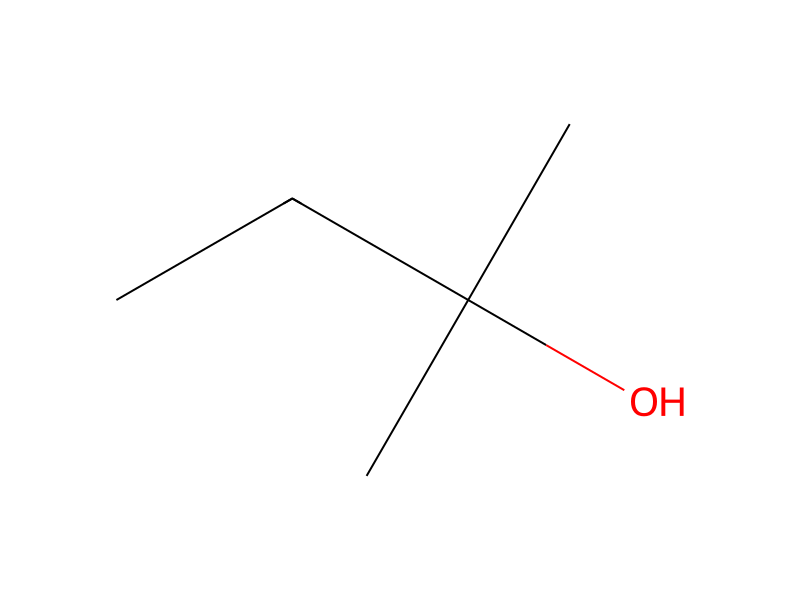
反応式

CO.[CH2:3](O)[CH3:4].[CH2:6]([OH:9])[CH2:7][CH3:8].[CH:10]([OH:13])([CH3:12])[CH3:11]>C(O)(C)(C)C.C(O)(CC)C.O>[CH:6](=[O:9])[C:7]([CH3:3])=[CH2:8].[C:10]([OH:13])([CH2:3][CH3:4])([CH3:12])[CH3:11]参加物








実験手順
In order to take advantage of the combustion step, the naphthalate diester is selected to produce an appropriate alcohol byproduct that has a volatility comparable to or greater than that of water. There are several ways of expressing this selection. As a first, the naphthalene diester can be selected on the basis of being one that will produce an alcohol byproduct that is selected form the group consisting of methanol (CH3OH, b.p. 64.5° C.), ethanol (CH3CH2OH; b.p. 64.5° C.), propanol (CH3CH2CH3OH; b.p. 78.3° C.), and isopropanol (CH3CHOHCH3 ; 82.5° C.), all of which have boiling points less than that of water and thus the appropriate volatility. Other possible alcohol byproducts that define qualifying naphthalene diesters, include secondary butanol (CH3CH2CHOHCH3 ; b.p. 99.5° C.) and tertbutanol ((CH3)3COH; b.p. 83° C.). Naphthalene diesters that produce isobutenal ((CH3)2CHCH2OH; b.p. 108° C.) and tertpentanol (CH3CH2C(OH)(CH3)2 ; b.p. 102° C.) are also candidates although their boiling points slightly exceed that of water at atmospheric pressure.
出典と根拠
- ORDレコード
- ord-b2bf3a292f2a4af1902ab667dcc558a3
- 出典データセット
- uspto-grants-2000_02
- 特許番号
- US06031065
関連ノート
読み込み中…