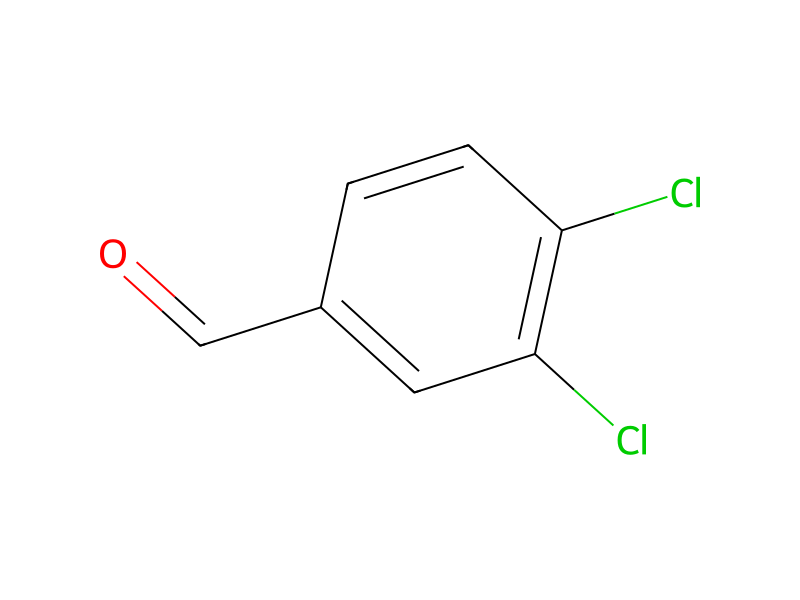
[NH2:1][CH2:2][CH2:3][CH2:4][NH:5][C:6]1[NH:7][C:8]2[C:13]([C:14](=[O:16])[CH:15]=1)=[CH:12][CH:11]=[CH:10][CH:9]=2.[Cl:17][C:18]1[CH:19]=[C:20]([CH:23]=[CH:24][C:25]=1[Cl:26])[CH:21]=O.C([BH3-])#N.[Na+]>CO.C(O)(=O)C>[ClH:17].[Cl:17][C:18]1[CH:19]=[C:20]([CH:23]=[CH:24][C:25]=1[Cl:26])[CH2:21][NH:1][CH2:2][CH2:3][CH2:4][NH:5][C:6]1[NH:7][C:8]2[C:13]([C:14](=[O:16])[CH:15]=1)=[CH:12][CH:11]=[CH:10][CH:9]=2To a solution of 2-(3-aminoprop-1-ylamino)-1H-quinolin-4-one (0.477 g, 2.2 mmol) in methanol (20 ml) and acetic acid (0.5 ml) was added 3,4-dichlorobenzaldehyde (0.385 g, 2.2 mmol) in methanol (5 ml). After stirring under argon for 30 min, sodium cyanoborohydride (0.207 g, 3.3 mmol) in methanol (3 ml) was added and the reaction stirred for 2 h. The reaction mixture was then cooled in an ice bath, and the precipitate filtered off, washed with cold methanol then dichloromethane and dried in vacuo to give the title compound as a pink powder (0.526 g, 64%); δH (CD3OD/DCl) 2.1-22.5 (2H, m), 3.2-3.4 (2H, m, under methanol), 3.62-3.73 (2H, m), 4.27 (2H, s), 6.38 (1H, s), 7.4-7.95 (6H, m), 8.1(1H, d); MS (ES+) 376, 378 (50, 33%, MH+) and 201 (100).