反応式
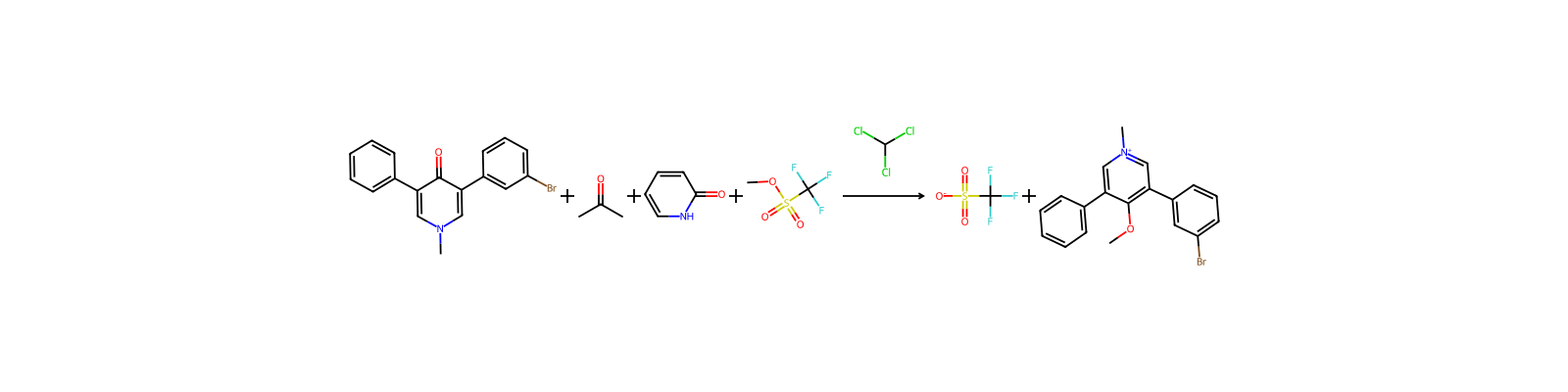
[Br:1][C:2]1[CH:3]=[C:4]([C:8]2[C:13](=[O:14])[C:12]([C:15]3[CH:20]=[CH:19][CH:18]=[CH:17][CH:16]=3)=[CH:11][N:10]([CH3:21])[CH:9]=2)[CH:5]=[CH:6][CH:7]=1.[CH3:22]C(=O)C.N1C=CC=CC1=O.[F:33][C:34]([F:41])([F:40])[S:35]([O:38]C)(=[O:37])=[O:36]>C(Cl)(Cl)Cl>[F:33][C:34]([F:41])([F:40])[S:35]([O-:38])(=[O:37])=[O:36].[Br:1][C:2]1[CH:3]=[C:4]([C:8]2[CH:9]=[N+:10]([CH3:21])[CH:11]=[C:12]([C:15]3[CH:20]=[CH:19][CH:18]=[CH:17][CH:16]=3)[C:13]=2[O:14][CH3:22])[CH:5]=[CH:6][CH:7]=1参加物
6




実験手順
A 10 g. portion of 3-(3-bromophenyl)-1-methyl-5-phenyl-4(1H)-pyridinone was made from 22 g. of the corresponding 2-propanone as described in Example 1. A 3.4 g. portion of the intermediate pyridinone was dissolved in chloroform and 1.8 g. of methyl trifluoromethanesulfonate was added. The reaction mixture was allowed to stand overnight, and the volatile portions were then evaporated under vacuum. The residue was identified as 3-(3-bromophenyl)-4-methoxy-1-methyl-5-phenylpyridinium trifluoromethanesulfonate, molecular weight 339 by mass spectroscopy.
後処理
- customthe volatile portions were then evaporated under vacuum
出典と根拠
- ORDレコード
- ord-b4933e6ff4514b2a8f47b2d1faa81725
- 出典データセット
- uspto-grants-1979_11
- 特許番号
- US04174209
関連ノート
読み込み中…