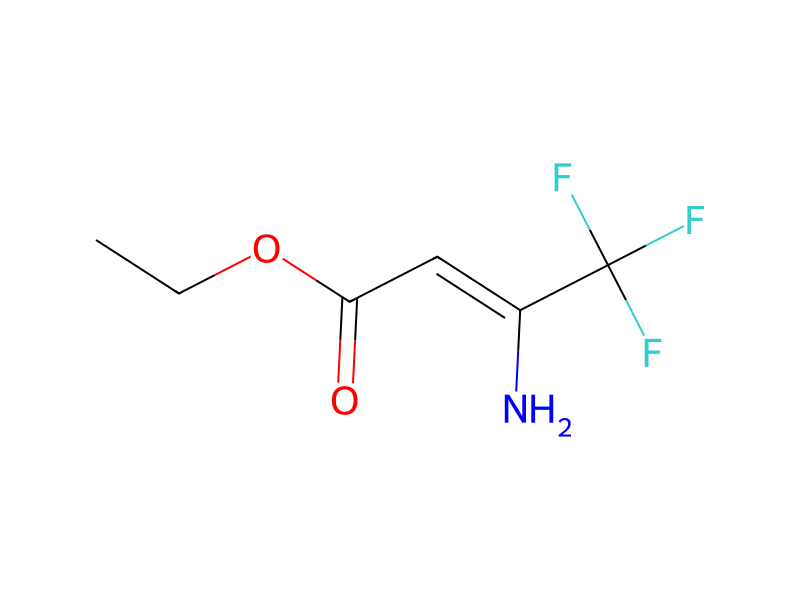
[NH2:1]/[C:2](/[C:9]([F:12])([F:11])[F:10])=[CH:3]\[C:4]([O:6]CC)=O.[H-].[Na+].[CH3:15][O:16][N:17]=[CH:18][C:19]1[CH:24]=[C:23]([N:25]=[C:26]=[O:27])[C:22]([F:28])=[CH:21][C:20]=1[Cl:29].O>CN(C)C=O.O1CCCC1.ClCCl>[CH3:15][O:16][N:17]=[CH:18][C:19]1[CH:24]=[C:23]([N:25]2[C:4](=[O:6])[CH:3]=[C:2]([C:9]([F:10])([F:11])[F:12])[NH:1][C:26]2=[O:27])[C:22]([F:28])=[CH:21][C:20]=1[Cl:29]A solution of 168.5 g (0.92 mol) of ethyl 3-amino-4,4,4-trifluorocrotonate in 0.1 l of dimethylformamide was added dropwise with ice-cooling to 30.4 g (1.01 mol) of 80% by weight sodium hydride in 0.5 l of dimethylformamide. After one hour at this temperature, the mixture was cooled to (−30) to (−35)° C., and a solution of 210.3 g (0.92 mol) of 2-chloro-4-fluoro-5-isocyanatobenzaldehyde (O-methyl)oxime in 0.15 l of tetrahydrofuran was added dropwise. The reaction mixture was then stirred for 20 hours at approximately 20° C., and 1.5 l of water were subsequently added with ice-cooling. Undissolved matter in the mixture formed was removed and washed using 300 ml of water. The combined filtrates were acidified using dilute hydrochloric acid. The product of value was then extracted from the solution obtained using dichloromethane. The extract was washed with water, dried over sodium sulfate and finally concentrated. Yield: 289 g; m.p.: 176-177° C. (diisopropyl ether/petroleum ether).