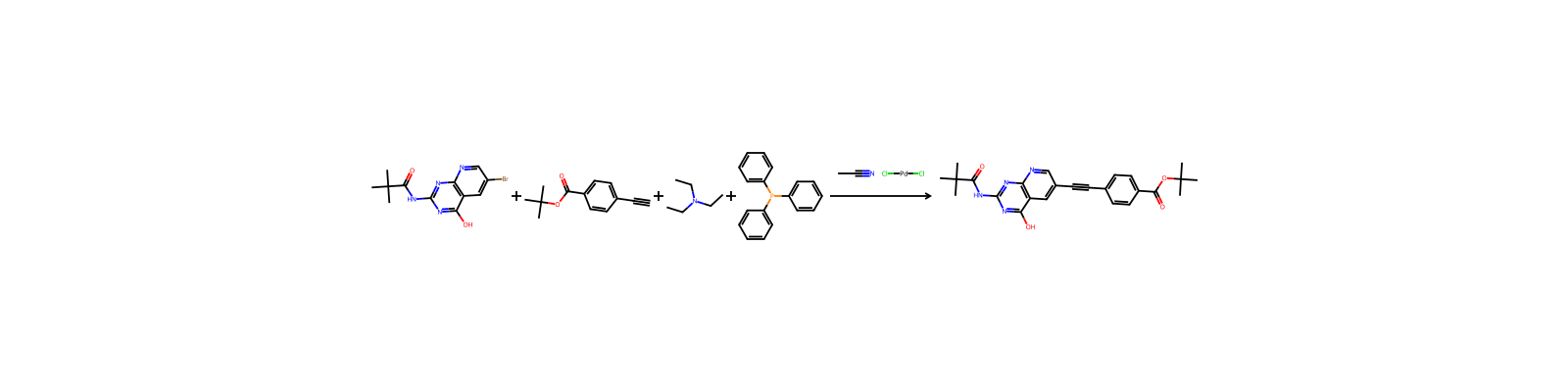
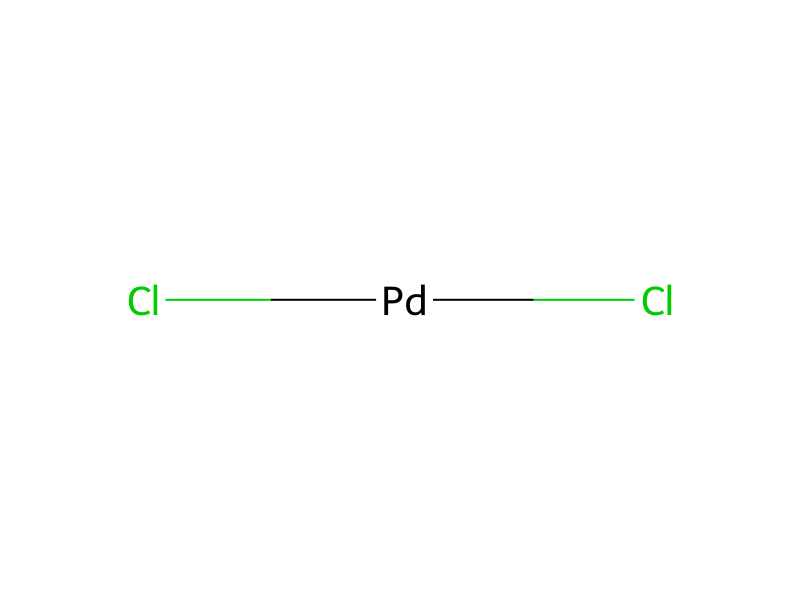
[C:1]([NH:7][C:8]1[N:9]=[C:10]([OH:19])[C:11]2[CH:17]=[C:16](Br)[CH:15]=[N:14][C:12]=2[N:13]=1)(=[O:6])[C:2]([CH3:5])([CH3:4])[CH3:3].[C:20]([C:22]1[CH:34]=[CH:33][C:25]([C:26]([O:28][C:29]([CH3:32])([CH3:31])[CH3:30])=[O:27])=[CH:24][CH:23]=1)#[CH:21].C(N(CC)CC)C.C1(P(C2C=CC=CC=2)C2C=CC=CC=2)C=CC=CC=1>C(#N)C.[Pd](Cl)Cl>[C:1]([NH:7][C:8]1[N:9]=[C:10]([OH:19])[C:11]2[CH:17]=[C:16]([C:21]#[C:20][C:22]3[CH:34]=[CH:33][C:25]([C:26]([O:28][C:29]([CH3:32])([CH3:31])[CH3:30])=[O:27])=[CH:24][CH:23]=3)[CH:15]=[N:14][C:12]=2[N:13]=1)(=[O:6])[C:2]([CH3:5])([CH3:4])[CH3:3]A mixture of 2.0 g of 2-pivaloylamino-4-hydroxy-6-bromopyrido[2,3-d]pyrimidine (prepared according to Example 6), 1.31 g of tert.-butyl 4-ethynylbenzoate, 2.57 ml of triethylamine, 0.11 g of palladium chloride, 0.32 g of triphenylphosphine, and 0.05 g of cuprous iodide in 150 ml of acetonitrile is heated at reflux under nitrogen for 2.5 hours. The reaction mixture is cooled to room temperature and then in an ice bath. The solid is collected and washed with small portions of cold acetonitrile to yield 1.91 g (69%) of 2-pivaloylamino-4-hydroxy-6-(4-tert.-butoxycarbonylphenylethynyl)pyrido[2,3-d]pyrimidine as a pale yellowish powder, which is sufficiently pure for the next reaction. A small sample of this solid, purified further by chromatography on silica gel using a 5% methanol:methylene chloride mixture as the eluent, had the following constants: m.p. >250° C.; NMR (CDCl3, 300 MHz) delta 1.37 (s, 9H), 1.63 (s, 9H), 7.61 (d, 2H, J=8.50 Hz), 8.02 (d, 2H, J=8.50 Hz), 8.42 (brs, 1H), 8.66 (slightly brs, 9.01 (slightly brs, 1H);IR (KBr) 3200, 2980, 1710, 1670, 1600, 1545, 1440, 1375, 1290, 1140, and 770 cm-1.