反応式

[Cl-].[C:2]1(C)[CH:7]=[CH:6][C:5]([S:8]([O-:11])(=[O:10])=O)=[CH:4][CH:3]=1.[NH+:13]1C=CC=C[CH:14]=1.CCN(C(C)C)C(C)C.FC(F)(F)S(OS(C(F)(F)F)(=O)=O)(=O)=O.[O-]S(C(F)(F)F)(=O)=O.CCN(C(C)C)C(C)C>CO.C(Cl)Cl>[S:8]1(=[O:10])(=[O:11])[C:5]2[CH:6]=[CH:7][CH:2]=[CH:3][C:4]=2[CH:14]=[N:13]1参加物
反応物 5


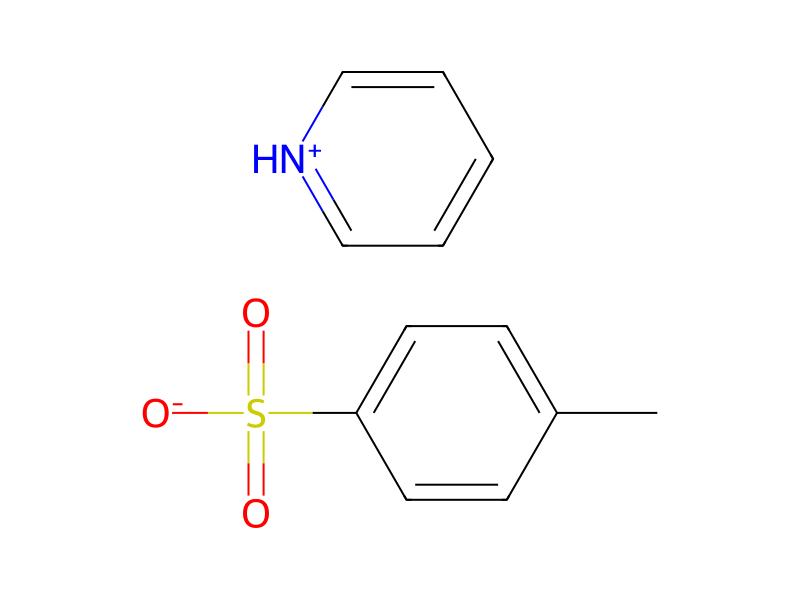


生成物 1

試薬・触媒・溶媒 2


実験手順
For longer side chains, the rearrangement is performed with n-BuLi (ca 1.6 M in hexane) in THF at −78° C. as above, followed by addition of a cosolvens such as DMPU and reaction with O-protected 1-bromo-alcohols or α-chloro-ω-iodoalkane (e.g. 1-bromo-n-tetrahydro-pyaranyloxyalkane) to yield the O-protected compounds 9b or the chloro compound 9c (step i). O-protected compounds 9b can be deprotected to the corresponding alkynol 9a (in MeOH at 50-60° C., in the presence of catalytic amount of pyridinium toluene-4-sulfonate). Alcohol 9a can be reacted with Huenig's base/trifluoromethane sulfonic acid anhydride at −15° C. in CH2Cl2 (in situ generation of the corresponding triflate) followed by treatment with Huenig's base and the corresponding amine NHA1A2at −15° C. to RT to give amine 5. Alternatively, mesylation of alcohol 9a with methanesulfonylchloride, pyridine and DMAP in CH2Cl2 at 0° C. to RT gives mesylate 10. Conversion of the mesylate 10 or the chloride 9c (or the in situ generated iodide) to the amine 5 can be accomplished with an excess of the corresponding amine NHA1A2 in DMA at RT or as described above (step 1).
後処理
- customat 50-60° C.
出典と根拠
- ORDレコード
- ord-e47e81576e534587b02ae994fcf0fcfd
- 出典データセット
- uspto-grants-2005_10
- 特許番号
- US06951879B2
関連ノート
読み込み中…