
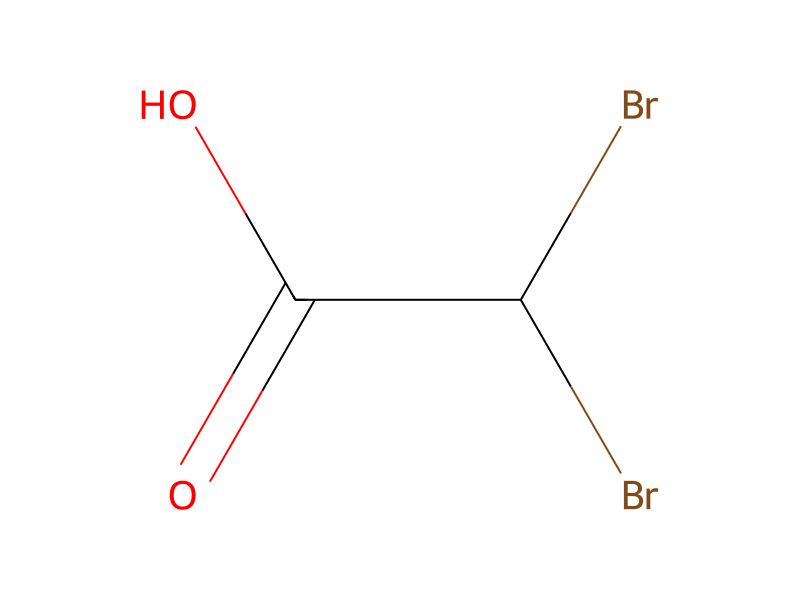
기본 정보
- 표준 SMILES
O=C(O)C(Br)Br- InChIKey
SIEILFNCEFEENQ-UHFFFAOYSA-N- 분자식
- C2H2Br2O2
- 평균 분자량
- 217.84 g/mol
- 단동위원소 질량
- 215.8421535
개요
Dibromoacetic Acid can cause cancer according to The National Toxicology Program.
이름 및 식별자
- 우선 이름
- Dibromoacetic Acid
- IUPAC
- 2,2-dibromoacetic acid
- 영어명
- Dibromoacetic acid
- 분자식
- C2H2Br2O2
- 분자량
- 217.84
이름 및 동의어
DIBROMOACETIC ACID631-64-12,2-dibromoacetic acidDibromoacetateDBAA2,2-dibromoethanoic acidDibromoethanoic acidDTXSID10238157FUW62YY5LDTXCID203815CHEBI:90124RefChem:132891
이름 더 보기
dibromo-aceticaciRARECHEM AL BO 0081Dodemorph Impurity 8Dibromoacetic acid 1Gdibromo acetic acidmdbaAcetic acid, 2,2-dibromo-
211-165-5Acetic acid, dibromo-DibromoaceticacidMFCD0000420510024-50-7CAS-631-64-1CCRIS 7636EINECS 211-165-5
데이터베이스 식별자
- CAS
631-64-1- PubChem CID
- 12433
- DTXSID
DTXSID1023815- ChEMBL
CHEMBL449362- ChEBI
CHEBI:90124- UNII
- 7FUW62YY5L
- EC Number
- 211-165-5
- Nikkaji
- J531B
물성
구조 계산 물성
- XLogP
- 1.5
- 극성 표면적
- 37.3 Ų
- 수소 결합 공여자 수
- 1
- 수소 결합 수용자 수
- 2
- 회전 가능 결합 수
- 1
- 무거운 원자 수
- 6
- 형식 전하
- 0
- 복잡도
- 60.6
실험 및 물리화학적 성질
Chemical ClassesOther Classes -> Organic Acids
LipidsFatty Acyls [FA] -> Fatty Acids and Conjugates [FA01] -> Halogenated fatty acids [FA0109]
Color/FormHygroscopic crystals
Solubility
Very soluble in ethanol; soluble in diethyl ether
In water, 2.11X10+6 mg/L at 25 °C
Flash Point235 °F (113 °C) (closed cup)
Endocrine DisruptorsPotential endocrine disrupting compound
Boiling Point
232-234 °C (decomposition)
BP: 195 °C at 250 mm Hg; 130 °C at 16 mm Hg
DecompositionWhen heated to decomposition it emits toxic vapors of /bromide./
Melting Point48 °C
Vapor Pressure0.02 [mmHg]
Henry's Law ConstantHenry's Law constant = 4.42X10⁻⁹ atm-cu m/mole at 25 °C
Physical DescriptionHygroscopic solid; [HSDB] White deliquescent solid; [IARC] Beige hygroscopic crystals; [Sigma-Aldrich MSDS]
물리화학적 성질
- 녹는점
- 32 · 32-38 °C (lit.)
- 끓는 점
- 128 · 128-130 °C/16 mmHg (lit.)
- 밀도
- 2.382 g/mL · 2.382 g/mL at 25 °C (lit.)
- 굴절률
- 1.522 · 1.5220 (estimate)
- 인화점
- 230 °F · >230 °F
- 저장 조건
- room temp
- 용해도
- 100 mg/mL · DMSO : 100 mg/mL (459.05 mM; Need ultrasonic)
- 물리적 상태
- Solid
- 산도 계수 (pKa)
- 1 · pK1:1.39 (25°C)
- 색상
- White to off-white
- BRN
- 1700457 · 1700457
- Henry's Law Constant
- 2.3 · 2.3×103 mol/(m3Pa) at 25℃, Burkholder et al. (2019)
- 안정성
- 흡습성
- InChI
- 1S/C2H2Br2O2/c3-1(4)2(5)6/h1H,(H,5,6)
- InChIKey
- SIEILFNCEFEENQ-UHFFFAOYSA-N
- SMILES
- OC(=O)C(Br)Br
- EPA
- Dibromoacetic acid (631-64-1)
안전 및 규제
GHS 분류
GHS Classification
Danger
H302 (92.9%): Harmful if swallowed [Warning Acute toxicity, oral]
P260, P261, P264, P270, P271, P280, P301+P317, P301+P330+P331, P302+P352, P302+P361+P354, P304+P340, P305+P354+P338, P316, P317, P321, P330, P362+P364, P363, P405, and P501 (click each P-code to see the statement)
Aggregated GHS information provided per 42 reports by companies from 3 notifications to the ECHA C&L Inventory. Each notification may be associated with multiple companies.
유해성 정보
Regulatory InformationHazard Traits - Carcinogenicity
Hazards SummaryCauses burns; Inhalation may cause corrosive injuries to upper respiratory tract; Harmful by ingestion, inhalation, and skin absorption; [Sigma-Aldrich MSDS] See Dichloroacetic acid.
Special Reports
Environmental Health Criteria 216: Disinfectants and DIsinfectant By-Products (1999) by the International Programme on Chemical Safety (IPCS) under the joint sponsorship of the United Nations Environment Programme, the International Labour Organisation and the World Health Organization. Available at http://www.inchem.org/documents/ehc/ehc/ehc216.htm as of August 1, 2008
DHHS/NTP; Toxicology and Carcinogenesis Studies of Toxicology and Carcinogenesis Studies of Dibromoacetic Acid (CAS No. 631-64-1) in F344/N Rats and B6C3F1 Mice (Drinking Water Studies) 326 pp. (2007) Technical Rpt Series No. 537 NIH Pub No.07-4475
Hazard Classes and CategoriesAcute Tox. 4 (92.9%)
Federal Drinking Water Standards
The maximum contaminant level for haloacetic acids (five) (HAA5) is 0.060 mg/L. /Haloacetic acids (five) (HAA5) mean the sum of the concentrations in milligrams per liter of the haloacetic acid compounds (monochloroacetic acid, dichloroacetic acid, trichloroacetic acid, monobromoacetic acid, and dibromoacetic acid), rounded to two significant figures after addition./
안전 및 보호
Firefighting HazardsEmits toxic fumes under fire conditions.
Fire Fighting Procedures
FIREFIGHTING. Protective Equipment: Wear self-contained breathing apparatus and protective clothing to prevent contact with skin and eyes.
EXTINGUISHING MEDIA . Carbon dioxide, dry chemical powder, or appropriate foam.
Storage ConditionsKeep tightly closed.
Cleanup MethodsSweep up, place in a bag and hold for waste disposal. Avoid raising dust. Ventilate area and wash spill site after material pickup is complete.
Disposal Methods
SRP: The most favorable course of action is to use an alternative chemical product with less inherent propensity for occupational exposure or environmental contamination. Recycle any unused portion of the material for its approved use or return it to the manufacturer or supplier. Ultimate disposal of the chemical must consider: the material's impact on air quality; potential migration in soil or water; effects on animal, aquatic, and plant life; and conformance with environmental and public health regulations.
Contact a licensed professional waste disposal service to dispose of this material. ... Observe all federal, state, and local environmental regulations.
Preventive Measures
Avoid breathing dust. Do not get in eyes, on skin, on clothing. Avoid prolonged or repeated exposure.
Wear self-contained breathing apparatus, rubber boots, and heavy rubber gloves. In case of leak or spill, evacuate the area.
Wash contaminated clothing before reuse. Discard contaminated shoes. Wash thoroughly after handling.
SRP: Contaminated protective clothing should be segregated in such a manner so that there is no direct personal contact by personnel who handle, dispose, or clean the clothing. Quality assurance to ascertain the completeness of the cleaning procedures should be implemented before the decontaminated protective clothing is returned for reuse by the workers. Contaminated clothing should not be taken home at end of shift, but should remain at employee's place of work for cleaning.
For more Preventive Measures (Complete) data for DIBROMOACETIC ACID (7 total), please visit the HSDB record page.
Personal Protective Equipment (PPE)
ENGINEERING CONTROLS. Safety shower and eye bath. Use only in a chemical fume hood.
PERSONAL PROTECTIVE EQUIPMENT. Respiratory: Use respirators and components tested and approved under appropriate government standards such as NIOSH (US) or CEN (EU). Where risk assessment shows air-purifying respirators are appropriate use a full-face particle respirator type N100 (US) or type P3 (EN 143) respirator cartridges as a backup to engineering controls. If the respirator is the sole means of protection, use a full-face supplied air respirator.
Hand: Compatible chemical-resistant gloves. Eye: Chemical safety goggles. Other: Faceshield (8-inch minimum).
독성 정보
Interactions
The disinfection by-product dibromoacetic acid (DBA) has been found in female rats to increase circulating concentrations of both estradiol (E2) and estrone (E1). This effect is apparently due, at least in part, to a suppression in hepatic catabolism. The present study investigated whether DBA, by increasing sex steroid levels, is able either to augment the hypothalamic up-regulation involved in triggering a luteinizing hormone (LH) surge, or to affect the ability of the neurotoxicant sodium dimethyldithiocarbamate (DMDC) to block the surge. Sprague-Dawley rats were gavaged for 14 days with DBA (0-150 mg/kg) and ovariectomized on dosing day 11, and at the same time implanted with an estradiol capsule to generate daily LH surges. An injection of 0.1 mM/kg DMDC was administered at 13:00 hr on day 14 and blood was sampled over the afternoon. DBA induced a dose-related increase in total estrogens. For identified surges, areas under the LH curve partitioned into two groups, comprising the two lower (0 and 37.5 mg/kg DBA) and the two higher (75 and 150 mg/kg) treatment groups. Consequently, low and high DBA groups were compared and found to be significantly different. At 150 mg DBA/0.1 mM DMDC, the timing of an identifiable LH peak was comparable to non-DMDC females, unlike the 37.5mg DBA/0.1 mM DMDC group in which the appearance of peak concentrations was delayed. A significant effect with DBA treatment alone was not present. Results indicated that this exposure to DBA induced a dose-related increase in total estrogen concentrations that paralleled a diminished DMDC blockade of the LH surge. The effect appeared to be attributable to an augmentation in the estrogen-associated up-regulation in brain mechanisms stimulating the surge.
Chlorination of drinking water generates disinfection by-products (DBPs) , which have been shown to disrupt spermatogenesis in rodents at high doses, suggesting that DBPs could pose a reproductive risk to men. ... A cohort study /was conducted/ to evaluate semen quality in men with well-characterized exposures to DBPs. ... The results of the present study do not support an association between exposure to DBPs at levels approaching regulatory limits and adverse sperm outcomes, although /there was/ an association between total organohalides and sperm concentration. ... The lone association of total organohalide exposure with sperm concentration may lend support to findings that have suggested that total organohalide is a stronger risk factor for adverse pregnancy outcomes than any of the regulated DBP groups or species and that the toxicity of total organohalides is greater than that of the individual or subclasses of DBPs. ... /Disinfection by-products/
Ecotoxicity Values
LC50; Species: Pimephales promelas (Fathead minnow, standard length 23.0 mm, weight 220 mg); Conditions: freshwater, static, 17.1-17.5 °C, pH 7.6-8.2, hardness 98-113 mg/L CaCO3, alkalinity 75-87 mg/L CaCO3, conductivity 143-178 umhos/cm, dissolved oxygen 6.4-8.8 mg/L; Concentration: 160000 ug/L for 24 hr (95% confidence interval: 138000-1380000 ug/L) /98.9% purity/
LC50; Species: Pimephales promelas (Fathead minnow, standard length 23.0 mm, weight 220 mg); Conditions: freshwater, static, 17.1-17.5 °C, pH 7.6-8.2, hardness 98-113 mg/L CaCO3, alkalinity 75-87 mg/L CaCO3, conductivity 143-178 umhos/cm, dissolved oxygen 6.4-8.8 mg/L; Concentration: 107000 ug/L for 48 hr (95% confidence interval: 99000-119000 ug/L) /98.9% purity/
LC50; Species: Pimephales promelas (Fathead minnow, standard length 23.0 mm, weight 220 mg); Conditions: freshwater, static, 17.1-17.5 °C, pH 7.6-8.2, hardness 98-113 mg/L CaCO3, alkalinity 75-87 mg/L CaCO3, conductivity 143-178 umhos/cm, dissolved oxygen 6.4-8.8 mg/L; Concentration: 81000 ug/L for 72 hr (95% confidence interval: 73000-91000 ug/L) /98.9% purity/
LC50; Species: Pimephales promelas (Fathead minnow, standard length 23.0 mm, weight 220 mg); Conditions: freshwater, static, 17.1-17.5 °C, pH 7.6-8.2, hardness 98-113 mg/L CaCO3, alkalinity 75-87 mg/L CaCO3, conductivity 143-178 umhos/cm, dissolved oxygen 6.4-8.8 mg/L; Concentration: 69000 ug/L for 96 hr (95% confidence interval: 62000-75000 ug/L) /98.9% purity/
Environmental Fate
TERRESTRIAL FATE: Based on a classification scheme(1), an estimated Koc value of 1.5(SRC), determined from a water solubility of 2.11X10+6 mg/L(2) and a regression-derived equation(3), indicates that dibromoacetic acid is expected to have very high mobility in soil(SRC). The pKa of dibromoacetic acid is 1.48(4), indicating that this compound will primarily exist in the anion form in the environment and anions generally do not adsorb more strongly to soils containing organic carbon and clay than their neutral counterparts(5). Volatilization of dibromoacetic acid from moist soil surfaces is not expected to be an important fate process(SRC) given the compound's pKa(4). Dibromoacetic acid is not expected to volatilize from dry soil surfaces(SRC) based upon an estimated vapor pressure of 2.3X10⁻² mm Hg(SRC), determined from a fragment constant method(6). Limited data are available regarding the biodegradation of dibromoacetic acid in soil. However, dibromoacetic acid (5 mM) was used as a carbon source by Xanthobacter autotrophicus GJ10 as measured by halide production after a period of 10 days at 30 °C(7).
AQUATIC FATE: Based on a classification scheme(1), an estimated Koc value of 1.5(SRC), determined from a water solubility of 2.11X10+6 mg/L(2) and a regression-derived equation(3), indicates that dibromoacetic acid is not expected to adsorb to suspended solids and sediment(SRC). A pKa of 1.48(4) indicates dibromoacetic acid will exist almost entirely in the anion form at pH values of 5 to 9 and therefore volatilization from water surfaces is not expected to be an important fate process(5). According to a classification scheme(6), an estimated BCF of 0.17(SRC), from its water solubility(2) and a regression-derived equation(7), suggests the potential for bioconcentration in aquatic organisms is low(SRC). Limited data are available regarding the biodegradation of dibromoacetic acid in water. However, dibromoacetic acid (5 mM) was used as a carbon source by Xanthobacter autotrophicus GJ10 as measured by halide production after a period of 10 days at 30 °C(8).
ATMOSPHERIC FATE: According to a model of gas/particle partitioning of semivolatile organic compounds in the atmosphere(1), dibromoacetic acid, which has an estimated vapor pressure of 2.3X10⁻² mm Hg at 25 °C(SRC), determined from a fragment constant method(2), is expected to exist solely as a vapor in the ambient atmosphere. Vapor-phase dibromoacetic acid is degraded in the atmosphere by reaction with photochemically-produced hydroxyl radicals(SRC); the half-life for this reaction in air is estimated to be 25.3 days(SRC), calculated from its rate constant of 6.3X10⁻¹³ cu cm/molecule-sec at 25 °C(SRC) that was derived using a structure estimation method(3). Dibromoacetic acid does not contain chromophores that absorb at wavelengths >290 nm(4) and therefore is not expected to be susceptible to direct photolysis by sunlight(SRC).
Adverse EffectsDermatotoxin - Skin burns.
Ongoing Test Status
The following link will take the user to the National Toxicology Program (NTP) Test Agent Search Results page, which tabulates all of the "Standard Toxicology & Carcinogenesis Studies", "Developmental Studies", and "Genetic Toxicity Studies" performed with this chemical. Clicking on the "Testing Status" link will take the user to the status (i.e., in review, in progress, in preparation, on test, completed, etc.) and results of all the studies that the NTP has done on this chemical. [http://ntp-apps.niehs.nih.gov/ntp_tox/index.cfm?fuseaction=ntpsearch.searchresults&searchterm=631-64-1]
Effluent ConcentrationsDibromoacetic acid was detected in the Tres Rios Wetlands, which receive tertiary-treated sewage effluent from the 91st Ave Wastewater Treatment Plant southwest of Phoenix, AZ, at concentrations of not detected-0.4 ug/L(1).
Soil Adsorption/Mobility
The Koc of dibromoacetic acid is estimated as 1.5(SRC), using a water solubility of 2.11X10+6 mg/L(1) and a regression-derived equation(2). According to a classification scheme(3), this estimated Koc value suggests that dibromoacetic acid is expected to have very high mobility in soil. The pKa of dibromoacetic acid is 1.48(4), indicating that this compound will primarily exist in the anion form in the environment and anions generally do not adsorb more strongly to soils containing organic carbon and clay than their neutral counterparts(5).
Atmospheric ConcentrationsSOURCE DOMINATED: Dibromoacetic acid was qualitatively identified as a component of smokestack emissions from a municipal incinerator in Boras, Sweden(1).
Human Toxicity Excerpts
/SIGNS AND SYMPTOMS/ Skin Contact: Causes burns. Skin Absorption: Harmful if absorbed through skin. Eye Contact: Causes burns. Inhalation: Material is extremely destructive to the tissue of the mucous membranes and upper respiratory tract. Harmful if inhaled. Ingestion: Harmful if swallowed.
/SIGNS AND SYMPTOMS/ Inhalation may result in spasm, inflammation and edema of the larynx and bronchi, chemical pneumonitis, and pulmonary edema. Material is extremely destructive to tissue of the mucous membranes and upper respiratory tract, eyes, and skin. Symptoms of exposure may include burning sensation, coughing, wheezing, laryngitis, shortness of breath, headache, nausea, and vomiting.
/EPIDEMIOLOGY STUDIES/ Chlorination of drinking water generates disinfection by-products (DBPs) , which have been shown to disrupt spermatogenesis in rodents at high doses, suggesting that DBPs could pose a reproductive risk to men. ...This study ...assessed DBP exposure and testicular toxicity, as evidenced by altered semen quality. ... A cohort study /was conducted/ to evaluate semen quality in men with well-characterized exposures to DBPs. Participants were 228 presumed fertile men with different DBP profiles. They completed a telephone interview about demographics, health history, water consumption, and other exposures and provided a semen sample. Semen outcomes included sperm concentration and morphology, as well as DNA integrity and chromatin maturity. Exposures to DBPs were evaluated by incorporating data on water consumption and bathing and showering with concentrations measured in tap water. ... Multivariable linear regression /was used/ to assess the relationship between exposure to DBPs and adverse sperm outcomes. ... The mean (median) sperm concentration and sperm count were 114.2 (90.5) million/mL and 362 (265) million, respectively. The mean (median) of the four trihalomethane species (THM4) exposure was 45.7 (65.3) ug/L, and the mean (median) of the nine haloacetic acid species (HAA9) exposure was 30.7 (44.2) ug/L. These sperm parameters were not associated with exposure to these classes of DBPs. For other sperm outcomes, we found no consistent pattern of increased abnormal semen quality with elevated exposure to trihalomethanes (THMs) or haloacetic acids (HAAs) . The use of alternate methods for assessing exposure to DBPs and site-specific analyses did not change these results. ... Overall, the results of the present study do not support an association between exposure to DBPs at levels approaching regulatory limits and adverse sperm outcomes, although /there was/ an association between total organohalides and sperm concentration that was in line with /the/ hypothesis.... The lone association of total organohalide exposure with sperm concentration may lend support to findings that have suggested that total organohalide is a stronger risk factor for adverse pregnancy outcomes than any of the regulated DBP groups or species... and that the toxicity of total organohalides is greater than that of the individual or subclasses of DBPs. ... Previous studies have suggested that exposures to THMs via bathing and showering may be more strongly associated with adverse reproductive outcomes than other exposure indicators... /These/ results did not support these findings. /Disinfection by-products/
/EPIDEMIOLOGY STUDIES/ ... A retrospective cohort study /was conducted/ to examine the effects of exposure to THMs and HAAs during the third trimester and during individual weeks and months of late gestation on the risks for term low birth weight, intrauterine growth retardation, and very preterm and preterm births. The study population (n = 48,119) included all live births and fetal deaths occurring from January 1998 through March 2003 to women whose residence was served by one of three community water treatment facilities. ... Evidence /was found/ of associations between exposure to specific HAAs and term low birth weight as well as intrauterine growth retardation and for exposure to the five regulated HAAs (HAA5) and term low birth weight. /These/ findings suggest a critical window of exposure with respect to fetal development during weeks 33-40 for the effects of dibromoacetic acid and during weeks 37-40 for the effects of dichloroacetic acid. Adjustment for potential confounders did not affect the conclusions.
Artificial Pollution SourcesDibromoacetic acid's formation as a chemical byproduct of chlorination and chloramination of drinking water(1) may result in its release to the environment through various waste streams.
Environmental Biodegradation
AEROBIC: Limited data are available regarding the biodegradation of dibromoacetic acid. However, dibromoacetic acid (5 mM) was used as a carbon source by Xanthobacter autotrophicus GJ10 as measured by halide production after a period of 10 days at 30 °C(1).
Carcinogen Classification
Dibromoacetic acid
Group 2B: Possibly carcinogenic to humans
Volume 101: (2012) Some Chemicals Present in Industrial and Consumer Products, Food and Drinking-water
2013
2011
Dibromoacetic Acid
규제 정보
Federal Drinking Water Standards
The maximum contaminant level for haloacetic acids (five) (HAA5) is 0.060 mg/L. /Haloacetic acids (five) (HAA5) mean the sum of the concentrations in milligrams per liter of the haloacetic acid compounds (monochloroacetic acid, dichloroacetic acid, trichloroacetic acid, monobromoacetic acid, and dibromoacetic acid), rounded to two significant figures after addition./
안전 데이터
- wgk
- 3
- tsca
- TSCA listed
- rtecs
- AG5980000
- ridadr
- UN 3261 8/PG 2
- risk_code
- 20/21/22-34-40-36/37/38-38-11
- hazard_code
- C,Xi,F
- safety_code
- 26-36/37/39-45-36-16-24-9
- 포장분류
- II
- 위험 등급
- 8
- F 고인화성물질
- 3-10-21
- Hazard Classifications
- Acute Tox. 4 DermalAcute Tox. 4 InhalationAcute Tox. 4 OralAquatic Chronic 3Eye Dam. 1Skin Corr. 1B
- 스토리지 클래스
- 8A - Combustible corrosive hazardous materials
- 유해 물질 데이터
- 631-64-1(Hazardous Substances Data)
화학 및 산업
약리 정보
Mechanism of Action
... The ability of dibromoacetic acid (DBA) to cause DNA hypomethylation, glycogen accumulation, and peroxisome proliferation /was examined/ ... Female B6C3F1 mice and male Fischer 344 rats were administered 0, 1,000, and 2,000 mg/L DBA in drinking water. The animals were euthanized after 2, 4, 7, and 28 days of exposure. Dibromoacetic acid caused a dose-dependent and time-dependent decrease of 20% to 46% in the 5-methylcytosine content of DNA. Hypomethylation of the c-myc gene was observed in mice after 7 days of DBA exposure. Methylation of 24 CpG sites in the insulin-like growth factor 2 (IGF-II) gene was reduced from 80.2% +/- 9.2% to 18.8% +/- 12.9% by 2,000 mg/l DBA for 28 days. mRNA expression of the c-myc and IGF-II genes in mouse liver was increased by DBA. A dose-dependent increase in the mRNA expression of the c-myc gene was also observed in rats. In both mice and rats, DBA caused dose-dependent accumulation of glycogen and an increase of peroxisomal lauroyl-CoA oxidase activity. Hence, DBA, like dichloroacetic acid and trichloroacetic acid, induced hypomethylation of DNA and of the c-myc and IGF-II genes, increased mRNA expression of both genes, and caused peroxisome proliferation. Again like DCA, DBA also induced glycogen accumulation. These results indicate that DBA shares biochemical and molecular activities in common with dichloroacetic acid and/or trichloroacetic acid, suggesting that it might also be a liver carcinogen.
Haloacetic acids (HAs) are embryotoxic contaminants commonly found in drinking water. The mechanism of HA embryotoxicity ... may be mediated in part by protein kinase C (PKC) inhibition. This study was conducted to evaluate the pathogenesis of HA embryotoxicity, and to compare these data with those from specific (Bis I) and non-specific (staurosporine) inhibitors of PKC. Embryos were incubated for varying times with several HAs, Bis I, staurosporine, or Bis V (a negative control). Cell cycle analysis was performed by flow cytometry following nuclear staining with propidium iodide; apoptosis was evaluated by fluorescence microscopy following LysoTracker staining. At concentrations producing 100% embryotoxicity with no embryolethality, only staurosporine perturbed the cell cycle. However, flow cytometry revealed accumulation of sub-G1 events (an apoptotic indicator) across time with bromochloroacetic acid, dichloroacetic acid, and staurosporine, but not dibromoacetic acid, Bis I, or Bis V. Sub-G1 events were particularly prominent in the head region, and remained at control levels in the heart. LysoTracker staining confirmed a similar pattern of apoptosis in the intact embryo; BCA and DCA produced intense staining in the prosencephalon, with virtually no staining in the heart. These data indicate that while cell-cycle perturbation may not mediate the pathogenesis of HA embryotoxicity, these agents do induce embryonic apoptosis. In addition, the lack of Bis I-induced apoptosis indicates that PKC inhibition is unlikely to be the sole mediator of HA embryotoxicity.
The mechanisms associated with the carcinogenic effects of HAAs include those identified for DCA and TCA. It is apparent that more than one mechanism is responsible for the effects of this class and that the importance of these mechanisms to the activity of individual members of the class varies. In part, these differences in mechanism can be related to the differences in tumor phenotypes that are induced. One phenotype seems to be associated with prior characterizations of tumors induced by peroxisome proliferators and is induced by TCA. The second phenotype involves glycogen-poor tumors that stain heavily with antibodies to c-Jun and c-Fos. This phenotype is produced by DCA. These effects are probably produced by selection of lesions with differing defects in cell signalling pathways that control the processes of cell division and cell death.
The brominated HAAs are about 10-fold more potent than their chlorinated analogues in their ability to induce point mutations. This does not establish that they are inducing cancer by mutagenic mechanisms in vivo, but this activity will have to be taken into account as data on their carcinogenic activity become more complete.
The HAAs vary widely in their ability to induce oxidative stress and to elevate the 8-OH-dG content of nuclear DNA of the liver. This property becomes increasingly apparent with the brominated compounds. It is notable that the brominated analogues are not more potent inducers of hepatic tumors than the corresponding chlorinated HAAs. Therefore, it is doubtful that this mechanism is the most important determinant of this effect.
Biological Half-LifeDibromoacetate was measured in the testicular interstitial fluid of male Sprague-Dawley rats given five daily gavage doses of 250 mg dibromoacetate/kg body weight ... . The half-life was approximately 1.5 hours.
MeSH Pharmacological Classification
Highly reactive chemicals that introduce alkyl radicals into biologically active molecules and thereby prevent their proper functioning. Many are used as antineoplastic agents, but most are very toxic, with carcinogenic, mutagenic, teratogenic, and immunosuppressant actions. They have also been used as components in poison gases.
Absorption, Distribution and Excretion
Dibromoacetic acid (DBA) ... /was/ provided in drinking water in range-finding reproductive/developmental toxicity studies (rats) ... Studies included absorption and biodisposition of DBA ... including passage into placentas, amniotic fluid, fetuses ... or milk ... . The DBA ... range-finding reproductive/developmental toxicity studies each included 50 Sprague-Dawley rats/sex/group. DBA (0, 125, 250, 500, or 1000 ppm) ... was provided in drinking water 14 days premating through gestation and lactation (63 to 70 days). ... Satellite groups (6 male, 17 female rats/group/study ... were used for bioanalytical sampling. Rats ... had exposure-related reduced water consumption caused by apparent taste aversion to DBA ..., especially in the parental animals at the two highest exposure levels (500 and 1000 ppm DBA ... . Female rats consumed slightly higher mg/kg/day doses of DBA than male rats, especially during gestation and lactation; weanling rats consumed the highest mg/kg/day doses. DBA produced detectable and quantifiable concentrations in plasma, placentas, amniotic fluid, and milk. Plasma samples confirmed that rats drink predominately during the dark; this drinking pattern, not accumulation, produced detectable plasma concentrations for 18 to 24 hours/day...
Dibromoacetate was measured in the testicular interstitial fluid of male Sprague-Dawley rats given five daily gavage doses of 250 mg dibromoacetate/kg body weight ... . The level of dibromoacetate in testicular fluid peaked at 79 ug/mL (approximately 370 uM) 30 minutes after the last dose, and the half-life was approximately 1.5 hours.
Dibromoacetate was administered to Sprague-Dawley rats in drinking water at concentrations ranging from 125 to 1,000 ppm (mg/L) with exposures beginning 14 days before cohabitation and continuing through gestation and lactation ... Quantifiable levels of dibromoacetate were measured in parental and fetal plasma, placental tissue, amniotic fluid, and milk. Thus, dibromoacetate crosses the placenta and is taken up by fetal tissue.
The oral bioavailability of dibromoacetate was reported to be 30% in male F344/N rats ... . The lower bioavailability of dibromoacetate compared to dichloroacetate is due to greater first-pass metabolism of dibromoacetate in the liver.
용도 및 제조
UsesFormed as a by-product of drinking-water disinfection; Only commercially produced for research applications; [IARC]
General Manufacturing Information
Acetic acid, 2,2-dibromo-: ACTIVE
Haloacetic acids (five) (HAA5) mean the sum of the concentrations in milligrams per liter of the haloacetic acid compounds (monochloroacetic acid, dichloroacetic acid, trichloroacetic acid, monobromoacetic acid, and dibromoacetic acid), rounded to two significant figures after addition. /Haloacetic Acids (five) (HAA5)/
Haloacetic acids ... are chemical byproducts of chlorination and chloramination of drinking water. /Haloacetates/
응용 분야
용도Dibromoacetic acid (Br2CHCOOH, CAS Number 631-64-1) may be used as an analytical reference standard for the determination of the analyte in aqueous samples by various chromatographic techniques.
일반 설명Dibromoacetic acid belongs to the category of haloacetic acids (HAAs) which are a class of disinfection by-products produced in water.
공급사30 곳
宁波季诺化学品有限公司0574-87314919 057487319282 · [email protected]
Syntechem Co.,Ltd[email protected]
安耐吉化学&3A(安徽泽升科技股份有限公司)400-0056266 · [email protected]
梯希爱(上海)化工贸易有限公司021-61109150 · [email protected]
上海毕楷科技有限公司18516304666
斯百全化学(上海)有限公司021-021-021-67601398-809-809-809 15221380277 · [email protected]
上海创赛科技有限公司400-6087598 15021221957 · [email protected]
上海麦克林生化科技股份有限公司15221275939 15221275939 · [email protected]
陕西缔都医药化工有限公司+86-29-87569262 +86-15003564040 · [email protected]
Sigma-Aldrich西格玛奥德里奇(上海)贸易有限公司021-61415566 800-8193336 · [email protected]
韶远科技(上海)有限公司021-50795510 4000665055 · [email protected]
艾吉析科技(上海)有限公司17721401538;17717235263 17721401538 · [email protected]
上海阿拉丁生化科技股份有限公司6206333 13167063860 · [email protected]
陕西缔都医药化工有限公司029-029-81120477 17792793610 · [email protected]
上海源叶生物科技有限公司13636370518 · [email protected]
深圳市丽晶生化科技有限公司0755-85201366 18938635012 · [email protected]
江苏艾康生物医药研发有限公司025-58859352 19370895928 · [email protected]
医恩医疗系统研发(上海)有限公司021-58958002 18930822973 · [email protected]
career henan chemical co+86-0371-86658258 · [email protected]
上海吉至生化科技有限公司021-4009004166/18616739031 18616739031 · [email protected]
上海珂华生物科技有限公司021-58581007 18019463053 · [email protected]
深圳聚合生化科技有限公司+86-400-002-6226 · [email protected]
Aladdin Scientific[email protected]
上海迈瑞尔生化科技有限公司18621169109 · [email protected]
上海安谱实验科技股份有限公司18502138905 · [email protected]
重庆卡兰医药有限公司[email protected]
广东翁江化学试剂有限公司0751-2815983 13927872582 · [email protected]
北京百灵威科技有限公司18210857532 18210857532 · [email protected]
DAYANG CHEM (HANGZHOU) CO.,LTD+86-88938639 +86-17705817739 · [email protected]
Hebei Chuanghai Biotechnology Co., Ltd+86-15350571055 · [email protected]
추가 설명
정의ChEBI: A monocarboxylic acid that is acetic acid in which two of the methyl hydrogens are replaced by bromo groups.
관련 반응
19건






연결된 노트
불러오는 중…