
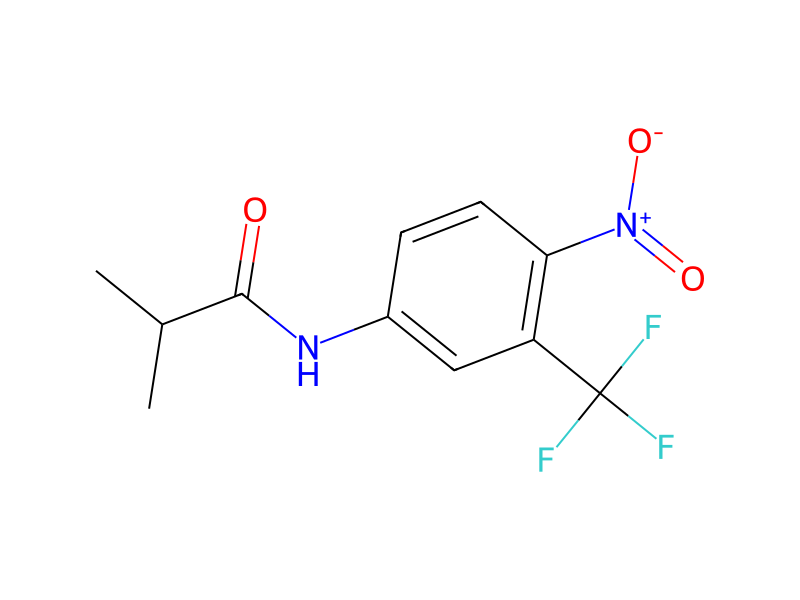
기본 정보
- 표준 SMILES
CC(C)C(=O)Nc1ccc([N+](=O)[O-])c(C(F)(F)F)c1- InChIKey
MKXKFYHWDHIYRV-UHFFFAOYSA-N- 분자식
- C11H11F3N2O3
- 평균 분자량
- 276.21 g/mol
- 단동위원소 질량
- 276.07217687
개요
Flutamide can cause developmental toxicity according to state or federal government labeling requirements.
이름 및 식별자
- 우선 이름
- Flutamide
- IUPAC
- 2-methyl-N-[4-nitro-3-(trifluoromethyl)phenyl]propanamide
- 현지명
- 플루타마이드
- 영어명
- Flutamide
- 분자식
- C11H11F3N2O3
- 분자량
- 276.21
이름 및 동의어
flutamide13311-84-7EulexinNiftolide2-Methyl-N-[4-nitro-3-(trifluoromethyl)phenyl]propanamideSch 13521NFBAniftolidDrogenilFlutamidaFlutamidumSch-13521
이름 더 보기
플루타마이드EunexOdyneEuflexDrognilFugerelEu.1eximFlucinom
4'-Nitro-3'-trifluoromethylisobutyranilide2-Methyl-N-(4-nitro-3-[trifluoromethyl]phenyl)propanamideEulexinePropanamide, 2-methyl-N-[4-nitro-3-(trifluoromethyl)phenyl]-SCH13521DTXSID7032004alpha,alpha,alpha-Trifluoro-2-methyl-4'-nitro-m-propionotoluidideNSC-215876
데이터베이스 식별자
- CAS
13311-84-7- PubChem CID
- 3397
- DTXSID
DTXSID7032004- ChEMBL
CHEMBL4759307、CHEMBL806- ChEBI
CHEBI:5132- UNII
- 76W6J0943E
- EC Number
- 236-341-9
- Nikkaji
- J8.099C
물성
구조 계산 물성
- XLogP
- 3.3
- 극성 표면적
- 74.9 Ų
- 수소 결합 공여자 수
- 1
- 수소 결합 수용자 수
- 6
- 회전 가능 결합 수
- 2
- 무거운 원자 수
- 19
- 형식 전하
- 0
- 복잡도
- 352
실험 및 물리화학적 성질
Drugs
Pharmaceuticals
Pharmaceuticals -> Antineoplastic and immunomodulating agents -> Antineoplastic agents
Pharmaceuticals -> Listed in ZINC15
Pharmaceutical
LogP2.6
Solubility
5.66e-03 g/L
>41.4 [ug/mL] (The mean of the results at pH 7.4)
Human Drugs
FDA approved drugs -> Active ingredient
FDA approved drugs -> Active ingredient
Hormones and antihormones
Endocrine DisruptorsPotential endocrine disrupting compound
Melting Point
111.5-112.5
111 - 113 °C
Physical DescriptionSolid
Collision Cross Section
154.9 Ų [M-H]- [CCS Type: DT; Buffer gas: N2; Ionization: ESI-; Dataset: TOXCAST; Source Identifier: DTXSID7032004]
160 Ų [M+H]+ [CCS Type: TW; Method: calibrated with polyalanine and drug standards]
154.25 Ų [M+H-H2O]+ [CCS Type: TW; Method: calibrated with polyalanine and drug standards]
물리화학적 성질
- 녹는점
- 112 °C · 112 °C
- 끓는 점
- 400.3 · 400.3±45.0 °C(Predicted)
- 밀도
- 1.3649 · 1.3649 (estimate)
- 저장 조건
- 2 · 2-8°C
- 용해도
- 물에는 거의 녹지 않으며, 아세톤과 에탄올(96%)에는 잘 녹습니다.
- 물리적 상태
- Solid
- 산도 계수 (pKa)
- 13.12 · 13.12±0.70(Predicted)
- 색상
- 연한 노란색에서 밝은 노란색까지
- Merck
- 14 · 14,4208
- 주요 응용
- 의약품(소분자)
- InChI
- InChI=1S/C11H11F3N2O3/c1-6(2)10(17)15-7-3-4-9(16(18)19)8(5-7)11(12,13)14/h3-6H,1-2H3,(H,15,17)
- InChIKey
- MKXKFYHWDHIYRV-UHFFFAOYSA-N
- SMILES
- C(NC1=CC=C([N+]([O-])=O)C(C(F)(F)F)=C1)(=O)C(C)C
- EPA
- Flutamide (13311-84-7)
화학적 성질
Light Yellow Solid
안전 및 규제
GHS 분류
GHS Classification
Danger
H302+H312+H332 (29.8%): Harmful if swallowed, in contact with skin or if inhaled [Warning Acute toxicity, oral; acute toxicity, dermal; acute toxicity, inhalation]
P203, P260, P261, P264, P270, P271, P273, P280, P301+P317, P302+P352, P304+P340, P317, P318, P319, P321, P330, P362+P364, P405, and P501 (click each P-code to see the statement)
Aggregated GHS information provided per 94 reports by companies from 15 notifications to the ECHA C&L Inventory. Each notification may be associated with multiple companies.
Danger
H361: Suspected of damaging fertility or the unborn child [Warning Reproductive toxicity]
유해성 정보
Regulatory InformationHazard Traits - Developmental Toxicity
Hazard Classes and Categories
Acute Tox. 4 (88.3%)
Reproductive toxicity - Category 2
독성 정보
Hepatotoxicity
Chronic therapy with flutamide is associated with elevations in serum aminotransferase levels in up to 62% of patients, but marked elevations (above 5 times ULN) in only 3% to 5%. Most of these abnormalities are transient, asymptomatic and do not require dose adjustment or drug discontinuation. However, in 0.1% to 1% of patients, acute liver injury with symptoms and jaundice arises which can be prolonged, severe and even fatal. The latency of onset ranges widely from 1 to 10 months (Cases 2 and 3), averaging 3 months. Allergic manifestations are rare as are autoantibodies. The pattern of liver enzyme elevations is most commonly hepatocellular, but many cases with cholestatic and mixed patterns have been described. Liver failure with a requirement for emergency liver transplantation or fatality has been described in many publications with 20 fatal cases reported from the FDA MedWatch program during the first 5 years of its availability. Fatal cases have been reported in children and young women being treated for hirsutism or acne (Case 1).
Adverse Effects
Flutamide comes with a black box warning due to the risk of hepatic failure. Hospitalization and death have occurred, although rarely, due to flutamide use; this is due to cholestatic hepatitis, which leads to failure. Cholestatic hepatitis results from the mitochondrial toxicity that occurs due to flutamide's major metabolite, hydroxyflutamide. This metabolite inhibits enzymes that are necessary for the electron transport chain within the mitochondria of the hepatocyte, leading to a halt of cellular respiration and, ultimately, cellular death. Hepatic failure would most likely be evident within the first three months of use. If the hepatic injury does occur in a patient, discontinuation of flutamide may help reverses the injury. Estimates of the rate at which this adverse effect occurs are three persons in 10,000 or 0.03% of all patients who use the drug. Due to this risk, it is advisable to perform liver function tests if symptoms suggest hepatic dysfunction. Such signs to watch for are abdominal pain, anorexia, nausea, vomiting, jaundice, and right upper quadrant pain and tenderness. Recommendations are to discontinue therapy if jaundice develops or if alanine aminotransferase increased to two times the upper limit of normal.
Exposure RoutesRapidly and completely absorbed.
Toxicity Summary
There is a risk for severe hepatic injury leading to hepatic failure. There is a potential for aniline toxicity, which may cause methemoglobinemia or hemolytic anemia. The risk of cardiovascular disease may increase due to androgen deprivation.
Flutamide is a nonsteroidal antiandrogen that blocks the action of both endogenous and exogenous testosterone by binding to the androgen receptor. In addition Flutamide is a potent inhibitor of testosterone-stimulated prostatic DNA synthesis. Moreover, it is capable of inhibiting prostatic nuclear uptake of androgen.
Signs and SymptomsIn animal studies with flutamide alone, signs of overdose included hypoactivity, piloerection, slow respiration, ataxia, and/or lacrimation, anorexia, tranquilization, emesis, and methemoglobinemia.
Carcinogen ClassificationNo indication of carcinogenicity to humans (not listed by IARC).
Drug Induced Liver Injury
Drug Induced Liver Injury Rank (DILIrank 2.0)
Flutamide
vMost-DILI-concern
8
Box warning
DOI:10.1016/j.drudis.2016.02.015
안전 데이터
- wgk
- 3
- rtecs
- UG5700000
- ridadr
- UN3077
- HS 번호
- 29242990
- risk_code
- 20/21/22-63-36/37/38
- hazard_code
- Xn,Xi
- safety_code
- 22-36-36/37/39-27-26
- 위험 등급
- 9
- Hazard Classifications
- Acute Tox. 4 OralAquatic Chronic 2Carc. 2Repr. 2STOT RE 2
- 스토리지 클래스
- 11 - Combustible Solids
화학 및 산업
약리 정보
ATC Code
L02BB01
L - Antineoplastic and immunomodulating agents
QL - Antineoplastic and immunomodulating agents
Protein Binding94-96%
Pharmacodynamics
Flutamide is a nonsteroidal antiandrogen. In animal studies, flutamide demonstrates potent antiandrogenic effects. It exerts its antiandrogenic action by inhibiting androgen uptake and/or by inhibiting nuclear binding of androgen in target tissues or both. Prostatic carcinoma is known to be androgen-sensitive and responds to treatment that counteracts the effect of androgen and/or removes the source of androgen, e.g. castration. Elevations of plasma testosterone and estradiol levels have been noted following flutamide administration.
Mechanism of Action
Flutamide is a nonsteroidal antiandrogen that blocks the action of both endogenous and exogenous testosterone by binding to the androgen receptor. In addition Flutamide is a potent inhibitor of testosterone-stimulated prostatic DNA synthesis. Moreover, it is capable of inhibiting prostatic nuclear uptake of androgen.
Biological Half-LifeThe plasma half-life for the alpha-hydroxylated metabolite of flutamide (an active metabolite) is approximately 6 hours.
Metabolism/Metabolites
Flutamide is rapidly and extensively metabolized, with flutamide comprising only 2.5% of plasma radioactivity 1 hour after administration.
Flutamide has known human metabolites that include 2-hydroxy-flutamide.
Flutamide is rapidly and extensively metabolized, with flutamide comprising only 2.5% of plasma radioactivity 1 hour after administration. Route of Elimination: Flutamide and its metabolites are excreted mainly in the urine with only 4.2% of a single dose excreted in the feces over 72 hours. Half Life: The plasma half-life for the alpha-hydroxylated metabolite of flutamide (an active metabolite) is approximately 6 hours.
FDA Pharmacological Classification
76W6J0943E
FLUTAMIDE
Mechanisms of Action [MoA] - Androgen Receptor Antagonists
Established Pharmacologic Class [EPC] - Androgen Receptor Inhibitor
Flutamide is an Androgen Receptor Inhibitor. The mechanism of action of flutamide is as an Androgen Receptor Antagonist.
FLUTAMIDE
MeSH Pharmacological Classification
Compounds which inhibit or antagonize the biosynthesis or actions of androgens.
Antineoplastic agents that are used to treat hormone-sensitive tumors. Hormone-sensitive tumors may be hormone-dependent, hormone-responsive, or both. A hormone-dependent tumor regresses on removal of the hormonal stimulus, by surgery or pharmacological block. Hormone-responsive tumors may regress when pharmacologic amounts of hormones are administered regardless of whether previous signs of hormone sensitivity were observed. The major hormone-responsive cancers include carcinomas of the breast, prostate, and endometrium; lymphomas; and certain leukemias. (From AMA Drug Evaluations Annual 1994, p2079)
Absorption, Distribution and Excretion
Rapidly and completely absorbed.
Flutamide and its metabolites are excreted mainly in the urine with only 4.2% of a single dose excreted in the feces over 72 hours.
Cellular LocationsCytoplasm
용도 및 제조
Uses
Use (kg; approx.) in Germany (2009): >1000
For the management of locally confined Stage B2-C and Stage D2 metastatic carcinoma of the prostate
응용 분야
개요Flutamide is an orally active, non-steroidal antiandrogen indicated for the treatment of prostatic cancer in both castrates and noncastrates.
역사Flutamide was first described as a member of a series of N-acyl anilides synthesized at Monsanto in the 1960s during a compound finding program aiming at bacteriostatic agents. Soon after, at Schering Corp., the compound was characterized pharmacologically and further developed as SCH-13521. It was found that flutamide inhibits agonist action at the AR by replacing the agonist at the ligand binding site, being the first nonsteroidal compound possessing anti-androgenic activity in animals. In contrast to steroidal anti-androgens, for instance, cyproterone acetate, which also displays significant progestational activity, flutamide has no other hormonal activity. There is also no reduction of serum testosterone levels seen with flutamide but rather a slight increase in luteinizing hormone (LH) and follicle-stimulating hormone (FSH) resulting in elevated serum testosterone levels. This accounts for the beneficial maintenance of libido and potency in sexually active patients. On the other hand, elevated serum estradiol levels resulting from peripheral testosterone aromatization leading to gynecomastia were observed in patients.
용도Flutamide is a nonsteroidal antiandrogen drug; antineoplastic (hormonal).
일반 설명Flutamide, 2-methyl-N-[4-nitro-3-(trifluoromethyl)phenyl]propanamide, is dosed 3 times daily(250-mg dose; 750-mg total daily dose). A major metaboliteof flutamide, hydroxyflutamide, is a more potent AR antagonistthan the parent compound. This metabolite, which ispresent at a much higher steady-state concentration than isflutamide, contributes a significant amount of the antiandrogen action of this drug. A limiting factor in the useof flutamide is hepatotoxicity in from 1% to 5% of patients.Although the hepatotoxicity usually is reversible followingcessation of treatment, rare cases of death associated withhepatic failure have been reported to be associated with flutamidetherapy. Diarrhea is also a limiting side effect withflutamide therapy for some patients.
상·하류 제품 정보
상류 원료
공급사50 곳
国药集团化学试剂有限公司86-21-63210123 · [email protected]
梯希爱(上海)化成工业发展有限公司021-67121386 · [email protected]
Baoji Guokang Healthchem co.,ltd+8615604608665 15604608665 · [email protected]
LGM Pharma1-(800)-881-8210 · [email protected]
Syntechem Co.,Ltd[email protected]
上海迈瑞尔生化科技有限公司4006356688 18621169109 · [email protected]
武汉易泰科技有限公司上海分公司18930552037 · [email protected]
太原市瑞和丰科贸有限公司+86 351 7031519 · [email protected]
安耐吉化学&3A(安徽泽升科技股份有限公司)400-0056266 · [email protected]
上海景颜化工科技有限公司13817811078 · [email protected]
Pure Chemistry Scientific Inc.001-857-928-2050 or 1-888-588-9418 · [email protected]
上海泰坦科技股份有限公司400-6009262 15618770481 · [email protected]
MedChemexpress LLC021-58955995 · [email protected]
孝感深远化工有限公司15527621225; 15527621225 · [email protected]
山东西亚化学有限公司13355009207 13355009207 · [email protected]
斯百全化学(上海)有限公司021-021-021-67601398-809-809-809 15221380277 · [email protected]
上海源叶生物科技有限公司13636370518 · [email protected]
江苏艾康生物医药研发有限公司025-66113011 13913916777 · [email protected]
TCI AMERICA800-4238616 · [email protected]
TOKYO CHEMICAL INDUSTRY CO., LTD.03-36680489 · [email protected]
TCI Europe320-37350700 · [email protected]
深圳振强药物研发有限公司0755-66853366 13670046396 · [email protected]
Hubei Datong Bio-Chemical Technology Co.,Ltd027-87666700 · [email protected]
广州爱纯医药科技有限公司020-39119399 18927568969 · [email protected]
南京生利德生物科技有限公司025-57798810 18652991625 · [email protected]
湖北威德利化学试剂有限公司186-02735115 18602735115 · [email protected]
湖北鑫源顺医药化工有限公司13971561712, 13995564702, 027-50664929 · [email protected]
上海将来实业股份有限公司021-61552785 · [email protected]
HBCChem, Inc.+1-510-219-6317 · [email protected]
杭州杰恒化工有限公司0571-87396432 · [email protected]
南京百鑫德诺生物科技有限公司025-58849295 · [email protected]
上海孚一生物科技有限公司+86 (21) 61124340
凯试(上海)科技有限公司021-50135380 · [email protected]
湖北巨胜科技有限公司027-59599241 18871490274 · [email protected]
常州百涛实业有限公司0519-82309982
Sigma-Aldrich西格玛奥德里奇(上海)贸易有限公司021-61415566 800-8193336 · [email protected]
石家庄通洋进出口有限公司[email protected]
Candia Pharmatech Co. , Ltd.+86-371-55216238
南京伶亚生物医药科技有限公司18068075658 · [email protected]
武汉森威尔世纪化工有限公司027-86652399 · [email protected]
TargetMol中国(陶术生物)021-021-33632979 15002134094 · [email protected]
上海陶术生物科技股份有限公司+1-781-999-5354; +1-00000000000 · [email protected]
上海波以尔化工有限公司021-50182298 021-50180596 · [email protected]
九鼎化学(上海)科技有限公司4009209199 · [email protected]
BOC Sciences16314854226; +8616314854226 · [email protected]
西安美川生物科技有限公司029-89275612 +8618991951683 · [email protected]
Alfa Chemistry+1-5166625404 · [email protected]
上海岚克医药科技发展有限公司0086-21-58956006
上海思言生物科技有限公司021-50908862,442785678,326799392 18721037013 · [email protected]
广州市齐云生物技术有限公司020-61288194 61288195 · [email protected]
관련 반응
11건


연결된 노트
불러오는 중…