

기본 정보
- 표준 SMILES
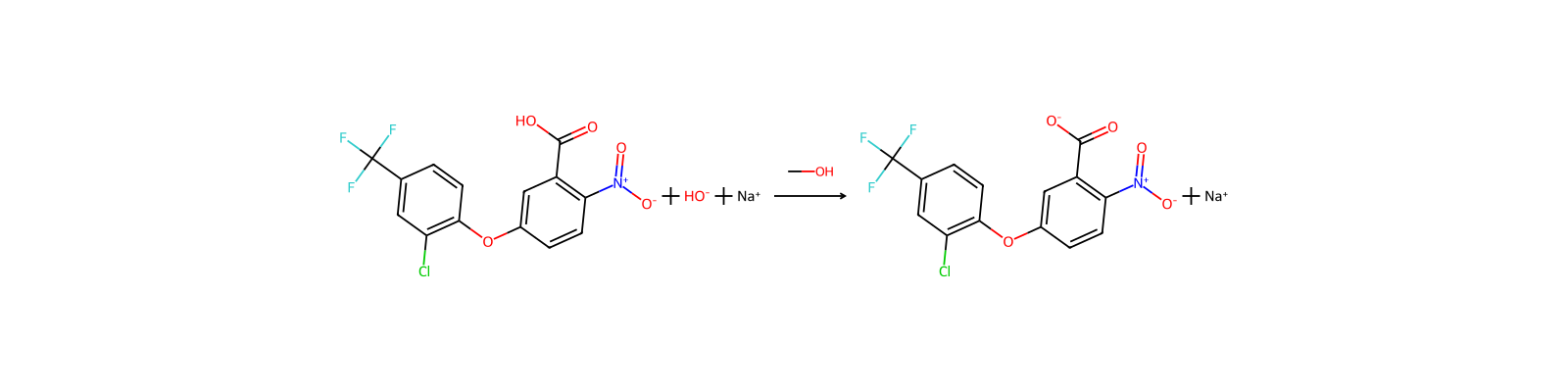
O=C([O-])c1cc(Oc2ccc(C(F)(F)F)cc2Cl)ccc1[N+](=O)[O-].[Na+]- InChIKey
RVULBHWZFCBODE-UHFFFAOYSA-M- 분자식
- C14H6ClF3NO5.Na
- 평균 분자량
- 383.64 g/mol
- 단동위원소 질량
- 382.97842891
개요
Acifluorfen Sodium can cause cancer according to The Environmental Protection Agency (EPA).
이름 및 식별자
- 우선 이름
- Acifluorfen sodium
- IUPAC
- sodium 5-[2-chloro-4-(trifluoromethyl)phenoxy]-2-nitrobenzoate
이름 및 동의어
62476-59-9Acifluorfen sodiumACIFLUORFEN-SODIUMCarbofluorfenScifluorfenSodium AcifluorfenAcifluorfen, sodium saltBlazer 2SSodium salt of acifluorfenAcifluorfen sodium saltDTXSID7023853RH 6205
이름 더 보기
MC 10978LS 80.12136H07I1G902DTXCID603853Tackle 2ASRefChem:915040263-560-7Sodium 5-(2-chloro-4-(trifluoromethyl)phenoxy)-2-nitrobenzoate
데이터베이스 식별자
- CAS
62476-59-9- PubChem CID
- 44072
- DTXSID
DTXSID7023853- ChEMBL
CHEMBL3184255- UNII
- 6H07I1G902
- EC Number
- 263-560-7
물성
구조 계산 물성
- 극성 표면적
- 95.2 Ų
- 수소 결합 공여자 수
- 0
- 수소 결합 수용자 수
- 8
- 회전 가능 결합 수
- 2
- 무거운 원자 수
- 25
- 형식 전하
- 0
- 복잡도
- 479
실험 및 물리화학적 성질
pHpH = 8 to 9
Pesticides
Pesticide -> EPA IRIS
Pesticides -> Herbicides, Protox-Inhibiting
Pesticide
Odor
Dry form ... with a mildly antiseptic odor
Odorless
Density1.26 at 23 °C /TECHNICAL 47% WATER SOLUTION/
Color/Form
Dry form is light yellow
White powder
Yellow; as aqueous solution yellow to brown
Dark liquid (40% active ingredient)
Solubility
In octanol 5.37, methanol 64.15, hexane <5X10⁻⁵ (all in g/100 mL, 25 °C)
Acetone >50%; benzene 1%; chloroform <1%; carbon tetrachloride <1%; dimethyl formamide >50%; dimethyl sulfoxide >50%; ethanol >50%; ethyl acetate >50%; hexane <1%; methanol >50%; methylene chloride <1%; xylene <1%. (all at 25 °C)
In water (unbuffered) 62.07, (pH 7) 60.81, (pH 9) 60.7 (all in g/100 g, 25 °C
CorrosivityNoncorrosive to equipment under normal use conditions.
Boiling Point>100 °C /47% WATER SOLUTION/
Decomposition
Decomposes at 235 °C. /Acifluorfen/
Decomposed by UV light, with a half-life of circa 110 hr. /Acifluorfen/
Melting Point
124-125 °C
Off-white solid, mp: 151.5 to 157 °C /Acifluorfen/
Vapor Pressure
0.00000001 [mmHg]
<1.3X10⁻³ mPa.
Physical Description
Acifluorfen sodium salt is a white powder. Melting point 255- 257 °F (124-125 °C). Irritates skin and eyes. Used as a herbicide.
White to yellow solid; Yellow to brown in aqueous solution; [HSDB] Light to dark amber liquid; [MSDSonline]
안전 및 규제
GHS 분류
GHS Classification
Danger
H302: Harmful if swallowed [Warning Acute toxicity, oral]
P264, P264+P265, P270, P273, P280, P301+P317, P302+P352, P305+P354+P338, P317, P321, P330, P332+P317, P362+P364, P391, and P501 (click each P-code to see the statement)
Danger
H302 (100%): Harmful if swallowed [Warning Acute toxicity, oral]
P264, P264+P265, P270, P273, P280, P301+P317, P302+P352, P305+P354+P338, P317, P321, P330, P332+P317, P362+P364, P391, and P501 (click each P-code to see the statement)
유해성 정보
Regulatory Information
Hazard Traits - Carcinogenicity
Status: Cease Manufacture Update: 13-10-2011 https://echa.europa.eu/registration-dossier/-/registered-dossier/7594
The New Jersey Worker and Community Right to Know Act requires public and private employers to provide information about hazardous substances at their workplaces. (N.J.S.A. 34:5A-1 et. seq.)
Other Safety InformationIMAP assessments - Benzoic acid, 5-[2-chloro-4-(trifluoromethyl)phenoxy]-2-nitro-, sodium salt: Environment tier I assessment
Hazards Summary
Acifluorfen: Caused severe eye and moderate skin irritation in rabbit studies; Tackle 2AS (20-21.6% pure): Effects in 90 day feeding study with rats include changes in blood chemistry, considerable increase in liver and kidney weight, and tissue damage in the liver; [HSDB] A skin and eye irritant; [CAMEO] A skin irritant; May cause serious damage to eyes; [eChemPortal: ESIS] Effects in high-dose animal studies include skin irritation, changes in erythrocyte count, and changes in liver, kidney, and adrenal weights; [RTECS] See Fluthiacet-methyl.
Reactive GroupNitro, Nitroso, Nitrate, and Nitrite Compounds, Organic
Special Reports
USEPA/Office of Pesticide Programs; Reregistration Eligibility Decision Document - Sodium Acifluorfen. The RED summarizes the risk assessment conclusions and outlines any risk reduction measures necessary for the pesticide to continue to be registered in the U.S.[Available from, as of February 27, 2007: http://www.epa.gov/pesticides/reregistration/status.htm]
FIFRA Requirements
Tolerances are established for combined residues of the herbicide sodium salt of acifluorfen, sodium 5-[2-chloro-4-(trifluoromethyl)phenoxy]-2-nitrobenzoate, and its metabolites (the corresponding acid, methyl ester, and amino analogues) in or on the following raw agricultural commodities: [Table#6055]
The Agency has determined that sodium acifluorfen is eligible for reregistration provided that: (1) current data gaps and additional data needs are addressed and (2) the risk mitigation measures outlined in this document are adopted, and label amendments are made to reflect these measures.
As the federal pesticide law FIFRA directs, EPA is conducting a comprehensive review of older pesticides to consider their health and environmental effects and make decisions about their future use. Under this pesticide reregistration program, EPA examines health and safety data for pesticide active ingredients initially registered before November 1, 1984, and determines whether they are eligible for reregistration. In addition, all pesticides must meet the new safety standard of the Food Quality Protection Act of 1996. Pesticides for which EPA had not issued Registration Standards prior to the effective date of FIFRA '88 were divided into three lists based upon their potential for human exposure and other factors, with List B containing pesticides of greater concern and List D pesticides of less concern. Sodium acifluorfen is found on List B. Case No: 2605; Pesticide type: herbicide; Case Status: OPP is reviewing data from the pesticide's producers regarding its human health and/or environmental effects, or OPP is determining the pesticide's eligibility for reregistration and developing the RED document.; Active ingredient (AI): 5-(2-Chloro-4-(trifluoromethyl)phenoxy)-2-nitrobenzoic acid, sodium salt; Data Call-in (DCI) Date(s): 06/07/91, 03/03/95, 10/13/95; AI Status: The producers of the pesticide have made commitments to conduct the studies and pay the fees required for reregistration, and are meeting those commitments in a timely manner.
Air and Water ReactionsWater soluble.
Hazard Classes and Categories
Acute Tox. 4 (100%)
Acute toxicity - category 4
Acute toxicity (Oral) - Category 3
Acute Tox. 4 *
State Drinking Water Guidelines
(FL) FLORIDA 1 ug/l /Acifluorfen/
(ME) MAINE 3.5 ug/l /Acifluorfen/
Shipment Methods and RegulationsAcifluorfen may be classified as a pesticide, solid, toxic nos. It would then fall in Hazard Class 6.1 and Packing Group III. This requires a "keep away from food" label.
Hazardous Reactivities and IncompatibilitiesStrong oxidizers. Avoid contact with all sources of ignition.
안전 및 보호
Fire Fighting Procedures
This chemical is a combustible solid but does not easily ignite. Use dry chemical, carbon dioxide, water spray, or alcohol foam extinguishers. Poisonous gases are produced in fire including nitrogen oxides, carbon monoxide, chlorides, and fluorides. If material of contaminated runoff enters waterways, notify downstream users of potentially contaminated waters. Notify local health and fire officials and pollution control agencies. From a secure, explosion-proof location, use water spray to cool exposed containers. If cooling streams are ineffective (venting sound increase in volume and pitch, tank discolors, or shows any signs of deforming), withdraw immediately to a secure position. If employees are expected to fight fires, they must be trained and equipped in OSHA 1910.156.
Storage Conditions
Do not store below 32 °F /Ultra Blazer Herbicide/
Do not store below 40 °F or above 100 °F. Store in a dry place way from heat or open flame /Storm Herbicide/
Safe Storage of Pesticides. Always store pesticides in their original containers, complete with labels that list ingredients, directions for use, and first aid steps in case of accidental poisoning. Never store pesticides in cabinets with or near food, animal feed, or medical supplies. Do not store pesticides in places where flooding is possible or in places where they might spill or leak into wells, drains, ground water, or surface water.
Cleanup Methods
Steps to be taken in case material is released or spilled: Dike and contain the spill with inert material (sand, earth, etc.) and transfer liquid and solid diking material to separate containers for disposal. ... Keep the spill out of all sewers and open bodies of water. /Storm Herbicide and Ultra Blazer Herbicide/
Large spillages should be dammed-off and pumped into containers; soak up remainder with absorbent material and dispose of in accordance with local regulations.
If a spill occurs, clean it up promptly. Don't wash it away. Instead, sprinkle the spill with sawdust, vermiculite, or kitty litter. Sweep it into a plastic garbage bag, and dispose of it as directed on the pesticide product label.
After Applying a Pesticide, Indoors or Outdoors. To remove pesticide residues, use a bucket to rinse tools or equipment three times, including any containers or utensils that you used when mixing the pesticide. Then pour the rinsewater into the pesticide sprayer and reuse the solution by applying it according to the pesticide product label directions. After applying any pesticide wash your hands and any other parts of your body that may have come in contact with the pesticide. To prevent tracking pesticides inside, remove or rinse your boots or shoes before entering your home. Wash any clothes that have been exposed to a lot of pesticide separately from your regular wash.
Disposal Methods
Must be disposed of by special means, e.g. suitable incineration, in accordance with local regulations.
SRP: The most favorable course of action is to use an alternative chemical product with less inherent propensity for occupational exposure or environmental contamination. Recycle any unused portion of the material for its approved use or return it to the manufacturer or supplier. Ultimate disposal of the chemical must consider: the material's impact on air quality; potential migration in soil or water; effects on animal, aquatic, and plant life; and conformance with environmental and public health regulations.
Pesticide Disposal: ...If these wastes cannot be disposed of according to label instructions, contact your State Pesticide or Environmental Control Agency, or the Hazardous Waste representatives at the nearest EPA Regional Office for Guidance. Container Disposal: Plastic containers: Triple rinse or equivalent. Then offer for recycling or reconditioning, or puncture and dispose of in a sanitary landfill, or by incineration, or, of allowed by state and local authorities, by burning. If burned, stay out of any smole. Bulk/mini0bulk Containers: Re-usable containers should be returned to the point of purchase for cleaning and refilling because the container must be thoroughly cleaned befor refilling. /Storm Herbicide and Ultra Blazer Herbicide/
Safe Disposal of Pesticides. The best way to dispose of small amounts of excess pesticides is to use them - apply them - according to the directions on the label. If you cannot use them, ask your neighbors whether they have a similar pest control problem and can use them. If all of the remaining pesticide cannot be properly used, check with your local solid waste management authority, environmental agency, or health department to find out whether your community has a household hazardous waste collection program or a similar program for getting rid of unwanted, leftover pesticides. These authorities can also inform you of any local requirements for pesticide waste disposal.
Safe Disposal of Pesticides. An empty pesticide container can be as hazardous as a full one because of residues left inside. Never reuse such a container. When empty, a pesticide container should be rinsed carefully three times and the rinsewater thoroughly drained back onto the sprayer or the container previously used to mix the pesticide. Use the rinsewater as a pesticide, following label directions. Replace the cap or closure securely. Dispose of the container according to label instructions. Do not puncture or burn a pressurized container like an aerosol - it could explode. Do cut or puncture other empty pesticide containers made of metal or plastic to prevent someone from reusing them. Wrap the empty container and put it in the trash after you have rinsed it.
Preventive Measures
Agricultural Use Requirements. Use this product only in accordance with its labeling and with the Worker Protection Standard (WPS), 40 CFR part 170. ... Do not enter or allow worker entry into treated areas during the restricted-entry interval (REI) of 48 hours. PPE required for early entry to treated areas that is permitted under the WPS and that involves contact with anything that has been treated, such as plants, soil, or water, is: coveralls, waterproof gloves,shoes plus socks, and protective eyewear and chemical resistant headgear for overhead exposure (Ultra Blazer only) /Storm Herbicide and Ultra Blazer Herbicide/
Follow the manufacturer's instructions for cleaning and maintaining personal protective equipment (PPE). If no such instructions for washables, use detergent and hot water. Keep and wash PPE separately from other laundry. /Storm Herbicide and Ultra Blazer Herbicide/
Users should: wash hands before eating, drinking, chewing gum, using tobacco, or using the toilet; remove clothing immediately if pesticide gets inside, then wash thoroughly an put on clean clothing; and remove personal protective equipment immediately after handling this product; wash the outside of gloves before removing; as soon as possible, wash thoroughly and change into clean clothing. /Storm Herbicide and Ultra Blazer Herbicide/
If in eyes hold eye open and rinse slowly and gently with water for 15-20 minutes, remove contact lenses, if present, after first 5 minutes, then continue rinsing eye, and call a poison control center or doctor for treatment advice. If on skin or clothing take off contaminated clothing, rinse skin immediately with plenty of water for 15-20 minutes, and call a poison control center or doctor for treatment advice. /Storm Herbicide and Ultra Blazer/
For more Preventive Measures (Complete) data for ACIFLUORFEN-SODIUM (7 total), please visit the HSDB record page.
Allowable Tolerances
Tolerances are established for combined residues of the herbicide sodium salt of acifluorfen, sodium 5-[2-chloro-4-(trifluoromethyl)phenoxy]-2-nitrobenzoate, and its metabolites (the corresponding acid, methyl ester, and amino analogues) in or on the following raw agricultural commodities: [Table#6054]
Personal Protective Equipment (PPE)
Personal Protection Equipment (PPE): Applicators and other handlers must wear: long-sleeved shirt and long pants, chemical -resistant gloves made out of any water-proof material, shoes plus socks, protective eyewear, and chemical-resistant headgear for overhead exposure. Discard clothing and other absorbent materials that have been drenched or heavily contaminated iwth this product's concentrate. Do not re-use them. When handlers use closed systems, enclosed cabs, or aircraft in a manner that meets the requirements listed in the Worker Protection Standard (WPS) for agricultural pesticides (40 CFR 170.240 (d) (4-6)), the handler PPE requirements may be reduced or modified as specified in the WPS./Ultra Blazer Herbicide/
Personal Protection Equipment (PPE): Applicators and other handlers must wear: long-sleeved shirt and loong pants, waterproof gloves, shoes plus socks, and protective eyewear. Discard clothing and other absorbent materials that have been drenched or heavily contaminated iwth this product's concentrate. Do not re-use them. /Storm Herbicide/
Chemical-resistant apron when cleaning equiptment, mixing, or loading. Chemical resistant-gloves. Protective eyewear.
독성 정보
Target OrgansDevelopmental
Ecotoxicity Values
LD50; Species: Anas platyrhychos (Mallard duck) oral 2,821 mg/kg /Acifluorfen/
LC50; Species: Oncorhynchus mykiss (Rainbow trout); 17 mg/L/96 hr /Acifluorfen; conditions of bioassay not specified/
LC50; Species: Lepomis macrochirus (Bluegill sunfish, fresh water); 62 mg a.i./L (Static)[EPA/Office of Pollution Prevention and Toxics; High Production Volume Information System (HPVIS) on Benzoic acid, 5-
LC50; Species: Salmo gairdneri (Fish, estuary, fresh water); 17 mg a.i./L (96 hr) (static)[EPA/Office of Pollution Prevention and Toxics; High Production Volume Information System (HPVIS) on Benzoic acid, 5-
For more Ecotoxicity Values (Complete) data for ACIFLUORFEN-SODIUM (9 total), please visit the HSDB record page.
Environmental Fate
TERRESTRIAL FATE: Acifluorfen-sodium is highly dissociated at typical soil pH to acifluorfen(1). Adsorption of this anion form is affected by soil type, pH, soil organic carbon content and soil iron content(3). Based on a classification scheme(2), a Koc range of 44 to 684(4,5), indicates that acifluorfen is expected to have very high to low mobility in soil(SRC). The pKa of aciflurofen-sodium is 3.86(4), indicating that this compound will primarily exist in the anion form in the environment and anions generally do not adsorb more strongly to soils containing organic carbon and clay than their neutral counterparts(6). Volatilization of acifluorfen from moist soil surfaces is not expected to be an important fate process(SRC) since anions do not volatilize. Acifluorfen is not expected to volatilize from dry soil surfaces(SRC) based upon an estimated vapor pressure of 1.5X10⁻⁶ mm Hg(SRC), determined from a fragment constant method(7). An aerobic biodegradation half-life range in soil of 108-200 days for acifluorfen(3) indicates that biodegratation is not an important environmental fate process in soil(SRC). However, under anaerobic conditions, a half-life of 30 days has been reported(3).
AQUATIC FATE: Acifluorfen-sodium dissociates in the environment to acifluorfen(SRC). Based on a classification scheme(1), a Koc range of 44-684(3,6) indicates that acifluorfen is expected to adsorb to some suspended solids and sediment(SRC). A pKa of 3.86(6) indicates acifluorfen-sodium will exist almost entirely in the anion form at pH values of 5 to 9 and therefore volatilization from water surfaces is not expected to be an important fate process(4). According to a classification scheme(5), an estimated BCF of 3(SRC), from its log Kow of 3.70(7) and a regression-derived equation(8), suggests the potential for bioconcentration in aquatic organisms is low(SRC). Photolysis in water occurs and it is rapidly degraded with a half-life of about 2 hours(6). An aerobic biodegradation half-life in water of 117 days for acifluorfen(2) indicates that biodegradation is not an important environmental fate process in water(SRC). However, under anaerobic conditions, a half-life of 2.75 days has been reported(2).
ATMOSPHERIC FATE: Acifluorfen-sodium dissociates in the environment to acifluorfen(SRC). According to a model of gas/particle partitioning of semivolatile organic compounds in the atmosphere(1), acifluorfen, which has an estimated vapor pressure of 1.5X10⁻⁸ mm Hg at 25 °C(SRC), determined from a fragment constant method(2), will exist in both the vapor and particulate phases in the ambient atmosphere. Vapor-phase acifluorfen is degraded in the atmosphere by reaction with photochemically-produced hydroxyl radicals(SRC); the half-life for this reaction in air is estimated to be 18 days(SRC), calculated from its rate constant of 8.7X10⁻¹³ cu cm/molecule-sec at 25 °C(SRC) that was derived using a structure estimation method(3). Photolysis in water occurs with a half-life of about 2 hours reported(4); therefore, the active ingredient may be susceptible to direct photolysis(SRC).
Adverse EffectsOccupational hepatotoxin - Secondary hepatotoxins: the potential for toxic effect in the occupational setting is based on cases of poisoning by human ingestion or animal experimentation.
Ecotoxicity Excerpts/OTHER TERRESTRIAL SPECIES/ Non-toxic to bees. /Acifluorfen/
EPA IRIS Information
Acifluorfen, sodium
Developmental
1.3 x 10 ^-2 mg/kg-day
Soil Adsorption/Mobility
The pKa of acifluorfen-sodium is 3.86(4). Acifluorfen-sodium is highly dissociated in moist soil at environmental pH to acifluorfen(1). Adsorption of this anion form is affected by soil type, pH, soil organic carbon content and soil iron content(2). Acifluorfen forms complexes with divalent and trivalent cations(1). Acifluorfen sorption is a nonequilibrium and time-dependent process and therefore mobility in soil is affected by the rate as well as the extent of sorption(1). An adsorption Koc range of 44-684(4,5) (Kd 0.13-1.98) has been reported(4). According to a classification scheme(3), these Koc values suggest that acifluorfen is expected to have very high to low mobility in soil. Acifluorfen is weakly and reversibly adsorbed(6) and therefore accumulation in soil does not occur(5). A desorption Koc range of 131-1955, Kd 0.39-4.6, has been reported(4).
Atmospheric Concentrations
URBAN/SUBURBAN: During a sampling period from October 1996 through September 1997, acifluorfen (the active ingredient of acifluorfen-sodium) was detected (detection limit = 0.1 to 0.2 ug/cu m) in 1 of the 634 (222 rainfall, 124 dry deposition and 228 air) samples collected over four sites within Johnson County, Iowa(1). The sample location/type was not identified. These sites reflect rural (260 acres of farmland 3 miles from Iowa City), urban (central Iowa City), regional (Macbride recreational park 10 miles from both rural and urban settings) conditions, and Oakdale laboratory control representing the 3 previous sites(1).
Human Toxicity Excerpts
/SIGNS AND SYMPTOMS/ DANGER: corrosive. Causes irreversible eye damage. Harmful if swallowed or absorbed through the skin...Prolonged or frequently repeated skin contact may cause allergic reactions in some individuals. /Storm Herbicide and Ultra Blazer/
Artificial Pollution SourcesAcifluorfen-sodium's production may result in its release to the environment through various waste streams; it's use as a herbicide(1) will result in its direct release to the environment(SRC).
Environmental Biodegradation
AEROBIC: Acifluorfen-sodium dissociates in the environment to acifluorfen(SRC). The active ingredient, acifluorfen, is persistent, with a half-life range of 108 days in silt loam - 200 days in clay loam(1,2), forming mainly bound residues and higher polar metabolites(1). Acifluorfen biodegradation in soil follows first-order degradation with no more than 6% of applied radio-labelled compound mineralized in 49 days using a Dundee silty clay loam from the Mississippi Delta(3). The acifluorfen ion is relatively stable in aquatic environments, with a half-life of 117 days reported(2).
ANAEROBIC: Acifluorfen-sodium dissociates in the environment to acifluorfen(SRC). Acifluorfen degrades under anaerobic conditions; a soil half-life of 30 days and a water half-life of 2.75 days were reported(1). Under anaerobic conditions, acifluorfen degrades to amino acifluorfen which is persistent in soil and may enter surface water via run-off and groundwater by leaching(1).
Carcinogen ClassificationNot listed by IARC.
규제 정보
FIFRA Requirements
Tolerances are established for combined residues of the herbicide sodium salt of acifluorfen, sodium 5-[2-chloro-4-(trifluoromethyl)phenoxy]-2-nitrobenzoate, and its metabolites (the corresponding acid, methyl ester, and amino analogues) in or on the following raw agricultural commodities: [Table#6055]
The Agency has determined that sodium acifluorfen is eligible for reregistration provided that: (1) current data gaps and additional data needs are addressed and (2) the risk mitigation measures outlined in this document are adopted, and label amendments are made to reflect these measures.
As the federal pesticide law FIFRA directs, EPA is conducting a comprehensive review of older pesticides to consider their health and environmental effects and make decisions about their future use. Under this pesticide reregistration program, EPA examines health and safety data for pesticide active ingredients initially registered before November 1, 1984, and determines whether they are eligible for reregistration. In addition, all pesticides must meet the new safety standard of the Food Quality Protection Act of 1996. Pesticides for which EPA had not issued Registration Standards prior to the effective date of FIFRA '88 were divided into three lists based upon their potential for human exposure and other factors, with List B containing pesticides of greater concern and List D pesticides of less concern. Sodium acifluorfen is found on List B. Case No: 2605; Pesticide type: herbicide; Case Status: OPP is reviewing data from the pesticide's producers regarding its human health and/or environmental effects, or OPP is determining the pesticide's eligibility for reregistration and developing the RED document.; Active ingredient (AI): 5-(2-Chloro-4-(trifluoromethyl)phenoxy)-2-nitrobenzoic acid, sodium salt; Data Call-in (DCI) Date(s): 06/07/91, 03/03/95, 10/13/95; AI Status: The producers of the pesticide have made commitments to conduct the studies and pay the fees required for reregistration, and are meeting those commitments in a timely manner.
State Drinking Water Guidelines
(FL) FLORIDA 1 ug/l /Acifluorfen/
(ME) MAINE 3.5 ug/l /Acifluorfen/
화학 및 산업
약리 정보
Mechanism of ActionActs by inhibition of protoporphyrinogen oxidase.
Metabolism/MetabolitesRapidly metabolized in plants to glucuronides, and homoglutathione and cysteine conjugates. /Acifluorfen/
MeSH Pharmacological Classification
Compounds or agents that combine with an enzyme in such a manner as to prevent the normal substrate-enzyme combination and the catalytic reaction.
Pesticides used to destroy unwanted vegetation, especially various types of weeds, grasses (POACEAE), and woody plants. Some plants develop HERBICIDE RESISTANCE.
용도 및 제조
Uses
Used as pre- or post-emergence herbicide for control of broadleaf weeds in soybeans, peanuts, rice, ornamentals, and residential areas (i.e. mulch, patios, and private roads); [HSDB]
Farming (Pesticides) [Category: Industry]
For acifluorfen-sodium (USEPA/OPP Pesticide Code: 114402) ACTIVE products with label matches. /SRP: Registered for use in the U.S. but approved pesticide uses may change periodically and so federal, state and local authorities must be consulted for currently approved uses./
Postemergence herbicide for annual broadleaf weeds (some side effects on some grasses) on soybeans, peanuts, rice. Controls weeds such as annual morning glory, cocklebur, jimson weed, hemp sesbania, nightshade, pigweed (Amaranthus spp.), smartweed, tropic croton, velvet leaf, and certain other weeds.
Selective herbicide for the pre-emergence and/or the post-emergence control of many broadleaf weeds ... .; Major broadleaf weeds controlled include ... common and giant ragweed, and lambsquarters. As an early post-emergence treatment, it also controls many grasses including foxtail species and seedling johnson grass.
used on mulch, ornamental and/or shade trees, ornamental herbaceous plants, ornamental lawns and turf, ornamental woody shrubs and vines, paths/patios, paved areas (private roads/sidewalks)
U.S. ProductionProduction volumes for non-confidential chemicals reported under the Inventory Update Rule.
Methods of ManufacturingAcifluorfen is produced by reaction of 2-chloro-4-trifluoromethylphenol with 2-nitro-5-chlorobenzoic acid. /Acifluorfen/
Formulations/Preparations
Liquid concentrate of the sodium salt.
Storm (1.33 lb/gal acifluorfen-sodium + 2.67 lb/gal bentazon); Galaxy (0.67 lb/gal acifluorfen-sodium + 3.0 lb/gal bentazon).
STORM HERBICIDE Active Ingredient 29.2%, Sodium bentazon 13.4% Sodium acifluorfen
KLEERAWAY GRASS & WEED KILLER 2 Active Ingredient 0.5% Glyphosate, isopropylamine salt, 0.12% Sodium acifluorfen
For more Formulations/Preparations (Complete) data for ACIFLUORFEN-SODIUM (7 total), please visit the HSDB record page.
Household ProductsInformation on 2 consumer products that contain Acifluorfen-sodium in the following categories is provided:
General Manufacturing InformationBenzoic acid, 5-[2-chloro-4-(trifluoromethyl)phenoxy]-2-nitro-, sodium salt (1:1): ACTIVE
관련 반응
27건



연결된 노트
불러오는 중…