홈MCP워크벤치Skills
홈워크벤치알림마이페이지
llms.txt · MCP 가이드개인정보처리방침 · 이용약관 · 지원v1.8.0
  1. 홈
  2. /화합물

Carbon tetrafluoride
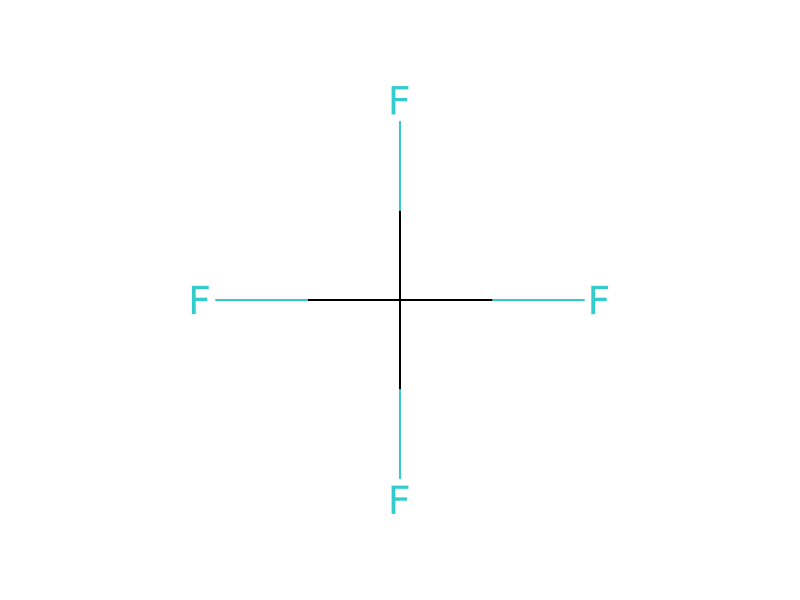
HCID 6393
새 노트새 반응견적 요청하기
인쇄 미리보기
기본 정보개요이름 및 식별자물성안전 및 규제화학 및 산업관련 반응화합물 노트
부분 구조 검색유사 구조 찾기

기본 정보

CAS
75-73-0
표준 SMILES
FC(F)(F)F
InChIKey
TXEYQDLBPFQVAA-UHFFFAOYSA-N
분자식
CF4
평균 분자량
88.004 g/mol
단동위원소 질량
87.99361288

개요

Tetrafluoromethane is a colorless nonflammable gas. It is shipped as a liquid under pressure. It may be narcotic at high concentrations. Under prolonged exposure to fire or heat the containers may rupture violently and rocket. It is used as a refrigerant.

이름 및 식별자

우선 이름
Carbon tetrafluoride
IUPAC
tetrafluoromethane
영어명
Carbon tetrafluoride
분자식
CF4
분자량
0

이름 및 동의어

CARBON TETRAFLUORIDETetrafluoromethane75-73-0PerfluoromethaneFreon 14TetrafluorocarbonHalon 14Methane, tetrafluoro-Refrigerant 14Halocarbon 14Arcton 0Refrigerant R 14
이름 더 보기
Fluorocarbon 14R 14 (Refrigerant)Carbon fluoride (CF4)CFC 14FC 14Ftoxycol94WG9QG0JNDTXSID2041757

데이터베이스 식별자

CAS
75-73-0
PubChem CID
6393
DTXSID
DTXSID2041757
ChEBI
CHEBI:38825
UNII
94WG9QG0JN
EC Number
200-896-5
Nikkaji
J1.464H

물성

구조 계산 물성

XLogP
1.8
극성 표면적
0 Ų
수소 결합 공여자 수
0
수소 결합 수용자 수
4
회전 가능 결합 수
0
무거운 원자 수
5
형식 전하
0
복잡도
19.1

실험 및 물리화학적 성질

PFASPFAS -> PFAS identified in REACH Regulation EC No. 1272/2008
SolventsSolvents -> Chlorofluorocarbons
SpringerMaterials PropertiesGibbs energy
LogP · 2건

log Kow = 1.18

1.36

OdorOdorless
Density · 3건

3.034 g/cu cm at 25 °C

Density: 1.89 at -183 °C (liquid); 1.98 at -195 °C (solid)

3.034 @25 °C

Color/FormColorless gas
Solubility · 3건

In water, 18.8 mg/L at 25 °C

Soluble in benzene, chloroform

Solubility in water: none

Boiling Point · 3건

-127.9 °C

-127.8 °C

-127.8 °C @760 [mm Hg]

Decomposition · 2건

When heated to decomposition it emits toxic fumes of /fluoride/.

Forms hydrogen fluoride and fluorides on decomposition with hot surfaces above 125 °F/52 °C or open flame.

안전 및 규제

안전 정보는 참고용이며, 공급업체의 물질안전보건자료(SDS), 관련 법규 및 전문가 평가를 대체하지 않습니다.

GHS 분류

GHS Classification · 6건

Warning

H280 (100%): Contains gas under pressure; may explode if heated [Warning Gases under pressure]

P410+P403</a, and a href="https://pubchem.ncbi.nlm.nih.gov/ghs/#P410+P403">P410+P403 (click each P-code to see the statement)

Aggregated GHS information provided per 271 reports by companies from 4 notifications to the ECHA C&L Inventory.

Warning

H336: May cause drowsiness or dizziness [Warning Specific target organ toxicity, single exposure; Narcotic effects]

유해성 정보

Regulatory Information · 5건

Chemical: Methane, tetrafluoro-

Methane, tetrafluoro- is listed on the EPA's Chemical Data Reporting (CDR) system. Manufacturers and importers of Methane, tetrafluoro- are required to report information about their production and use of this chemical to the EPA under the Toxic Substances Control Act (TSCA). (40 eCFR Part 711)

Status: Active Update: 28-04-2023 https://echa.europa.eu/registration-dossier/-/registered-dossier/21573

Tetrafluoromethane: Non hazardous

The New Jersey Worker and Community Right to Know Act requires public and private employers to provide information about hazardous substances at their workplaces. (N.J.S.A. 34:5A-1 et. seq.)

DOT LabelNon-Flammable Gas
Fire Hazards · 4건

Excerpt from ERG Guide 126 [Gases - Compressed or Liquefied (Including Refrigerant Gases)]:

· Some may burn but none ignite readily.

· Some may burn but none ignite readily.

Gives off irritating or toxic fumes (or gases) in a fire.

Fire PotentialTetrafluoromethane may burn, but does not readily ignite.
Health Hazards · 3건

Excerpt from ERG Guide 126 [Gases - Compressed or Liquefied (Including Refrigerant Gases)]:

화학 및 산업

약리 정보

Absorption, Distribution and ExcretionThe substance can be absorbed into the body by inhalation.

용도 및 제조

Uses · 3건

Used as low temperature refrigerant and gaseous insulator; [Merck Index]

Low temperature refrigerant; gaseous insulator.

Plasma etching of silicon wafers in the semiconductor industry.

U.S. Exports · 2건

(1972) No Data

(1975) No Data

U.S. Imports · 2건

(1972) No Data

(1975) No Data

U.S. Production · 5건

2023: 550,000 - <700,000 lb

(1972) Probably greater than 4.54x10+5 grams

(1975) Probably greater than 4.54x10+5 grams

Production volumes for non-confidential chemicals reported under the Inventory Update Rule. [Table#3100]

Non-confidential 2012 Chemical Data Reporting (CDR) information on the production and use of chemicals manufactured or imported into the United States. Chemical: Methane, tetrafluoro-. National Production Volume: 100,000 - 500,000 lb/yr.

Consumption PatternsRefrigerants, 39%; foam blowing agents, 17%; solvents, 14%; fluoropolymers, 14%; sterilant gas, 2%; aerosol propellants, 2%; food freezant, 1%; other, 8%; exports, 3% (1985) /fluorocarbons/
Consumer UsesSemiconductor and photovoltaic agent
Industry UsesOther
Methods of Manufacturing · 3건

Tetrafluoromethane (carbon tetrafluoride, CF4) can be produced by reaction of CCl2F2 or CCl3F and hydrogen fluoride in the gas phase or by direct fluorination of carbon.

관련 반응

5건
반응 기록 만들기
HRID 50411 반응식
HRID 50411반응물로uspto-grants-2004_03
HRID 1095207 반응식
HRID 1095207반응물로uspto-grants-2012_03
HRID 1132005 반응식
HRID 1132005반응물로Training data from https://doi.org/10.1039/C8SC04228D (7/10)
HRID 1182631 반응식
HRID 1182631반응물로uspto-grants-2014_03
HRID 1633739 반응식
HRID 1633739용매로uspto-grants-2003_01

화합물 노트

불러오는 중…

이 페이지에서기본 정보개요이름 및 식별자물성안전 및 규제화학 및 산업관련 반응화합물 노트
더보기
새 노트새 반응견적 요청하기
Melting Point · 3건

-183.582 °C

-183.6 °C

-183.6 °C

Vapor DensityRelative vapor density (air = 1): 3.04

· Vapors may cause dizziness or asphyxiation without warning, especially when in closed or confined areas.

· Vapors may cause dizziness or asphyxiation without warning, especially when in closed or confined areas.

Hazards Summary · 1건

High concentrations can have narcotic effect; [Merck Index] Forms hydrofluoric acid on contact with hot surfaces or flames; In confined space spill, may displace air and act as simple asphyxiant; Evaporating liquid can cause frostbite; Inhalation of high concentrations can cause CNS depression and cardiac arrhythmias; [ICSC] Shipped as pressurized liquid; Containers may explode if heated; In confined space spill, may displace air and act as simple asphyxiant; [CAMEO] See CHLOROFLUOROCARBONS.

DOT ID and Guide · 2건

1982 126

1982 126

Reactive GroupFluorinated Organic Compounds
UN ClassificationUN Hazard Class: 2.2
Special ReportsDanish EPA; Survey of selected fluorinated green-house gases (2015)[Available from, as of March 3, 2016: http://eng.mst.dk/]
Reactivity Profile · 1건

The reaction of aluminum with various halogenated hydrocarbons produces a self-sustaining reaction with sufficient heat to melt aluminum pieces, examples of other halogenated hydrocarbons are fluorotrichloromethane, dichlorodifluoromethane, chlorodifluoromethane, tetrafluoromethane. The vigor of the reaction appears to be dependent on the combined degree of fluorination and the vapor pressure [Chem. Eng. News 39(27):44. 1961].

Chemical DangersDecomposes on contact with hot surfaces or flames. Decomposes above 52 °C . This produces hydrofluoric acid. Incompatible with certain metal powders (aluminium, zinc, beryllium).

안전 및 보호

Fire Fighting · 2건

Excerpt from ERG Guide 126 [Gases - Compressed or Liquefied (Including Refrigerant Gases)]:

In case of fire in the surroundings, use appropriate extinguishing media. In case of fire: keep cylinder cool by spraying with water. Combat fire from a sheltered position.

First Aid Measures · 3건

Fresh air, rest. Artificial respiration may be needed. Refer for medical attention.

ON FROSTBITE: rinse with plenty of water, do NOT remove clothes. Refer for medical attention .

First rinse with plenty of water for several minutes (remove contact lenses if easily possible), then refer for medical attention.

Accidental Release Measures · 4건

· CALL 911. Then call emergency response telephone number on shipping paper. If shipping paper not available or no answer, refer to appropriate telephone number listed on the inside back cover.

· Do not touch or walk through spilled material.

· CALL 911. Then call emergency response telephone number on shipping paper. If shipping paper not available or no answer, refer to appropriate telephone number listed on the inside back cover.

· Do not touch or walk through spilled material.

First Aid · 3건

Excerpt from ERG Guide 126 [Gases - Compressed or Liquefied (Including Refrigerant Gases)]:

General First Aid:

General First Aid:

Safe StorageCool. Keep in a well-ventilated room. Well closed. Separated from powdered metals.
Firefighting HazardsUnder prolonged exposure to fire or heat the containers may rupture violently and rocket. /Tetrafluoromethane, compressed or refrigerant gas R14/
Exposure Control and Personal Protection · 2건

· Wear positive pressure self-contained breathing apparatus (SCBA).

· Wear positive pressure self-contained breathing apparatus (SCBA).

Fire Fighting Procedures · 5건

Suitable extinguishing media: Use water spray, alcohol-resistant foam, dry chemical or carbon dioxide.

Advice for firefighters: Wear self-contained breathing apparatus for firefighting if necessary.

Use water spray to cool unopened containers.

If material on fire or involved in fire: Extinguish fire using agent suitable for type of surrounding fire. (Material itself does not burn or burns with difficulty.) Cool all affected containers with flooding quantities of water. Apply water from as far a distance as possible. Do not use water on material itself. Use water spray to knock-down vapors. /Tetrafluoromethane, compressed or refrigerant gas R14/

Wear positive pressure self-contained breathing apparatus. /Tetrafluoromethane, compressed or refrigerant gas R14/

Storage Conditions · 3건

Keep container tightly closed in a dry and well-ventilated place. Contents under pressure.

Check that oxygen content is at least 19% before entering storage or spill area ... Store in tightly closed containers in a cool, well-ventilated area away from powdered metals, including aluminum, zinc, and beryllium; and from open flames or temperatures above 125 °F/51.6 °C.

May be stored in steel cylinders.

Cleanup Methods · 2건

ACCIDENTAL RELEASE MEASURES: Personal precautions, protective equipment and emergency procedures: Avoid breathing vapors, mist or gas. Ensure adequate ventilation. Evacuate personnel to safe areas; Environmental precautions: Do not let product enter drains; Methods and materials for containment and cleaning up: Clean up promptly by sweeping or vacuum.

High concentrations cause a deficiency of oxygen with the risk of unconsciousness or death. Check that oxygen content is at least 19% before entering storage or spill area. If in a building, evacuate building and confine vapors by closing doors and shutting down HVAC systems. Restrict persons not wearing protective equipment from area of spill or leak until cleanup is complete. Remove all ignition sources. Ventilate area of spill or leak to disperse the gas. Wear chemical protective suit with self-contained breathing apparatus to combat spills. Stay upwind and use water spray to "knock down" vapor; contain runoff. Stop the flow of gas, if it can be done safely from a distance. If source is a cylinder and the leak cannot be stopped in place, remove the leaking cylinder to a safe place; and repair leak or allow cylinder to empty. Absorb liquids in vermiculite, dry sand, earth, or a similar material and deposit in sealed containers. Keep this chemical out of confined spaces, such as a sewer, because of the possibility of explosion, unless the sewer is designed to prevent the buildup of explosive concentrations.

Nonfire Spill ResponseExcerpt from ERG Guide 126 [Gases - Compressed or Liquefied (Including Refrigerant Gases)]:
Disposal Methods · 2건

SRP: Recycle any unused portion of the material for its approved use or return it to the manufacturer or supplier. Ultimate disposal of the chemical must consider: the material's impact on air quality; potential migration in air, soil or water; effects on animal, aquatic and plant life; and conformance with environmental and public health regulations. If it is possible or reasonable use an alternative chemical product with less inherent propensity for occupational harm/injury/toxicity or environmental contamination.

Product: Offer surplus and non-recyclable solutions to a licensed disposal company. Contact a licensed professional waste disposal service to dispose of this material; Contaminated packaging: Dispose of as unused product.

독성 정보

Interactions · 1건

The anesthetic potencies of binary mixtures of the gases argon (Ar), nitrous oxide (N2O) and sulfur hexafluoride (SF6) have been measured using mice. The mixtures SF6-N2O and N2O-Ar showed additive behavior, whereas the constituents of the mixture SF6-Ar were non-additive, having a smaller total potency than expected. Further experiments on this mixture with Italian Great Newts and on the carbon tetrafluoride mixtures CF4-Ar and CF4-SF6 with mice suggested that the anomalous potencies may arise from specific pulmonary effects associated with the breathing of SF6 accompanied by a high pressure of some other gas.

Environmental Fate · 3건

TERRESTRIAL FATE: Based on a classification scheme(1), an estimated Koc value of 44(SRC), determined from a structure estimation method(2), indicates that tetrafluoromethane is expected to have very high mobility in soil(SRC). Volatilization of tetrafluoromethane from moist soil surfaces is expected to be an important fate process(SRC) given a Henry's Law constant of 5.15 atm-cu m/mole(3). Tetrafluoromethane is expected to volatilize from dry soil surfaces(SRC) based upon a vapor pressure of 1.75X10+5 mm Hg at 25 °C(4). Highly chlorinated/fluorinated compounds are not expected to biodegrade rapidly(5).

AQUATIC FATE: Based on a classification scheme(1), an estimated Koc value of 44(SRC), determined from a structure estimation method(2), indicates that tetrafluoromethane is not expected to adsorb to suspended solids and sediment(SRC). Volatilization from water surfaces is expected(3) based upon a Henry's Law constant of 5.15 atm-cu m/mole(4). Using this Henry's Law constant and an estimation method(3), volatilization half-lives for a model river and model lake are 3 hours and 4 days, respectively(SRC). Tetrafluoromethane is not expected to undergo hydrolysis in the environment due to the lack of functional groups that hydrolyze under environmental conditions(3). According to a classification scheme(5), an estimated BCF of 3(SRC), from its log Kow of 1.18(6) and a regression-derived equation(2), suggests the potential for bioconcentration in aquatic organisms is low(SRC). Highly chlorinated/fluorinated compounds are not expected to biodegrade rapidly(7).

ATMOSPHERIC FATE: According to a model of gas/particle partitioning of semivolatile organic compounds in the atmosphere(1), tetrafluoromethane, which has a vapor pressure of 1.75X10+5 mm Hg at 25 °C(2), is expected to exist solely as a gas in the ambient atmosphere. Tetrafluoromethane has an atmospheric lifetime of 2300 to 50,000 years(3). Tetrafluoromethane is exceedingly inert photochemically, with no absorption at wavelengths longer than 110 nm(4) and, therefore, is not expected to be susceptible to direct photolysis by sunlight(SRC).

Adverse EffectsNeurotoxin - Acute solvent syndrome
Exposure RoutesThe substance can be absorbed into the body by inhalation.
Toxicity Summary · 1건

IDENTIFICATION AND USE: Tetrafluoromethane (CF4) is a colorless odorless gas. It is used as low temperature refrigerant; gaseous insulator. It is also used for plasma etching of silicon wafers in the semiconductor industry. HUMAN EXPOSURE AND TOXICITY: It can cause confusion, headache by inhalation. ANIMAL STUDIES: Tetrafluoromethane caused increases in acetylcholine output from the guinea-pig ileum. The anesthetic potencies of binary mixtures of the gases CF4-Ar and CF4-SF6 were studied in mice.

Signs and Symptoms · 3건

Confusion. Dizziness. Headache. Irregular heartbeat. Unconsciousness.

ON CONTACT WITH GAS: FROSTBITE.

ON CONTACT WITH GAS: FROSTBITE.

Effluent ConcentrationsTetrafluoromethane was detected in air samples obtained from air plumes of aluminum production plants(1).
ICSC Environmental DataIt is strongly advised not to let the chemical enter into the environment because it is persistent.
Soil Adsorption/Mobility · 1건

Using a structure estimation method based on molecular connectivity indices(1), the Koc of tetrafluoromethane can be estimated to be 44(SRC). According to a classification scheme(2), this estimated Koc value suggests that tetrafluoromethane is expected to have very high mobility in soil.

Natural Pollution Sources · 1건

No natural sources have been identified(1,2) however data are conflicting(SRC). Tetrafluoromethane was tested for but not detected in volcanic fumeroles on Hawaii(3). A background (unspecified rocks and soils) concentration of 40 parts/trillion volume was reported in 1997(4), released following the heating, crushing, and aqueous dissolution of certain rocks and minerals(5).

Atmospheric Concentrations · 3건

Air samples collected at altitudes of 10 to 33 km at 44 deg N (southern France) in 1980 contained tetrafluoromethane; its mixing ratio was measured as 65 parts per trillion by volume at 14.4 km and 62 parts per trillion by volume at 33.2 km(1). Median tetrafluoromethane concentrations from remote, suburban, and source dominated sites were 0.070, 0.095, and 0.140 ppb by volume, respectively, for the years 1980 to 1987(2). The average daily ambient tetrafluoromethane concentration from 1980 to 1987 for 8 sites was 0.101 ppb by volume(2).

RURAL/REMOTE: Annual average concentrations of tetrafluoromethane in Pt. Barrow, AK were 73.6 and 74.5 parts/trillion volume in 1996 and 1997, respectively(1). Annual average concentrations reported for Cape Meares, OR were as follows (parts/trillion volume, (year)): 56.1 (1978); 58.8 (1979); 60.2 (1980); 61.6 (1981); 62.7 (1982); 61.6 (1983); 63.2 (1984); 64.9 (1985); 66.5 (1986); 65.2 (1987); 67.7 (1988); 67.3 (1989); 67.8 (1990); 69.5 (1991); 71.4 (1992); 70.0 (1993); 73.7 (1994); 73.4 (1995); 74.1 (1996); 74.2 (1997). Annual average concentrations of tetrafluoromethane reported for Palmer Station, Antarctic were 69.8, 72.4, 72.7, and 72.6 parts/trillion volume for 1994, 1995, 1996, and 1997, respectively. The ever increasing concentrations are attributed mainly to aluminum manufacturing (33 parts/trillion volume) and electronic chip production(1). The worldwide primary aluminum producers have reduced polyfluorinated carbon emissions per unit aluminum production by 47% from 1990 through 1997(2). Firn air (air present inside snow) samples collected at the North Greenland ice core project site in Greenland and from Berkner Island, Antarctica indicate that tetrafluoromethane increased from 40 to 78 parts/trillion between 1959 and 2003(3).

SOURCE DOMINATED: Tetrafluoromethane is a byproduct of the electrolytic production of primary aluminum(1). Monitoring of 8 aluminum smelters in Quebec Province, Canada (about 11% of the global aluminum production) was conducted during a 6-month period in 1993-1994. The emission of tetrafluoromethane was <1 ppb volume for periods between anode events; the average flux per anode event (a total of 1,105 events) ranged between 0.50 to 1.0 kg(2).

Human Toxicity Excerpts · 3건

/SIGNS AND SYMPTOMS/ On contact with gas: Frostbite.

/SIGNS AND SYMPTOMS/ Inhalation: Confusion, headache. Skin: On contact with liquid: frostbite /from table/

/SIGNS AND SYMPTOMS/ Toxic by inhalation.

안전 데이터

신호 어
Warning
유해·위험 문구
암호 유해·위험 문구 위험 등급 범주 신호 어 그림 문자 P- 코드 H280

Reaction of fluorine with amorphous forms of carbon (eg, wood charcoal) at ambient temperature

Prepared from carbon or carbon monoxide and fluorine. ... May also be prepared from ... /silicon carbide/ and ... /fluorine/.

Formulations/PreparationsGrade: 95% min purity.
General Manufacturing Information · 5건

Computer and Electronic Product Manufacturing

Methane, tetrafluoro-: ACTIVE

Hydrofluorocarbons have gained increasing commercial interest as substitutes for chlorofluoro- and hydrochlorofluorocarbons since governmental regulations banned the worldwide production and consumption of CFCs by 1996 and introduced a specific timetable for the phase out of HCFCs. In contrast to CFCs, hydrofluorocarbons have no adverse effect on the ozone layer and only a low contribution to global warming ... The latter effect could be further minimized by avoiding leakages in refrigeration and air-conditioning equipment and by refrigerant recycling. /Hydrofluorocarbons/

1.3-3.6 kg of tetrafluoromethane estimated to be produced per ton of aluminum for the period up to approximately 1985

Light membranes composed of single-walled carbon nanotubes (SWNTs) can serve as efficient nanoscale vessels for encapsulation of tetrafluoromethane at 300 K and operating external pressure of 1 bar ... The amount of adsorbed CF4 strongly depends on the pore size in nanotubes; at 1 bar the most efficient nanotubes for volumetric storage have size R = 0.68 nm. This size corresponds to the (10,10) armchair nanotubes produced nowadays in large quantities. For mass storage (i.e., weight %) the most efficient nanotubes have size R = 1.02 nm corresponding to (15,15) armchair nanotubes. They are better adsorbents than currently used activated carbons and zeolites, reaching approximately equal to 2.4 mol/kg of CF4, whereas, the best activated carbon Carbosieve G molecular sieve can adsorb 1.7 mol/kg of CF4 at 300 K and 1 bar ...