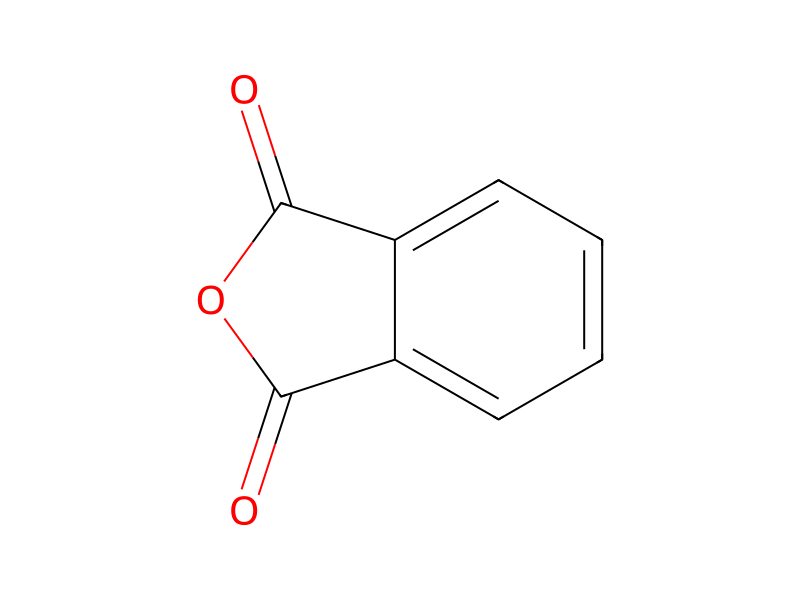
무수프탈산
Phthalic Anhydride
기본 정보
- CAS
85-44-9- 표준 SMILES
O=C1OC(=O)c2ccccc21- InChIKey
LGRFSURHDFAFJT-UHFFFAOYSA-N- 분자식
- C8H4O3
- 평균 분자량
- 148.11 g/mol
- 단동위원소 질량
- 148.01604399
개요
Phthalic anhydride appears as a colorless to white lustrous solid in the form of needles with a mild distinctive odor. Moderately toxic by inhalation or ingestion and a skin irritant. Melting point 64 °F Flash point 305 °F. Forms a corrosive solution when mixed with water. Used in the manufacture of materials such as artificial resins.
이름 및 식별자
- 우선 이름
- Phthalic Anhydride
- IUPAC
- 2-benzofuran-1,3-dione
- 현지명
- 무수프탈산
- 영어명
- Phthalic anhydride
- 분자식
- C8H4O3
- 분자량
- 148.12
이름 및 동의어
PHTHALIC ANHYDRIDE85-44-91,3-Isobenzofurandione2-Benzofuran-1,3-dionePhthalandioneRetarder esen1,3-Dioxophthalan1,3-PhthalandionePhthalic acid anhydrideRetarder AKRetarder PDo-Phthalic acid anhydride
이름 더 보기
무수프탈산1,2-벤젠디카르복실산무수물억제제AK에센푸탈란디온1,2-벤젠디카르복실무수물1,3-디옥소푸탈란1,3-이소벤조푸란디온1,3-푸탈란디온프탈무수물프탈산무수물프탈산언하이드라이드프탈무수물프탈릭안하이드라이드프탈산언하이드라이드1,2-벤젠디카복실 무수물1,2-벤젠디카복실산 무수물1,3-아이소벤조푸란디온아이소벤조푸란-1,3-디온프탈 무수물Isobenzofuran-1,3-dionephthalicPTHALIC ANHYDRIDEPHATHALIC ANHYDRIDEO-PHTHALIC ANHYDRIDE
PhthalsaeureanhydridESENVulkalent B/CAnidride ftalicaFtalowy bezwodnikFtaalzuuranhydrideAnhydride phtaliqueFtalanhydrid
데이터베이스 식별자
- CAS
85-44-9- PubChem CID
- 6811
- DTXSID
DTXSID2021159- ChEMBL
CHEMBL1371297- ChEBI
CHEBI:36605- UNII
- UVL263I5BJ
- EC Number
- 201-607-5
- Nikkaji
- J4.919K
물성
구조 계산 물성
- XLogP
- 1.3
- 극성 표면적
- 43.4 Ų
- 수소 결합 공여자 수
- 0
- 수소 결합 수용자 수
- 3
- 회전 가능 결합 수
- 0
- 무거운 원자 수
- 11
- 형식 전하
- 0
- 복잡도
- 187
실험 및 물리화학적 성질
Chemical Classes
Hazardous Air Pollutants (HAPs)
Corrosives
Phthalate
PolymersPlastics & Rubber -> Acid Anhydrides, Cyclic
SpringerMaterials PropertiesBoiling point
PesticidesPesticide -> EPA IRIS
LogP
log Kow = 1.60
1.6
0.7
Odor
Mild
Characteristic, acrid odor
Density
1.2 at 275 °F 1.53 at 20 °C (solid) (USCG, 1999) - Denser than water; will sink
1.20 (molten); 1.53 (flake)
1.53 g/cm³
1.53 at 68 °F
1.527 @ 4°C
1.53 (Flake) 1.20 (Molten)
Viscosity1.19 mPa.s at 132 °C; 1.125 mPa.s at 155 °C
Color/Form
White, lustrous needles
Colorless needles; monoclinic or rhombic prisms
White needles from alcohol and benzene
White solid (flake) or a clear colorless liquid (molten)
Solubility
Decomposes (NTP, 1992)
In water, 6,000 mg/L at 25 °C
In water, 6,200 mg/L at 26 °C; 5,964 mg/L at room temperature
In water, 6,200 to 6,400 mg/L at 20-25 °C
In water, 16,400 mg/L including rapid hydrolysis to phthalic acid
For more Solubility (Complete) data for PHTHALIC ANHYDRIDE (7 total), please visit the HSDB record page.
Flash Point
305 °F (NTP, 1992)
305 °F (152 °C) (Closed cup)
329 °F (Open cup); 305 °F (Closed cup)
152 °C c.c.
305 °F
305 °F
Boiling Point
563 °F at 760 mmHg (sublimes) (NTP, 1992)
285.3 °C
Sublimes below the boiling point
284 °C (sublimes)
563 °F
295 °C @760 [mm Hg]
물리화학적 성질
- 녹는점
- 131 · 131-134 °C(lit.)
- 끓는 점
- 284 °C · 284 °C(lit.)
- 밀도
- 1 · 1,53 g/cm3
- 증기 밀도
- 5.1 · 5.1 (vs air)
- 증기압
- 0.01 mm · <0.01 mm Hg ( 20 °C)
- 굴절률
- 1.45 · 1.4500 (estimate)
- 인화점
- 152 °C · 152 °C
- 저장 조건
- 30 °C · Store below +30°C.
- 용해도
- 6 g/l · 6g/l(느린 분해)
- 물리적 상태
- 片状晶体
- 산도 계수 (pKa)
- 2.97 · 2.97[at 20 ℃]
- 색상
- 하얀색
- 수소이온지수(pH)
- 2 · 2 (6g/l, H2O, 20℃)
- 냄새
- 숨이 막히는 특유의 냄새
- 폭발한계
- 1.7 · 1.7-10.5%(V)
- 수용성
- 6 g/L · 6g/L(20℃)
- 비열
- 1.08 J/ · Cp(crystal): 1.08 J/(g·K), at 25℃
- Merck
- 14 · 14,7372
- BRN
- 118515 · 118515
- Henry's Law Constant
- 6.29 at · 6.29 at 20 °C (approximate - calculated from water solubility and vapor pressure)
- 안정성
- 안정적인. 타기 쉬운. 강산화제, 강염기, 습기, 강산과 호환되지 않습니다. 먼지는 공기와 혼합되어 폭발성 혼합물을 형성할 수 있습니다.
- InChI
- 1S/C8H4O3/c9-7-5-3-1-2-4-6(5)8(10)11-7/h1-4H
- InChIKey
- LGRFSURHDFAFJT-UHFFFAOYSA-N
- SMILES
- O=C1OC(=O)c2ccccc12
- LogP
- 2.07 at · 2.07 at 20℃
- NIST
- Phthalic anhydride(85-44-9)
- EPA
- Phthalic anhydride (85-44-9)
화학적 성질
Phthalic Anhydride is moderately flammable, white solid (flake) or a clear, colorless, mobile liquid (molten) Characteristic, acrid, choking odor. It is very slightly soluble in H2O, soluble in alcohol, and slightly soluble in ether.
안전 및 규제
안전 정보는 참고용이며, 공급업체의 물질안전보건자료(SDS), 관련 법규 및 전문가 평가를 대체하지 않습니다.
GHS 분류
GHS Classification
Danger
H302: Harmful if swallowed [Warning Acute toxicity, oral]
P233, P260, P261, P264, P264+P265, P270, P271, P272, P280, P284, P301+P317, P302+P352, P304+P340, P305+P354+P338, P317, P319, P321, P330, P332+P317, P333+P317, P342+P316, P362+P364, P403, P403+P233, P405, and P501 (click each P-code to see the statement)
This chemical does not meet GHS hazard criteria for 0.4% (14 of 3919) of reports.
Danger
H302 (99.6%): Harmful if swallowed [Warning Acute toxicity, oral]
유해성 정보
Regulatory Information
Chemical: 1,3-Isobenzofurandione
Hazard Traits - Dermatotoxicity; Respiratory Toxicity
1,3-Isobenzofurandione is listed on the EPA's Chemical Data Reporting (CDR) system. Manufacturers and importers of 1,3-Isobenzofurandione are required to report information about their production and use of this chemical to the EPA under the Toxic Substances Control Act (TSCA). (40 eCFR Part 711)
REACH registered substance: Phthalic anhydride (EC: 201-607-5)
Phthalic anhydride: Does not have an individual approval but may be used under an appropriate group standard
The New Jersey Worker and Community Right to Know Act requires public and private employers to provide information about hazardous substances at their workplaces. (N.J.S.A. 34:5A-1 et. seq.)
Other Safety InformationIMAP assessments - 1,3-Isobenzofurandione: Human health tier II assessment
DOT LabelCorrosive
Fire Hazards
Excerpt from ERG Guide 156 [Substances - Toxic and/or Corrosive (Combustible / Water-Sensitive)]:
· Combustible material: may burn but does not ignite readily.
Combustible. Finely dispersed particles form explosive mixtures in air.
Fire Potential
Combustible solid
Combustible when exposed to heat or flame.
Health Hazards
Solid irritates skin and eyes, causing coughing and sneezing. Liquid causes severe thermal burns. (USCG, 1999)
· TOXIC and/or CORROSIVE; inhalation, ingestion or contact (skin, eyes) with vapors, dusts or substance may cause severe injury, burns or death.
Hazards Summary
Exposure to phthalic anhydride may occur during its use as a chemical intermediate in the plastics industry. The acute (short-term) effects from exposure to phthalic anhydride in humans consists of irritation to the eyes, respiratory tract, and skin, but no permanent injury is observed. Chronic (long-term) effects observed in workers exposed to phthalic anhydride included conjunctivitis, rhinitis, rhinoconjunctivitis, bronchitis, and irritation of the skin and mucous membranes of the respiratory tract. Animal studies indicate that chronic exposure to phthalic anhydride vapor causes congestion, irritation, and injury to lung cells. No studies are available on the reproductive, developmental, or carcinogenic effects of phthalic anhydride in humans. EPA has not classified phthalic anhydride for carcinogenicity.
Occupational asthma reported in plastic resin production workers; [Malo] Solid form causes first degree burns on short exposure; [CHRIS] Phthalic anhydride is a skin irritant. [Quick CPC] Workers exhibiting dermal or respiratory symptoms (e.g., rhinitis) may benefit from early intervention to reduce or eliminate further exposure. . . . A number of human studies found that phthalic anhydride exposure can cause or is associated with sensitization, elevated IgE and IgG, occupational asthma (immediate, late or both), rhinitis, conjunctivitis, chronic bronchitis, respiratory irritation, and contact urticaria. It may also cause allergic contact dermatitis. [ACGIH] See ACID ANHYDRIDES.
DOT ID and Guide
2214 156
2214 156
Reactive GroupAnhydrides
Special Reports
European Chemicals Bureau; IUCLID Dataset, Phthalic anhydride (CAS No. 85-44-9) (2000 CD-ROM edition). Description of information on usage patterns, toxicology, and ecological effects submitted by industry to the European Union.[Available from, as of August 22, 2006: http://esis.jrc.ec.europa.eu/]
DHEW/NCI; Bioassay of Phthalic Anhydride for Possible Carcinogenicity (1979) Technical Report Series No. 159 (DHEW Pub No. (NIH) 79-1715)[Available from, as of April 4, 2003: http://ntp.niehs.nih.gov/ntp/htdocs/LT_rpts/tr159.pdf]
RCRA Requirements
U190; As stipulated in 40 CFR 261.33, when phthalic anhydride, as a commercial chemical product or manufacturing chemical intermediate or an off-specification commercial chemical product or a manufacturing chemical intermediate, becomes a waste, it must be managed according to Federal and/or State hazardous waste regulations. Also defined as a hazardous waste is any residue, contaminated soil, water, or other debris resulting from the cleanup of a spill, into water or on dry land, of this waste. Generators of small quantities of this waste may qualify for partial exclusion from hazardous waste regulations (40 CFR 261.5).
OSHA StandardsPermissible Exposure Limit: Table Z-1 8-hr Time Weighted Avg: 2 ppm (12 mg/cu m).
안전 및 보호
Fire Fighting
Excerpt from ERG Guide 156 [Substances - Toxic and/or Corrosive (Combustible / Water-Sensitive)]:
Use water spray, foam, dry powder, carbon dioxide.
First Aid Measures
Fresh air, rest. Refer for medical attention.
Wear protective gloves when administering first aid. Remove contaminated clothes. Rinse skin with plenty of water or shower for at least 15 minutes. Refer for medical attention .
First rinse with plenty of water for several minutes (remove contact lenses if easily possible), then refer for medical attention.
Rinse mouth. Do NOT induce vomiting. Give one or two glasses of water to drink. Refer for medical attention .
Accidental Release Measures
· CALL 911. Then call emergency response telephone number on shipping paper. If shipping paper not available or no answer, refer to appropriate telephone number listed on the inside back cover.
· ELIMINATE all ignition sources (no smoking, flares, sparks or flames) from immediate area.
First Aid
EYES: First check the victim for contact lenses and remove if present. Flush victim's eyes with water or normal saline solution for 20 to 30 minutes while simultaneously calling a hospital or poison control center. Do not put any ointments, oils, or medication in the victim's eyes without specific instructions from a physician. IMMEDIATELY transport the victim after flushing eyes to a hospital even if no symptoms (such as redness or irritation) develop.
General First Aid:
(General first aid procedures)
Safe StorageSeparated from combustible substances, reducing agents, strong oxidants, strong bases, strong acids and food and feedstuffs. See Chemical Dangers. Ventilation along the floor. Dry. Well closed. Store only in original container.
Firefighting HazardsA harmful concentration of airborne particles can be reached quickly when dispersed, especially if powdered.
Exposure Control and Personal Protection· Wear positive pressure self-contained breathing apparatus (SCBA).
독성 정보
Target Organs
Respiratory
Eyes, skin, respiratory system, liver, kidneys
Ecotoxicity Values
LC50; Species: Leuciscus idus (orfe); Conditions: static; Concentration: 313 mg/L for 48 hr
EC50; Species: Pseudokirchneriella subcapitata (Green algae); Conditions: freshwater; static; Concentration: 41400 ug/L (95% confidence limit: 0 to 109100 ug/L) for 96 hr; Effect: population, biomass /active ingredient/
EC50; Species: Pseudokirchneriella subcapitata (Green algae); Conditions: freshwater; static; Concentration: 78530 ug/L (95% confidence limit: 0 to 1353330 ug/L) for 96 hr; Effect: population, biomass /active ingredient/
EC50; Species: Pseudokirchneriella subcapitata (Green algae); Conditions: freshwater; static; Concentration: 147 ug/L (95% confidence limit: 60 to 350 ug/L) for 96 hr; Effect: population, biomass /active ingredient/
For more Ecotoxicity Values (Complete) data for PHTHALIC ANHYDRIDE (8 total), please visit the HSDB record page.
Environmental Fate
TERRESTRIAL FATE: Based on a classification scheme(1), an estimated Koc value of 10(SRC), determined from a structure estimation method(2), indicates that phthalic anhydride is expected to have very high mobility in soil(SRC). However, phthalic anhydride hydrolyzes rapidly in water with a half-life of about 25 minutes or less at 25 °C(3,4) which suggests that leaching may not be an important fate process(SRC). Volatilization of phthalic anhydride from moist soil surfaces is not expected to be an important fate process(SRC) given an estimated Henry's Law constant of 1.7X10⁻⁸ atm-cu m/mole(SRC) based upon its vapor pressure, 5.17X10⁻⁴ mm Hg(5), and water solubility, 6000 mg/L(6). Hydrolysis in moist soil will also attenuate volatilization(SRC). Phthalic anhydride is not expected to volatilize from dry soil surfaces(SRC) based upon its vapor pressure. Based on the available experimental biodegradation test results, phthalic anhydride can be classified as readily biodegradable(3). However, biodegradation test results may be reflective of biodegradation of phthalic acid which is the hydrolysis product of phthalic anhydride(3,4).
AQUATIC FATE: Based on a classification scheme(1), an estimated Koc value of 10(SRC), determined from a structure estimation method(2), indicates that phthalic anhydride is not expected to adsorb to suspended solids and sediment(SRC). Volatilization from water surfaces is not expected(3) based upon an estimated Henry's Law constant of 1.7X10⁻⁸ atm-cu m/mole(SRC), derived from its vapor pressure, 5.17X10⁻⁴ mm Hg(4), and water solubility, 6000 mg/L(5). Phthalic anhydride hydrolyzes rapidly in water with a half-life of about 25 minutes or less at 25 °C(6,7). Phthalic acid is the hydrolysis product(6). Hydrolysis half-lives may drop to one minute or less depending on buffering agents in the water and pH(6-8). According to a classification scheme(9), an estimated BCF of 5(SRC), from its log Kow of 1.60(6) and a regression-derived equation(2), suggests the potential for bioconcentration in aquatic organisms is low(SRC). Any potential volatilization or bioconcentration will be attenuated by hydrolysis(SRC). Based on the available experimental biodegradation test results, phthalic anhydride can be classified as readily biodegradable(6). However, biodegradation test results may be reflective of biodegradation of phthalic acid which is the hydrolysis product of phthalic anhydride(6,7).
규제 정보
RCRA Requirements
U190; As stipulated in 40 CFR 261.33, when phthalic anhydride, as a commercial chemical product or manufacturing chemical intermediate or an off-specification commercial chemical product or a manufacturing chemical intermediate, becomes a waste, it must be managed according to Federal and/or State hazardous waste regulations. Also defined as a hazardous waste is any residue, contaminated soil, water, or other debris resulting from the cleanup of a spill, into water or on dry land, of this waste. Generators of small quantities of this waste may qualify for partial exclusion from hazardous waste regulations (40 CFR 261.5).
Atmospheric Standards
This action promulgates standards of performance for equipment leaks of Volatile Organic Compounds (VOC) in the Synthetic Organic Chemical Manufacturing Industry (SOCMI). The intended effect of these standards is to require all newly constructed, modified, and reconstructed SOCMI process units to use the best demonstrated system of continuous emission reduction for equipment leaks of VOC, considering costs, non air quality health and environmental impact and energy requirements. Phthalic anhydride is produced, as an intermediate or a final product, by process units covered under this subpart.
Listed as a hazardous air pollutant (HAP) generally known or suspected to cause serious health problems. The Clean Air Act, as amended in 1990, directs EPA to set standards requiring major sources to sharply reduce routine emissions of toxic pollutants. EPA is required to establish and phase in specific performance based standards for all air emission sources that emit one or more of the listed pollutants. Phthalic anhydride is included on this list.
CERCLA Reportable Quantities
Persons in charge of vessels or facilities are required to notify the National Response Center (NRC) immediately, when there is a release of this designated hazardous substance, in an amount equal to or greater than its reportable quantity of 5000 lb or 2270 kg. The toll free number of the NRC is (800) 424-8802. The rule for determining when notification is required is stated in 40 CFR 302.4 (section IV. D.3.b).
State Drinking Water Guidelines(FL) FLORIDA 14,000 ug/L
안전 데이터
- OEB
- B
- OEL
- TWA: 6 mg/m3 (1 ppm)
- wgk
- 1
- IDLA
- 60 mg/m3
- tsca
- TSCA listed
- rtecs
- TI3150000
- ridadr
- UN 2214 (PHTHALIC ANHYDRIDE with more than 0.05 % of maleic anhydride)
- 독성
- LD50 orally in Rabbit: 1530 mg/kg LD50 dermal Rabbit > 3160 mg/kg
- HS 번호
- 29173500
- risk_code
- 22-37/38-41-42/43
- hazard_code
- Xn
- safety_code
- 23-24/25-26-37/39-46-22
- 포장분류
- III
- 위험 등급
- 8
- 기존화학 물질
- KE-21147
- F 고인화성물질
- 10-21
- 자연 발화 온도
- 580 °C
- Hazard Classifications
- Acute Tox. 4 OralEye Dam. 1Resp. Sens. 1Skin Irrit. 2Skin Sens. 1STOT SE 3
- 스토리지 클래스
- 11 - Combustible Solids
- 유해 물질 데이터
- 85-44-9(Hazardous Substances Data)
화학 및 산업
약리 정보
Biological Half-Life
The excretion of phthalic anhydride in humans has been investigated in a study where urine samples were collected from nine subjects occupationally exposed to phthalic anhydride, primarily by the inhalation route... Phthalic anhydride is converted to phthalic acid in the presence of water... The concentration of phthalic acid in the urine was found to increase from the pre-shift level to a maximum in the immediate postshift or evening urine sample. The concentration then decreased, with a half-life of approx. 14 hours (no further information on half-life estimation). No evidence was seen of conjugate formation...
Metabolism/Metabolites
The excretion of phthalic anhydride in humans has been investigated in a study where urine samples were collected from nine subjects occupationally exposed to phthalic anhydride, primarily by the inhalation route. Samples were taken pre-shift (7:00 hours) on-shift, post-shift (15:00 hours) and in the evening and the next morning after work day. Airborne phthalic anhydride levels ranged from 0.03 to 10.5 mg/cu m (mean value, MMAD not stated), determined from personal air samples from the worker breathing zone. Urine was also taken from a control group of 22 persons not occupational exposed to phthalic anhydride. Phthalic anhydride is converted to phthalic acid in the presence of water. Phthalic acid concentration in the urine was measured after esterification with methanol by electron capture gas chromatography, and expressed in terms of urinary creatinine. Urine samples were also subjected to acid, alkaline, and enzymatic hydrolysis by beta-glucuronidase or aryl sulphatase. At low atmospheric phthalic anhydride concentrations (mean +/- SD; 0.15 +/- 0.15 mg/cu m, range 0.03 - 0.33 mg/cu m, n=5) the excretion of phthalic acid increased from the pre-shift (7:00 hours) concentration to the post-shift (15:00 hours) concentration and decreased then until the pre-shift concentration was again reached. The pre-shift phthalic acid concentration in the urine (0.49 +/- 0.15 umol/mmol creatinine) were not significantly different from those of occupationally unexposed people (0.34 +/- 0.25 mol/mmol creatinine, range 0.02-0.089 umol/mmol creatinine, n=22). Exposure to higher concentrations of phthalic anhydride in air (1.63 +/- 0.13 mg/cu m, n=2) resulted in a body load of phthalic acid which was not totally cleared overnight, and with pre-shift phthalic acid concentrations in the urine with a mean value three times the mean control value (1.02 +/- 0.25 umol/mmol creatinine). One worker exposed to high concentration of phthalic anhydride (10.2 mg/cu m) had a pre-shift urinary concentration of 4.8 umol of phthalic acid /mmol creatinine; approximately 14 times that of the control group. The concentration of phthalic acid in the urine was found to increase from the pre-shift level to a maximum in the immediate postshift or evening urine sample. The concentration then decreased, with a half-life of approx. 14 hours (no further information on half-life estimation). No evidence was seen of conjugate formation. Thus, workers occupationally exposed to atmospheric phthalic anhydride absorbed the substance with some being excreted in the urine as unconjugated phthalic acid.
Absorption, Distribution and Excretion
Covalently bound radioactivity was found in all tissues of fetuses of CD-1 mouse dams injected ip with 80 mg/kg (14)C-phthalic anhydride on days 11, 12 and 13 of gestation.
Administration of [(14)-C]- or [(3)H]-phthalic anhydride to pregnant rabbits during embryogenesis /resulted in/ bound radioactivity ... found in all tissues examined.
Bound radioactivity was found in the fetuses of mice receiving [(14)C]- phthalic anhydride by the intraperitoneal route, indicating the phthalic anhydride or a metabolite of the substrate may can cross the placenta.
The excretion of phthalic anhydride in humans has been investigated in a study where urine samples were collected from nine subjects occupationally exposed to phthalic anhydride, primarily by the inhalation route. Samples were taken pre-shift (7:00 hours) on-shift, post-shift (15:00 hours) and in the evening and the next morning after work day. Airborne phthalic anhydride levels ranged from 0.03 to 10.5 mg/cu m (mean value, MMAD not stated), determined from personal air samples from the worker breathing zone. Urine was also taken from a control group of 22 persons not occupational exposed to phthalic anhydride. Phthalic anhydride is converted to phthalic acid in the presence of water. Phthalic acid concentration in the urine was measured after esterification with methanol by electron capture gas chromatography, and expressed in terms of urinary creatinine. Urine samples were also subjected to acid, alkaline, and enzymatic hydrolysis by beta-glucuronidase or aryl sulphatase. At low atmospheric phthalic anhydride concentrations (mean +/- SD; 0.15 +/- 0.15 mg/cu m, range 0.03 - 0.33 mg/cu m, n=5) the excretion of phthalic acid increased from the pre-shift (7:00 hours) concentration to the post-shift (15:00 hours) concentration and decreased then until the pre-shift concentration was again reached. The pre-shift phthalic acid concentration in the urine (0.49 +/- 0.15 umol/mmol creatinine) were not significantly different from those of occupationally unexposed people (0.34 +/- 0.25 mol/mmol creatinine, range 0.02-0.089 umol/mmol creatinine, n=22). Exposure to higher concentrations of phthalic anhydride in air (1.63 +/- 0.13 mg/cu m, n=2) resulted in a body load of phthalic acid which was not totally cleared overnight, and with pre-shift phthalic acid concentrations in the urine with a mean value three times the mean control value (1.02 +/- 0.25 umol/mmol creatinine). One worker exposed to high concentration of phthalic anhydride (10.2 mg/cu m) had a pre-shift urinary concentration of 4.8 umol of phthalic acid /mmol creatinine; approximately 14 times that of the control group. The concentration of phthalic acid in the urine was found to increase from the pre-shift level to a maximum in the immediate postshift or evening urine sample. The concentration then decreased, with a half-life of approx. 14 hours (no further information on half-life estimation). No evidence was seen of conjugate formation. Thus, workers occupationally exposed to atmospheric phthalic anhydride absorbed the substance with some being excreted in the urine as unconjugated phthalic acid.
용도 및 제조
Uses
Phthalic anhydride is an important chemical intermediate in the plastics industry from which are derived numerous phthalate esters that function as plasticizers in synthetic resins. Phthalic anhydride itself is used as a monomer for synthetic resins such as glyptal, the alkyd resins, and the polyester resins. Phthalic anhydride is used in the synthesis of primary amines, the agricultural fungicide phaltan, and thalidomide. Other reactions with phthalic anhydride yield phenolphthalein, benzoic acid, phthalylsulfathiazole (an intestinal antimicrobial agent), and orthophthalic acid.
Chemical intermediate for various chemical resins, dyes, and pigments; curing agent for epoxy resins; [HSDB] Occupational asthma reported in plastic resin production workers; [Malo] Used to make alkyd resins in the production of paints; Workers may be exposed while welding on painted metals containing alkyd resin with phthalic anhydride hardener; [ACGIH]
Plastic Composites Manufacturing [Category: Industry]
Manufacture phthaleins, phthalates, benzoic acid, synthetic indigo, artificial resins (glyptal). Buffer.
Chem int for dioctyl phthalates-eg, di(2-ethylhexyl), other phthalate plasticizers-eg, dibutyl, insect repellents-eg, dimethyl phthalate, unsaturated polyester resins, alkyd resins, dyes and pigments, isatoic anhydride, halogenated phthalic anhydrides, diallyl phthalate, urethane polyester polyols, phenolphthalein; curing agent for epoxy resins.
Rubber retarder
Impurities
The most troublesome impurity is phthalide (1(3)-isobenzofuranone), which is structurally similar to phthalic anhydride.
Impure phthalic anhydride may contain small amt of maleic anhydride & traces of naphthoquinone, which might augment irritant action.
U.S. Exports
(1978) 4.18X10+8 G
(1982) 5.05X10+9 G
U.S. Imports
(1978) 1.83X10+10 G
(1982) 8.63X10+8 G
U.S. Production
2023: 400,000,000 - <550,000,000 lb
(1978) 4.44X10+11 G
(1982) 3.14X10+11 G
(1988) 9.99X10+8 LB
Production volumes for non-confidential chemicals reported under the Inventory Update Rule. [Table#4706]
For more U.S. Production (Complete) data for PHTHALIC ANHYDRIDE (7 total), please visit the HSDB record page.
응용 분야
용도프탈산을 가열하여 탈수시키면 프탈산무수물을 얻을 수 있으나, 공업적으로는 오산화바나듐 V2O5을 촉매로 써서 나프탈렌 또는 오쏘자일렌을 기체상에서 산화시켜 제조한다.
용도페놀프탈레인, 플루오레세인, 에오신, 프탈이미드, 안트라닐산, 기타 색소, 염색 중간체, 향료 등의 합성 원료, 최근 합성 수지 공업에서 알키드 수지, 에스테르계 가소제 등의 제조에 다량 이용되며, 살충제 제조에도 이용된다. 칼륨염으로 변화한 후 이성질화하여 테레프탈산으로 한다.
용도플라스틱의 가소제로서 쓰이고, 또한 알키드수지·색소(페놀프탈레인)·염료 등의 제조원료로 사용된다.
용도무수프탈산은 가소제, 불포화폴리에스테르수지, 페인트 등의 주원료로 사용되고 있습니다.
개요Phthalic anhydride is the organic compound with the formula C6H4(CO)2O. It is the anhydride of phthalic acid. This colourless solid is an important industrial chemical, especially for the large-scale production of plasticizers for plastics. Phthalic anhydride is an important chemical intermediate in the plastics industry from which are derived numerous phthalate esters that function as plasticizers in synthetic resins. Phthalic anhydride itself is used as a monomer for synthetic resins such as glyptal, the alkyd resins, and the polyester resins. Phthalic anhydride is also used as a precursor of anthraquinone, phthalein, rhodamine, phthalocyanine, fluorescein, and xanthene dyes. Phthalic anhydride is used in the synthesis of primary amines, the agricultural fungicide phaltan, and thalidomide. Other reactions with phthalic anhydride yield phenolphthalein, benzoic acid, phthalylsulfathiazole (an intestinal antimicrobial agent), and orthophthalic acid.
일반 설명A colorless to white lustrous solid in the form of needles with a mild distinctive odor. Moderately toxic by inhalation or ingestion and a skin irritant. Melting point 64°F Flash point 305°F. Forms a corrosive solution when mixed with water. Used in the manufacture of materials such as artificial resins.
제조 방법
The most important modifying component used in the manufacture of linear unsaturated polyesters is phthalic anhydride. The anhydride is generally obtained by the oxidation of o-xylene: The reaction is carried out in the vapour phase by passing a mixture of o-xylene and air over a catalyst such as vanadium pentoxide supported on silica and promoted with titanium dioxide at about 400C. The exit gases are cooled and the phthalic anhydride is collected and purified by distillation under reduced pressure.
상·하류 제품 정보
상류 원료
하류 제품
추가 설명
정의ChEBI: Phthalic anhydride is the cyclic dicarboxylic anhydride that is the anhydride of phthalic acid. It has a role as an allergen. It is a cyclic dicarboxylic anhydride and a member of 2-benzofurans.
관련 반응
1,309건




화합물 노트
불러오는 중…