기본 정보
- 표준 SMILES
O=C1c2ccccc2Cc2ccccc21- InChIKey
RJGDLRCDCYRQOQ-UHFFFAOYSA-N- 분자식
- C14H10O
- 평균 분자량
- 194.23 g/mol
- 단동위원소 질량
- 194.07316494
개요
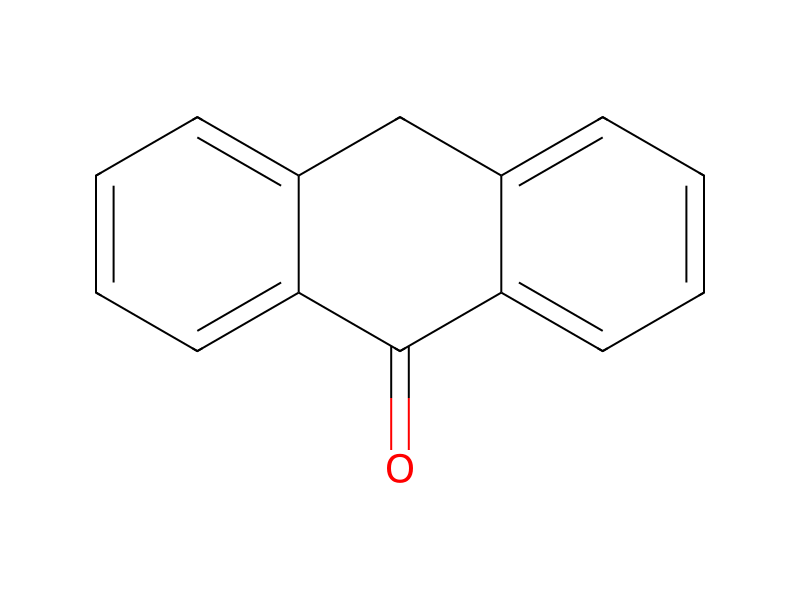
Anthrone is a member of the class of anthracenes that is 9,10-dihydroanthracene carrying an oxo group at C-9. It has a role as a radical scavenger. It is a tautomer of a 9-anthrol.
이름 및 식별자
- 우선 이름
- Anthrone
- IUPAC
- 10H-anthracen-9-one
- 현지명
- 안트론
- 영어명
- Anthrone
- 분자식
- C14H10O
- 분자량
- 194.23
이름 및 동의어
ANTHRONE90-44-89(10H)-AnthracenoneCarbothroneanthracen-9(10H)-oneAnthranone9-Oxoanthracene9,10-Dihydro-9-oxoanthraceneAnthracene, 9,10-dihydro-9-oxo-DTXSID1049431FP0FJ7K744CHEBI:33835
이름 더 보기
안트론9(10H)-안트라세논Anthron(10H)-9-AnthracenoneAnthroneGrANTHRACENONEAnthrone,97%
NSC-1965DTXCID0029391RefChem:113082201-994-010H-anthracen-9-oneAz-OMFCD000011879,10-DIHYDROANTHRACEN-9-ONE
데이터베이스 식별자
- CAS
90-44-8- PubChem CID
- 7018
- DTXSID
DTXSID1049431- ChEMBL
CHEMBL124440- ChEBI
CHEBI:33835- UNII
- FP0FJ7K744
- EC Number
- 201-994-0
- Nikkaji
- J3.916K
물성
구조 계산 물성
- XLogP
- 3.7
- 극성 표면적
- 17.1 Ų
- 수소 결합 공여자 수
- 0
- 수소 결합 수용자 수
- 1
- 회전 가능 결합 수
- 0
- 무거운 원자 수
- 15
- 형식 전하
- 0
- 복잡도
- 234
실험 및 물리화학적 성질
PolymersOther Classes -> Polycyclic Aromatic Hydrocarbons
SpringerMaterials PropertiesAngular frequency
LogP
Log Kow = 3.66
3.46
Color/Form
ORTHORHOMBIC NEEDLES FROM BENZENE AND PETROLEUM ETHER
COLORLESS NEEDLES
Solubility
SOL IN MOST ORG SOLVENTS WITHOUT FLUORESCENCE
SOL IN ACETONE, HOT BENZENE, CONCN SULFURIC ACID, HOT DIL ALKALI
Melting Point155 °C
Vapor Pressure0.0000183 [mmHg]
Physical DescriptionColorless solid; [Hawley] Colorless crystalline powder; [Alfa Aesar MSDS]
Stability/Shelf LifeTENDENCY TO CHANGE TO ANTHRAQUINONE /IN SOLN/
Other Experimental Properties
ANY FLUORESCENCE PRESENT IS DUE TO ANTHRANOL
ADDITION CMPD WITH 4 MOLECULES DESOXYCHOLIC ACID, C110-H170-O17, MP 179 °C
EQUIL IN ABSOLUTE ALCOHOL: 89% ANTHRONE; 11% ANTHRANOL; TENDENCY TO CHANGE TO ANTHRAQUINONE
물리화학적 성질
- 녹는점
- 154 · 154-157 °C (lit.)
- 끓는 점
- 721 °C · 721 °C
- 밀도
- 1.055 · 1.0550 (rough estimate)
- 굴절률
- 1.55 · 1.5500 (estimate)
- 저장 조건
- 2 · 2-8°C
- 용해도
- 불용성
- 물리적 상태
- 가루
- 색상
- 노란색
- 수용성
- 불용성
- Merck
- 14 · 14,691
- BRN
- 1910173 · 1910173
- Henry's Law Constant
- 1.2 · 1.2×101 mol/(m3Pa) at 25℃, HSDB (2015)
- 안정성
- 안정적인. 강한 산화제와 호환되지 않습니다. 타기 쉬운.
- 주요 응용
- 진단 검사 제조혈액학조직학
- InChI
- 1S/C14H10O/c15-14-12-7-3-1-5-10(12)9-11-6-2-4-8-13(11)14/h1-8H,9H2
- InChIKey
- RJGDLRCDCYRQOQ-UHFFFAOYSA-N
- SMILES
- O=C1c2ccccc2Cc3ccccc13
- NIST
- Anthrone(90-44-8)
- EPA
- 9 · 9(10H)-Anthracenone (90-44-8)
화학적 성질
off-white to light yellow crystals
안전 및 규제
GHS 분류
GHS Classification
This chemical does not meet GHS hazard criteria for 3.9% (2 of 51) of reports.
Warning
H315 (96.1%): Causes skin irritation [Warning Skin corrosion/irritation]
P261, P264, P264+P265, P271, P280, P302+P352, P304+P340, P305+P351+P338, P319, P321, P332+P317, P337+P317, P362+P364, P403+P233, P405, and P501 (click each P-code to see the statement)
Aggregated GHS information provided per 51 reports by companies from 9 notifications to the ECHA C&L Inventory. Each notification may be associated with multiple companies.
유해성 정보
Regulatory Information
Chemical: 9(10H)-Anthracenone
9(10H)-Anthracenone: Does not have an individual approval but may be used under an appropriate group standard
Hazards SummaryA skin and severe eye irritant; [Alfa Aesar MSDS] See POLYCYCLIC AROMATIC HYDROCARBONS.
Hazard Classes and CategoriesSkin Irrit. 2 (96.1%)
안전 및 보호
Disposal Methods
SRP: At the time of review, criteria for land treatment or burial (sanitary landfill) disposal practices are subject to significant revision. Prior to implementing land disposal of waste residue (including waste sludge), consult with environmental regulatory agencies for guidance on acceptable disposal practices.
독성 정보
Environmental Fate
TERRESTRIAL FATE: Based on a recommended classification scheme(1), an estimated Koc value of 2300(SRC), determined from a measured log Kow(2) and a recommended regression-derived equation(3), indicates that anthrone will have only slight mobility in soil(SRC). Biodegradation of anthrone is expected based on limited data and may be a major fate process for this compound in soil(SRC). A mixed bacterial population, isolated from a hydrocarbon-polluted creek, degraded 40% of anthrone to traces of anthrone and to anthraquinone in 30% yield(4). Anthrone's estimated values for vapor pressure(5) and Henry's Law constant(6,SRC) indicate that volatilization from dry and moist soil surfaces is not likely to be a major fate process for this compound(SRC).
AQUATIC FATE: Based on a recommended classification scheme(1), an estimated Koc value of 2300(SRC), determined from a measured log Kow(2) and a recommended regression-derived equation(3), indicates that anthrone should adsorb to sediment and suspended solids(SRC). Anthrone may volatilize slowly from water surfaces based on an estimated Henry's Law constant of 7.9X10⁻⁷ atm-cu m/mole(SRC), developed using a fragment constant estimation method(4). Estimated half-lives for a model river and model lake are 65 and 480 days, respectively(3,SRC). An estimated BCF value of 360(3,SRC), from a measured log Kow(2), suggests that anthrone will bioconcentrate in aquatic organisms(SRC), according to a recommended classification scheme(5).
ATMOSPHERIC FATE: According to a suggested classification scheme(1), an estimated vapor pressure of 1.8X10⁻⁵ mm Hg at 25 °C(2,SRC) indicates that anthrone will exist in both the vapor and particulate phases in the ambient atmosphere. Vapor-phase anthrone is degraded in the atmosphere by reaction with photochemically produced hydroxyl radicals(SRC); the half-life for this reaction in air is estimated to be about 40 hours(3,SRC). Particulate-phase anthrone may be physically removed from the air by dry deposition(SRC).
Animal ConcentrationsSnails, Thais haemostoma, which had been collected from two areas offshore in Pensacola Bay, FL near an onshore hazardous-waste site contained anthrone/phenanthrone at unreported concentrations(1).
Effluent Concentrations
Several unspecified isomers of anthrone were detected in chlorinated coal-tar leachate at unreported concentrations(1). A heavy-duty diesel exhaust particulate sample, NBS SRM 1650, contained anthrone at unreported concentrations(2). Diesel emission particulates, collected from a Volkswagen Rabbit contained anthrone(3). Fine particle emissions from the combined exhaust of a vented natural gas-fired residential space heater plus a water heater contained 21.4 pg/kJ anthrone(4).
Soil Adsorption/Mobility
The Koc of anthrone is estimated as approximately 2300(SRC), using a measured log Kow of 3.66(1) and a regression-derived equation(2,SRC). According to a recommended classification scheme(3), this estimated Koc value suggests that anthrone has only slight mobility in soil(SRC).
Atmospheric ConcentrationsREMOTE: Anthrone was found on aerosols from the southern North Atlantic Ocean, at a mean concentration of 0.47 ng/cu m(1).
Artificial Pollution SourcesAnthrone's production and use in organic synthesis and as a general reagent for carbohydrates(1) may result in its release to the environment through various waste streams(SRC).
Sediment/Soil Concentrations
Superficial marine sediments of Cortiou Creek, in the sewage area of Marseilles, France, are contaminated with anthrone at concentrations ranging from non-detectable to 300 ng/g (9 of 10 sites had measurable quantities of anthrone; detection limit not given)(1).
Environmental Bioconcentration
An estimated BCF value of 360 was calculated for anthrone(SRC), using a measured log Kow of 3.66(1) and a recommended regression-derived equation(2). According to a recommended classification scheme(3), this BCF value suggests that bioconcentration in aquatic organisms will be an important fate process(SRC).
Volatilization from Water/Soil
The Henry's Law constant for anthrone is estimated as 7.9X10⁻⁷ atm-cu m/mole(SRC) using a fragment constant estimation method(1). This value indicates that anthrone will slowly volatilize from water surfaces(2,SRC). Based on this Henry's Law constant, the volatilization half-life from a model river (1 m deep, flowing 1 m/sec, wind velocity of 3 m/sec) is estimated as approximately 65 days(2,SRC). The volatilization half-life from a model lake (1 m deep, flowing 0.05 m/sec, wind velocity of 0.5 m/sec) is estimated as approximately 480 days(2,SRC). Anthrone's values for vapor pressure(3) and Henry's Law constant(1,SRC) indicate that volatilization from dry and moist soil surfaces is not likely to be a major fate process for this compound(SRC).
Environmental Abiotic Degradation
The rate constant for the vapor-phase reaction of anthrone with photochemically produced hydroxyl radicals has been estimated as 9.8X10⁻¹² cu cm/molecule-sec at 25 °C(SRC) using a structure estimation method(1,SRC). This corresponds to an atmospheric half-life of about 40 hours at an atmospheric concentration of 5X10+5 hydroxyl radicals per cu cm(1,SRC).
Probable Routes of Human ExposureNIOSH (NOES Survey 1981-1983) has statistically estimated that 28 workers are potentially exposed to anthrone in the USA(1).
Environmental Water ConcentrationsDRINKING WATER: Two samples of Ottawa drinking water, one collected in January and the other in February 1978, contained non-detectable (detection limit not reported) and 1.4 ng/L anthrone, respectively(1).
안전 데이터
- wgk
- 3
- tsca
- TSCA listed
- rtecs
- CB8925500
- 독성
- mmo-sat 60 mg/plate MUREAV 157,149,85
- HS 번호
- 29143990
- risk_code
- 36/37/38-20/21/22
- hazard_code
- Xi,Xn
- safety_code
- 26-36
- 기존화학 물질
- KE-01829
- F 고인화성물질
- 8
- Hazard Classifications
- Eye Irrit. 2Skin Irrit. 2STOT SE 3
- 스토리지 클래스
- 11 - Combustible Solids
- 유해 물질 데이터
- 90-44-8(Hazardous Substances Data)
화학 및 산업
약리 정보
Metabolism/MetabolitesYIELDS ANTHRAQUINONE & 9-HYDROXYANTHRACENE IN RATS. /FROM TABLE/
용도 및 제조
Uses
Used in the colorimetric determination of sugar and animal starch in body fluids, as a general reagent for carbohydrates, in the determination of animal starch in liver tissue, and in organic synthesis; [HSDB]
IN COLORIMETRIC DETERMINATION OF SUGAR AND ANIMAL STARCH IN BODY FLUIDS; IN ORG SYNTHESIS
GENERAL REAGENT FOR CARBOHYDRATES; DETERMINATION OF ANIMAL STARCH IN LIVER TISSUE
Derivatives: melitracen
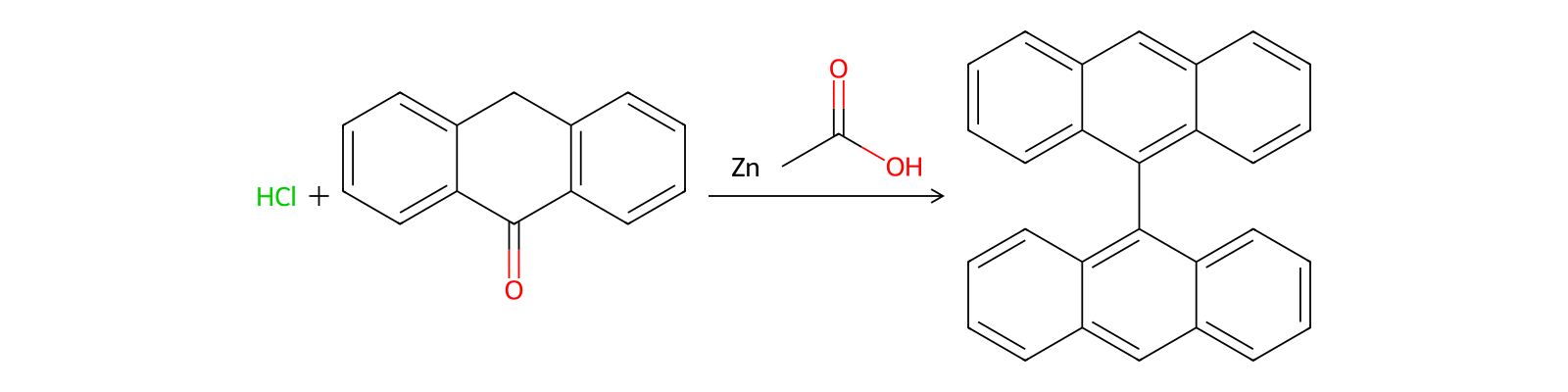
Methods of ManufacturingFROM ANTHRAQUINONE BY REDN WITH TIN, GLACIAL ACETIC ACID AND HYDROCHLORIC ACID. BY CYCLIZATION OF O-BENZYLBENZOIC ACID WITH LIQ HF.
General Manufacturing Information9(10H)-Anthracenone: ACTIVE
응용 분야
용도Anthrone is a tricyclic aromatic ketone and related compound of anthracene. Anthrone is used as a reagent in the colorometric determination of carbohydrates.
일반 설명Anthrone has the ability to reduce aldehyde containing reducing sugars such as streptose and N-acetyl glucosamine present in streptomycin, into acids. It develops a red- violet color. Therefore, it is used to determine streptomycin quantitatively. Anthrone has been used to detect carbohydrate containing lipids and to measure sugar content such as sucrose and trehalose in the liquid medium.
상·하류 제품 정보
상류 원료
하류 제품
공급사50 곳
国药集团化学试剂有限公司86-21-63210123 · [email protected]
梯希爱(上海)化成工业发展有限公司021-67121386 · [email protected]
上海阿拉丁生化科技股份有限公司400-6206333 13167063860 · [email protected]
INTATRADE GmbH+49 3493/605464 · [email protected]
T&W GROUP021-61551611 13296011611 · [email protected]
爱斯特(成都)生物制药股份有限公司+86-28-85122536 85324413 · [email protected]
安徽秀朗新材料科技有限公司0550-5261666 19901505185
上海将来实业股份有限公司400-0066400 13621662912 · [email protected]
Syntechem Co.,Ltd[email protected]
上海迈瑞尔生化科技有限公司4006356688 18621169109 · [email protected]
武汉易泰科技有限公司上海分公司18930552037 · [email protected]
大连美仑生物技术有限公司0411-62910999 13889544652 · [email protected]
阿法埃莎(中国)化学有限公司400-6106006 · [email protected]
安耐吉化学&3A(安徽泽升科技股份有限公司)400-0056266 · [email protected]
北京绿百草科技发展有限公司010-61136123 · [email protected]
上海瀚鸿科技股份有限公司021-54306202 13764082696 · [email protected]
上海柯维化学技术有限公司021-64609169 18901607656 · [email protected]
上海景颜化工科技有限公司13817811078 · [email protected]
伊势久(江苏连云港)生物科技有限责任公司18082049515 · [email protected]
山东西亚化学有限公司13355009207 13355009207 · [email protected]
玛雅试剂+86 (573) 82222445 (0)18006601000 452520369 · [email protected]
四川库利南科技有限公司400-1166-196 18981987031 · [email protected]
上海耐士化工科技有限公司400-188-0725 +86 21 34310725 13611771617
天津希恩思生化科技有限公司400 638 7771 · [email protected]
斯百全化学(上海)有限公司021-021-021-67601398-809-809-809 15221380277 · [email protected]
上海源叶生物科技有限公司13636370518 · [email protected]
艾科试剂4008-755-333 18080918076 · [email protected]
上海思域化工科技有限公司86-21-34053660 · [email protected]
赛默飞世尔科技(中国)有限公司800-810-5118 · [email protected]
北京伊诺凯科技有限公司400-810-7969 010-59572699 · [email protected]
上海特伯化学科技有限公司+86-21-60341587 · [email protected]
上海遐瑞医药科技有限公司+86 21 61551611
江苏艾康生物医药研发有限公司025-66113011 13913916777 · [email protected]
TCI AMERICA800-4238616 · [email protected]
TOKYO CHEMICAL INDUSTRY CO., LTD.03-36680489 · [email protected]
TCI Europe320-37350700 · [email protected]
上海贤鼎生物科技有限公司4009209199 · [email protected]
深圳康特腾科技有限公司86-0755-86635001 · [email protected]
南京杜莱生物技术有限公司025-84699383-8003;025-846993838003-8003 18013301590 · [email protected]
上海灏云化工科技有限公司021-68367562 · [email protected]
上海倍卓生物科技有限公司021-61119791,13386096464 · [email protected]
上海湄水化工科技有限公司021-60549325 18616193163
上海将来实业股份有限公司400-0066400 13621662912 · [email protected]
HBCChem, Inc.+1-510-219-6317 · [email protected]
上海毕得医药科技股份有限公司400-164-7117 18317119277 · [email protected]
上海笛柏生物科技有限公司400-008-9730,021-54359730 400-008-9730 · [email protected]
成都零六生物科技有限公司400-1166-196 13458535857 · [email protected]
上海创赛科技有限公司400-6087598 15021221957 · [email protected]
上海御略医药科技有限公司021-60345187 13671753212 · [email protected]
上海麦克林生化科技股份有限公司15221275939 15221275939 · [email protected]
추가 설명
정의ChEBI: A member of the class of anthracenes that is 9,10-dihydroanthracene carrying an oxo group at C-9.
관련 반응
22건


연결된 노트
불러오는 중…